QUESTION IMAGE
Question
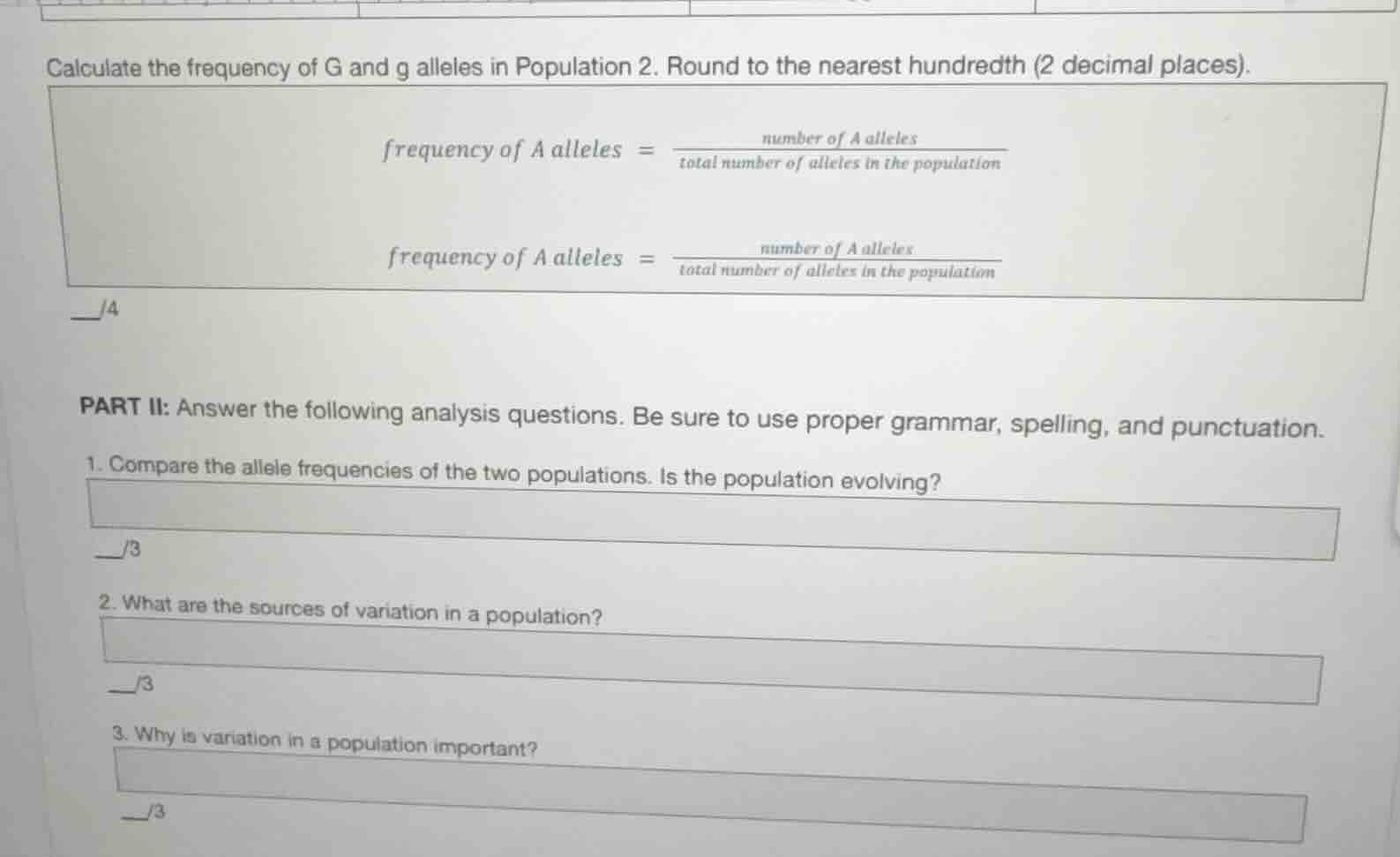
calculate the frequency of g and g alleles in population 2. round to the nearest hundredth (2 decimal places).
frequency of a alleles = (number of a alleles)/(total number of alleles in the population)
frequency of a alleles = (number of a alleles)/(total number of alleles in the population)
__/4
part ii: answer the following analysis questions. be sure to use proper grammar, spelling, and punctuation.
- compare the allele frequencies of the two populations. is the population evolving?
__/3
- what are the sources of variation in a population?
__/3
- why is variation in a population important?
__/3
To calculate the allele frequencies, we need the number of individuals with each genotype (e.g., GG, Gg, gg) in Population 2. Since that data is missing, let's assume a common example (you can substitute with your actual data):
Step 1: Define Genotype Counts (Example Data)
Suppose in Population 2:
- Number of GG individuals: \( n_{GG} = 30 \) (each contributes 2 G alleles)
- Number of Gg individuals: \( n_{Gg} = 40 \) (each contributes 1 G and 1 g allele)
- Number of gg individuals: \( n_{gg} = 30 \) (each contributes 2 g alleles)
Step 2: Calculate Total Number of Alleles
Total alleles = \( 2 \times (n_{GG} + n_{Gg} + n_{gg}) \)
Substitute values:
\( 2 \times (30 + 40 + 30) = 2 \times 100 = 200 \)
Step 3: Calculate Number of G Alleles
G alleles = \( (2 \times n_{GG}) + (1 \times n_{Gg}) \)
Substitute values:
\( (2 \times 30) + (1 \times 40) = 60 + 40 = 100 \)
Step 4: Calculate Frequency of G Allele
\( f(G) = \frac{\text{Number of G alleles}}{\text{Total alleles}} = \frac{100}{200} = 0.50 \)
Step 5: Calculate Number of g Alleles
g alleles = \( (2 \times n_{gg}) + (1 \times n_{Gg}) \)
Substitute values:
\( (2 \times 30) + (1 \times 40) = 60 + 40 = 100 \)
Step 6: Calculate Frequency of g Allele
\( f(g) = \frac{\text{Number of g alleles}}{\text{Total alleles}} = \frac{100}{200} = 0.50 \)
Final Answer (Using Example Data)
- Frequency of G: \( \boldsymbol{0.50} \)
- Frequency of g: \( \boldsymbol{0.50} \)
Note:
If your actual data (number of GG, Gg, gg individuals) differs, substitute the values into the same formula:
- \( f(G) = \frac{2n_{GG} + n_{Gg}}{2(n_{GG} + n_{Gg} + n_{gg})} \)
- \( f(g) = \frac{2n_{gg} + n_{Gg}}{2(n_{GG} + n_{Gg} + n_{gg})} \)
For the analysis questions (Part II):
1. Compare Allele Frequencies & Evolution
If allele frequencies differ between Population 1 and Population 2, the population is evolving (evolution = change in allele frequencies over time). For example, if Population 1 has \( f(G) = 0.6 \) and \( f(g) = 0.4 \), while Population 2 has \( f(G) = 0.5 \) and \( f(g) = 0.5 \), the allele frequencies have changed, so the population is evolving.
2. Sources of Variation
Sources of variation in a population include:
- Mutation: Random changes in DNA (new alleles).
- Gene Flow: Transfer of alleles between populations (e.g., migration).
- Genetic Drift: Random changes in allele frequencies (e.g., bottleneck/founder effect).
- Natural Selection: Differential survival/reproduction of alleles.
- Sexual Reproduction: Recombination (crossing over) and independent assortment.
3. Importance of Variation
Variation is critical for:
- Adaptation: Allows populations to adapt to changing environments (e.g., antibiotic resistance in bacteria).
- Evolution: Provides raw material for natural selection to act on.
- Resilience: Increases a population’s ability to survive disturbances (e.g., disease outbreaks).
If you provide the actual genotype counts for Population 2, I can compute the exact allele frequencies.

Snap & solve any problem in the app
Get step-by-step solutions on Sovi AI
Photo-based solutions with guided steps
Explore more problems and detailed explanations
To calculate the allele frequencies, we need the number of individuals with each genotype (e.g., GG, Gg, gg) in Population 2. Since that data is missing, let's assume a common example (you can substitute with your actual data):
Step 1: Define Genotype Counts (Example Data)
Suppose in Population 2:
- Number of GG individuals: \( n_{GG} = 30 \) (each contributes 2 G alleles)
- Number of Gg individuals: \( n_{Gg} = 40 \) (each contributes 1 G and 1 g allele)
- Number of gg individuals: \( n_{gg} = 30 \) (each contributes 2 g alleles)
Step 2: Calculate Total Number of Alleles
Total alleles = \( 2 \times (n_{GG} + n_{Gg} + n_{gg}) \)
Substitute values:
\( 2 \times (30 + 40 + 30) = 2 \times 100 = 200 \)
Step 3: Calculate Number of G Alleles
G alleles = \( (2 \times n_{GG}) + (1 \times n_{Gg}) \)
Substitute values:
\( (2 \times 30) + (1 \times 40) = 60 + 40 = 100 \)
Step 4: Calculate Frequency of G Allele
\( f(G) = \frac{\text{Number of G alleles}}{\text{Total alleles}} = \frac{100}{200} = 0.50 \)
Step 5: Calculate Number of g Alleles
g alleles = \( (2 \times n_{gg}) + (1 \times n_{Gg}) \)
Substitute values:
\( (2 \times 30) + (1 \times 40) = 60 + 40 = 100 \)
Step 6: Calculate Frequency of g Allele
\( f(g) = \frac{\text{Number of g alleles}}{\text{Total alleles}} = \frac{100}{200} = 0.50 \)
Final Answer (Using Example Data)
- Frequency of G: \( \boldsymbol{0.50} \)
- Frequency of g: \( \boldsymbol{0.50} \)
Note:
If your actual data (number of GG, Gg, gg individuals) differs, substitute the values into the same formula:
- \( f(G) = \frac{2n_{GG} + n_{Gg}}{2(n_{GG} + n_{Gg} + n_{gg})} \)
- \( f(g) = \frac{2n_{gg} + n_{Gg}}{2(n_{GG} + n_{Gg} + n_{gg})} \)
For the analysis questions (Part II):
1. Compare Allele Frequencies & Evolution
If allele frequencies differ between Population 1 and Population 2, the population is evolving (evolution = change in allele frequencies over time). For example, if Population 1 has \( f(G) = 0.6 \) and \( f(g) = 0.4 \), while Population 2 has \( f(G) = 0.5 \) and \( f(g) = 0.5 \), the allele frequencies have changed, so the population is evolving.
2. Sources of Variation
Sources of variation in a population include:
- Mutation: Random changes in DNA (new alleles).
- Gene Flow: Transfer of alleles between populations (e.g., migration).
- Genetic Drift: Random changes in allele frequencies (e.g., bottleneck/founder effect).
- Natural Selection: Differential survival/reproduction of alleles.
- Sexual Reproduction: Recombination (crossing over) and independent assortment.
3. Importance of Variation
Variation is critical for:
- Adaptation: Allows populations to adapt to changing environments (e.g., antibiotic resistance in bacteria).
- Evolution: Provides raw material for natural selection to act on.
- Resilience: Increases a population’s ability to survive disturbances (e.g., disease outbreaks).
If you provide the actual genotype counts for Population 2, I can compute the exact allele frequencies.