QUESTION IMAGE
Question
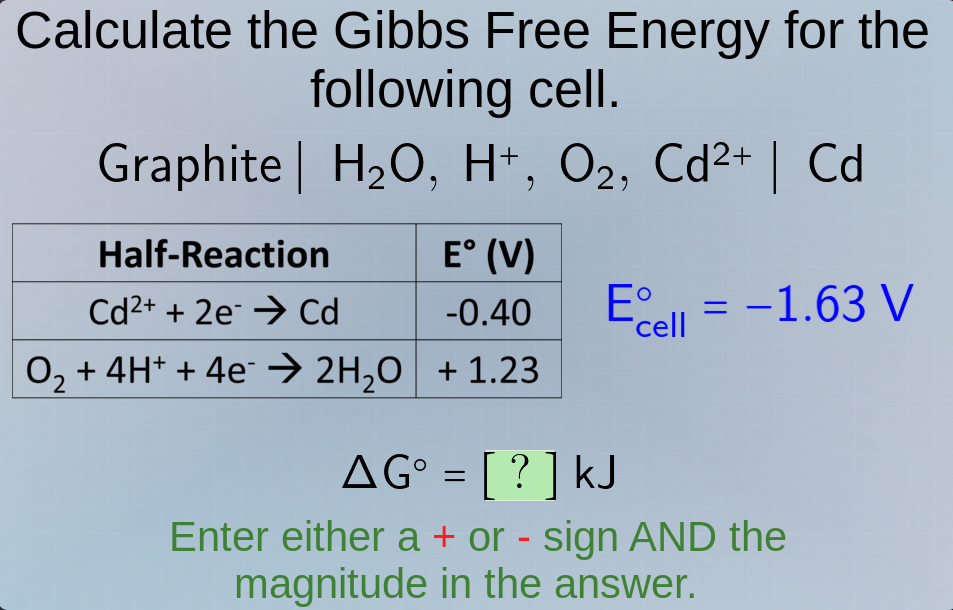
calculate the gibbs free energy for the following cell. graphite | h₂o, h⁺, o₂, cd²⁺ | cd half-reaction e° (v) cd²⁺ + 2e⁻ → cd -0.40 o₂ + 4h⁺ + 4e⁻ → 2h₂o + 1.23 e°_cell = -1.63 v δg° = ? kj enter either a + or - sign and the magnitude in the answer.
Step1: Recall the formula for Gibbs Free Energy
The formula relating Gibbs Free Energy change ($\Delta G^\circ$) to cell potential ($E^\circ_{cell}$) and the number of moles of electrons transferred ($n$) is $\Delta G^\circ = -nFE^\circ_{cell}$, where $F$ is Faraday's constant ($F = 96485\ \text{C/mol e}^- = 96.485\ \text{kJ/(V·mol e}^-)$).
Step2: Determine the number of moles of electrons transferred ($n$)
First, balance the half-reactions. The reduction of $\text{Cd}^{2+}$: $\text{Cd}^{2+} + 2\text{e}^-
ightarrow \text{Cd}$ (2 electrons gained). The reduction of $\text{O}_2$: $\text{O}_2 + 4\text{H}^+ + 4\text{e}^-
ightarrow 2\text{H}_2\text{O}$ (4 electrons gained). To balance the electrons, multiply the $\text{Cd}$ half-reaction by 2: $2\text{Cd}^{2+} + 4\text{e}^-
ightarrow 2\text{Cd}$. Now, the number of electrons transferred ($n$) is 4 (since both half-reactions now involve 4 electrons).
Step3: Substitute the values into the formula
We have $n = 4$, $F = 96.485\ \text{kJ/(V·mol e}^-)$, and $E^\circ_{cell} = -1.63\ \text{V}$.
Substitute into $\Delta G^\circ = -nFE^\circ_{cell}$:
$\Delta G^\circ = - (4\ \text{mol e}^-) \times (96.485\ \text{kJ/(V·mol e}^-)) \times (-1.63\ \text{V})$
Step4: Calculate the value
First, multiply the constants: $4 \times 96.485 = 385.94$. Then multiply by $-1.63$: $385.94 \times (-1.63) = -629.0822$. Then apply the negative sign from the formula: $-(-629.0822) = 629.0822\ \text{kJ}$. Wait, no, let's recheck. Wait, the formula is $\Delta G^\circ = -nFE^\circ_{cell}$. So:
$\Delta G^\circ = - (4) \times (96.485) \times (-1.63)$
$= 4 \times 96.485 \times 1.63$
Calculate $96.485 \times 1.63 = 157.27055$. Then $4 \times 157.27055 = 629.0822\ \text{kJ}$. Wait, but let's check the sign again. Wait, $E^\circ_{cell}$ is the cell potential. Wait, actually, in a galvanic cell, $E^\circ_{cell}$ is positive, but here $E^\circ_{cell} = -1.63\ \text{V}$, which means the reaction is non-spontaneous as written (it's an electrolytic cell or the reverse reaction is spontaneous). But the formula still holds. Wait, maybe I messed up the half-reactions. Wait, the cell notation is Graphite | $\text{H}_2\text{O}$, $\text{H}^+$, $\text{O}_2$, $\text{Cd}^{2+}$ | $\text{Cd}$. So the anode and cathode: the left side (Graphite) is the anode (oxidation) or cathode? Wait, in cell notation, the left is anode (oxidation), right is cathode (reduction). Wait, maybe I got the half-reactions reversed. Wait, the $\text{Cd}^{2+} + 2\text{e}^-
ightarrow \text{Cd}$ is reduction (cathode, right side). The $\text{O}_2$ reaction: if Graphite is the anode, then oxidation occurs there. Wait, maybe the oxidation is $\text{Cd}
ightarrow \text{Cd}^{2+} + 2\text{e}^-$ (reverse of the given $\text{Cd}$ half-reaction, so $E^\circ_{ox} = +0.40\ \text{V}$), and reduction is $\text{O}_2 + 4\text{H}^+ + 4\text{e}^-
ightarrow 2\text{H}_2\text{O}$ ($E^\circ_{red} = +1.23\ \text{V}$). Then $E^\circ_{cell} = E^\circ_{red} - E^\circ_{ox} = 1.23 - 0.40 = 0.83\ \text{V}$? Wait, no, the given $E^\circ_{cell} = -1.63\ \text{V}$. So maybe the cell is set up with the $\text{O}_2$ reduction as the anode? No, the problem states $E^\circ_{cell} = -1.63\ \text{V}$, so we have to use that. Let's go back. The formula is $\Delta G^\circ = -nFE^\circ_{cell}$. We need to find $n$. Let's balance the two half-reactions as they are. The $\text{Cd}$ half-reaction: 2 electrons. The $\text{O}_2$ half-reaction: 4 electrons. To make the electrons equal, multiply the $\text{Cd}$ half-reaction by 2: $2\text{Cd}^{2+} + 4\text{e}^-
ightarrow 2\text{Cd}$ (reduction, 4 elect…

Snap & solve any problem in the app
Get step-by-step solutions on Sovi AI
Photo-based solutions with guided steps
Explore more problems and detailed explanations
+629 (or more precisely, 629.08, but rounded to a reasonable value)