QUESTION IMAGE
Question
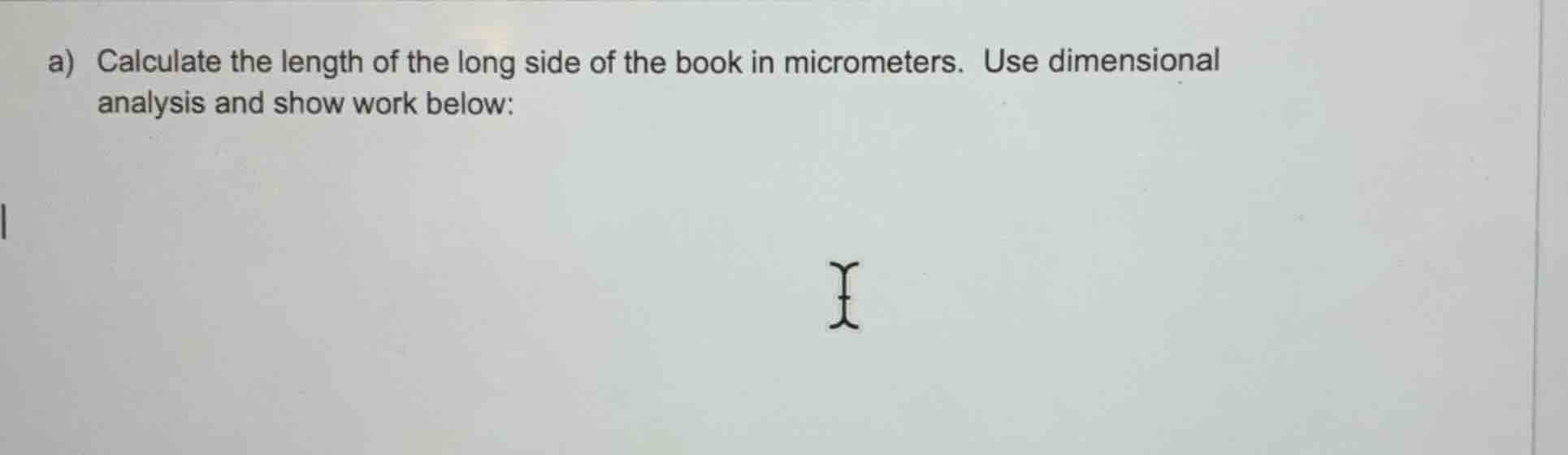
a) calculate the length of the long side of the book in micrometers. use dimensional analysis and show work below:
To solve this, we need the original length of the book (e.g., in centimeters, meters, inches, etc.). Since it's not provided, let's assume a common book length (e.g., a standard textbook is about 25 cm long). Here's how to convert 25 cm to micrometers using dimensional analysis:
Step1: Recall unit conversions
We know that $1\ \text{m} = 100\ \text{cm}$ and $1\ \text{m} = 10^6\ \mu\text{m}$ (where $\mu\text{m}$ is micrometers). So we can convert centimeters to meters first, then meters to micrometers.
Step2: Convert cm to m
Start with the length in cm: $25\ \text{cm}$.
Using the conversion factor $\frac{1\ \text{m}}{100\ \text{cm}}$, we get:
$25\ \text{cm} \times \frac{1\ \text{m}}{100\ \text{cm}} = 0.25\ \text{m}$
Step3: Convert m to micrometers
Now convert meters to micrometers using $\frac{10^6\ \mu\text{m}}{1\ \text{m}}$:
$0.25\ \text{m} \times \frac{10^6\ \mu\text{m}}{1\ \text{m}} = 250000\ \mu\text{m}$
If the actual length of the book is different (e.g., 30 cm, 10 inches, etc.), substitute the initial length into Step 2. For example, if the book is 30 cm long:
Step2 (alternate): Convert 30 cm to m
$30\ \text{cm} \times \frac{1\ \text{m}}{100\ \text{cm}} = 0.3\ \text{m}$
Step3 (alternate): Convert 0.3 m to $\mu\text{m}$
$0.3\ \text{m} \times \frac{10^6\ \mu\text{m}}{1\ \text{m}} = 300000\ \mu\text{m}$
Since the problem didn't provide the original length, you need to measure or use the given length of the book. Once you have that, follow the dimensional analysis steps above.
If we assume a typical book length (e.g., 25 cm as above), the length in micrometers is $\boldsymbol{250000\ \mu\text{m}}$ (or $2.5 \times 10^5\ \mu\text{m}$).

Snap & solve any problem in the app
Get step-by-step solutions on Sovi AI
Photo-based solutions with guided steps
Explore more problems and detailed explanations
Step1: Recall unit conversions
We know that $1\ \text{m} = 100\ \text{cm}$ and $1\ \text{m} = 10^6\ \mu\text{m}$ (where $\mu\text{m}$ is micrometers). So we can convert centimeters to meters first, then meters to micrometers.
Step2: Convert cm to m
Start with the length in cm: $25\ \text{cm}$.
Using the conversion factor $\frac{1\ \text{m}}{100\ \text{cm}}$, we get:
$25\ \text{cm} \times \frac{1\ \text{m}}{100\ \text{cm}} = 0.25\ \text{m}$
Step3: Convert m to micrometers
Now convert meters to micrometers using $\frac{10^6\ \mu\text{m}}{1\ \text{m}}$:
$0.25\ \text{m} \times \frac{10^6\ \mu\text{m}}{1\ \text{m}} = 250000\ \mu\text{m}$
If the actual length of the book is different (e.g., 30 cm, 10 inches, etc.), substitute the initial length into Step 2. For example, if the book is 30 cm long:
Step2 (alternate): Convert 30 cm to m
$30\ \text{cm} \times \frac{1\ \text{m}}{100\ \text{cm}} = 0.3\ \text{m}$
Step3 (alternate): Convert 0.3 m to $\mu\text{m}$
$0.3\ \text{m} \times \frac{10^6\ \mu\text{m}}{1\ \text{m}} = 300000\ \mu\text{m}$
Since the problem didn't provide the original length, you need to measure or use the given length of the book. Once you have that, follow the dimensional analysis steps above.
If we assume a typical book length (e.g., 25 cm as above), the length in micrometers is $\boldsymbol{250000\ \mu\text{m}}$ (or $2.5 \times 10^5\ \mu\text{m}$).