QUESTION IMAGE
Question
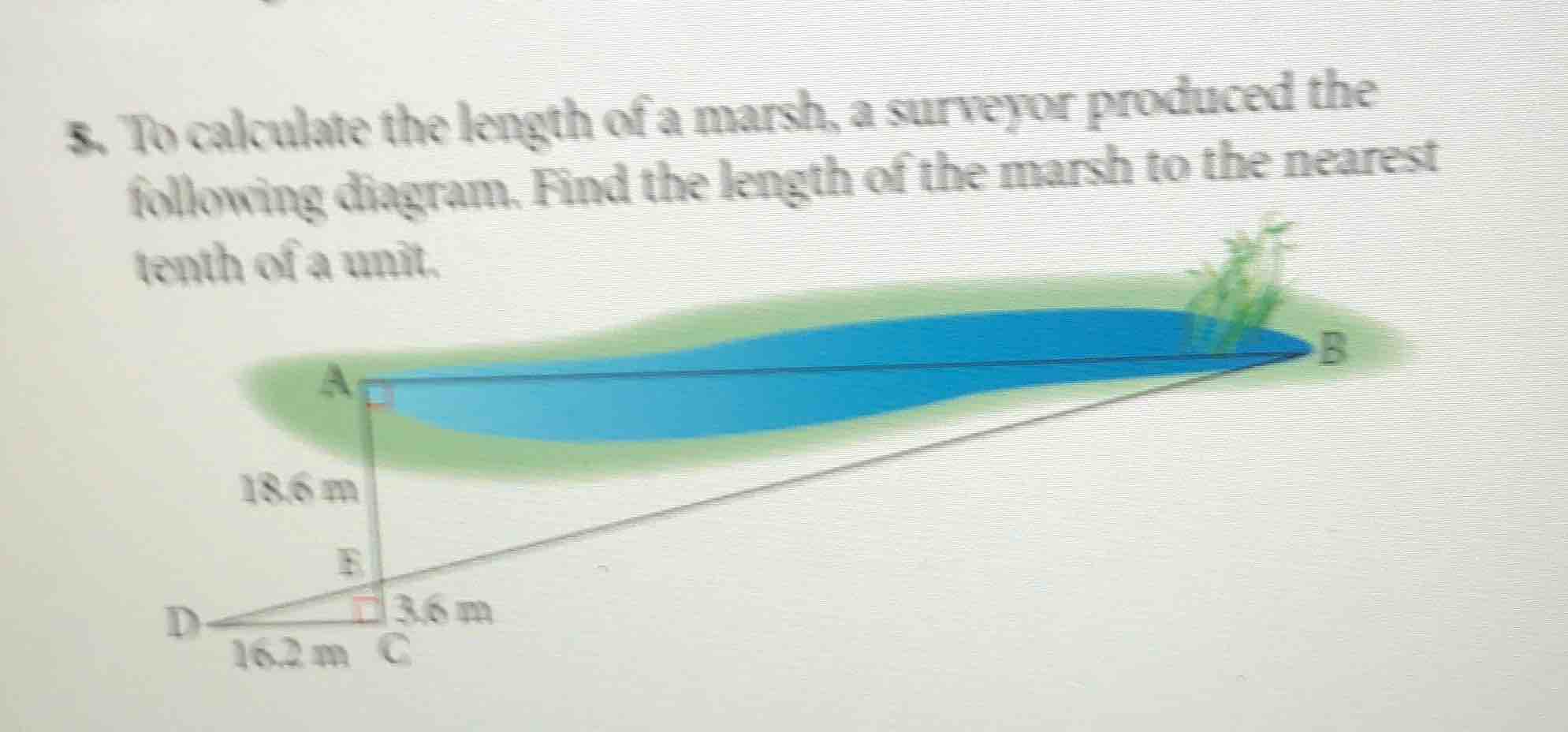
- to calculate the length of a marsh, a surveyor produced the following diagram. find the length of the marsh to the nearest tenth of a unit.
(diagram: a right angle at a, segment ae is 18.6 m, segment dc is 16.2 m, segment ec is 3.6 m, right angle at e between dc and ec, and triangle-like figure with marsh ab.)
Step1: Identify Similar Triangles
Triangles \( \triangle ABC \) and \( \triangle DEC \) are similar (by AA similarity, as \( \angle A = \angle DEC = 90^\circ \) and \( \angle C \) is common). So, the ratios of corresponding sides are equal: \( \frac{AB}{DE} = \frac{AC}{EC} \). Wait, actually, \( AC = AE + EC \)? No, looking at the diagram, \( AC \) is \( 18.6 \) m? Wait, no, \( AE \) is \( 18.6 \) m? Wait, the right angles: \( \angle A = 90^\circ \), \( \angle E = 90^\circ \) (wait, \( \angle C \) is right angle? Wait, \( \angle ECD = 90^\circ \) and \( \angle CAB = 90^\circ \), so \( \triangle DCE \sim \triangle BCA \) (AA similarity: \( \angle DCE = \angle BCA = 90^\circ \), \( \angle D = \angle D \) (common angle? Wait, no, \( \angle D \) is common to \( \triangle DCE \) and \( \triangle DBA \)? Wait, let's re-examine.
Wait, \( \angle C = 90^\circ \), \( \angle A = 90^\circ \), so \( AB \parallel EC \) (both perpendicular to \( AC \) or \( DC \)? Wait, \( AC \) is a line? Wait, the diagram: \( A \) and \( C \) are connected? Wait, \( AE \) is \( 18.6 \) m? No, the label is \( 18.6 \) m from \( A \) to \( E \)? Wait, no, the vertical segment from \( A \) to \( C \) is \( 18.6 \) m? Wait, the diagram has \( A \) with a right angle, \( C \) with a right angle, \( D \) to \( C \) is \( 16.2 \) m, \( C \) to \( E \) is \( 3.6 \) m, and \( A \) to \( E \) is \( 18.6 \) m? Wait, maybe \( \triangle DCE \sim \triangle DBA \) (similar triangles) because \( \angle DCE = \angle DBA = 90^\circ \), and \( \angle D \) is common. So, the ratio of corresponding sides: \( \frac{DC}{DB} = \frac{EC}{AB} \)? No, wait, \( \triangle DCE \sim \triangle DAB \) (AA similarity: \( \angle DCE = \angle DAB = 90^\circ \), \( \angle D = \angle D \)). So, \( \frac{DC}{DA} = \frac{EC}{AB} \). Wait, \( DC = 16.2 \) m, \( DA = DC + CA \)? No, \( DC = 16.2 \), \( CE = 3.6 \), \( AE = 18.6 \). Wait, maybe \( AC = AE + EC = 18.6 + 3.6 = 22.2 \)? No, that doesn't make sense. Wait, maybe \( \triangle DCE \sim \triangle BCA \). Wait, let's use the correct similar triangles.
Looking at the diagram, \( \angle C = 90^\circ \), \( \angle A = 90^\circ \), so \( AB \) and \( EC \) are both perpendicular to \( AC \), so \( AB \parallel EC \). Therefore, \( \triangle DEC \sim \triangle DAB \) (by AA similarity, since \( \angle DEC = \angle DAB = 90^\circ \), \( \angle D = \angle D \) (common angle)). Therefore, the ratio of corresponding sides is equal: \( \frac{DC}{DB} = \frac{EC}{AB} \)? No, \( \frac{DC}{DA} = \frac{EC}{AB} \). Wait, \( DC = 16.2 \) m, \( EC = 3.6 \) m, \( DA = DC + CA \)? Wait, no, \( DA \) is the hypotenuse? No, \( DA \) is the horizontal segment? Wait, no, \( D \) to \( C \) is \( 16.2 \) m (horizontal), \( C \) to \( E \) is \( 3.6 \) m (vertical), \( A \) to \( E \) is \( 18.6 \) m (vertical)? Wait, I think I misread the labels. Let's assume:
- \( \triangle DCE \) is a right triangle with \( DC = 16.2 \) m (horizontal leg), \( EC = 3.6 \) m (vertical leg).
- \( \triangle DBA \) is a right triangle with \( DA = DC + CA \)? No, \( CA \) is the vertical leg of \( \triangle DBA \), which is \( 18.6 \) m? Wait, no, the vertical segment from \( A \) to \( C \) is \( 18.6 \) m? Wait, the label \( 18.6 \) m is next to the vertical segment from \( A \) to \( E \), but \( E \) is on \( DC \)? No, the diagram: \( A \) is at the top, \( B \) is at the end of the marsh, \( D \) is at the bottom left, \( C \) is at the bottom right, with \( DC = 16.2 \) m, \( CE = 3.6 \) m, \( AE = 18.6 \) m. So, \( AC = AE + EC = 18.6 + 3.6 = 22.2 \) m? No, that can't be. Wait,…

Snap & solve any problem in the app
Get step-by-step solutions on Sovi AI
Photo-based solutions with guided steps
Explore more problems and detailed explanations
\( 83.7 \) meters