QUESTION IMAGE
Question
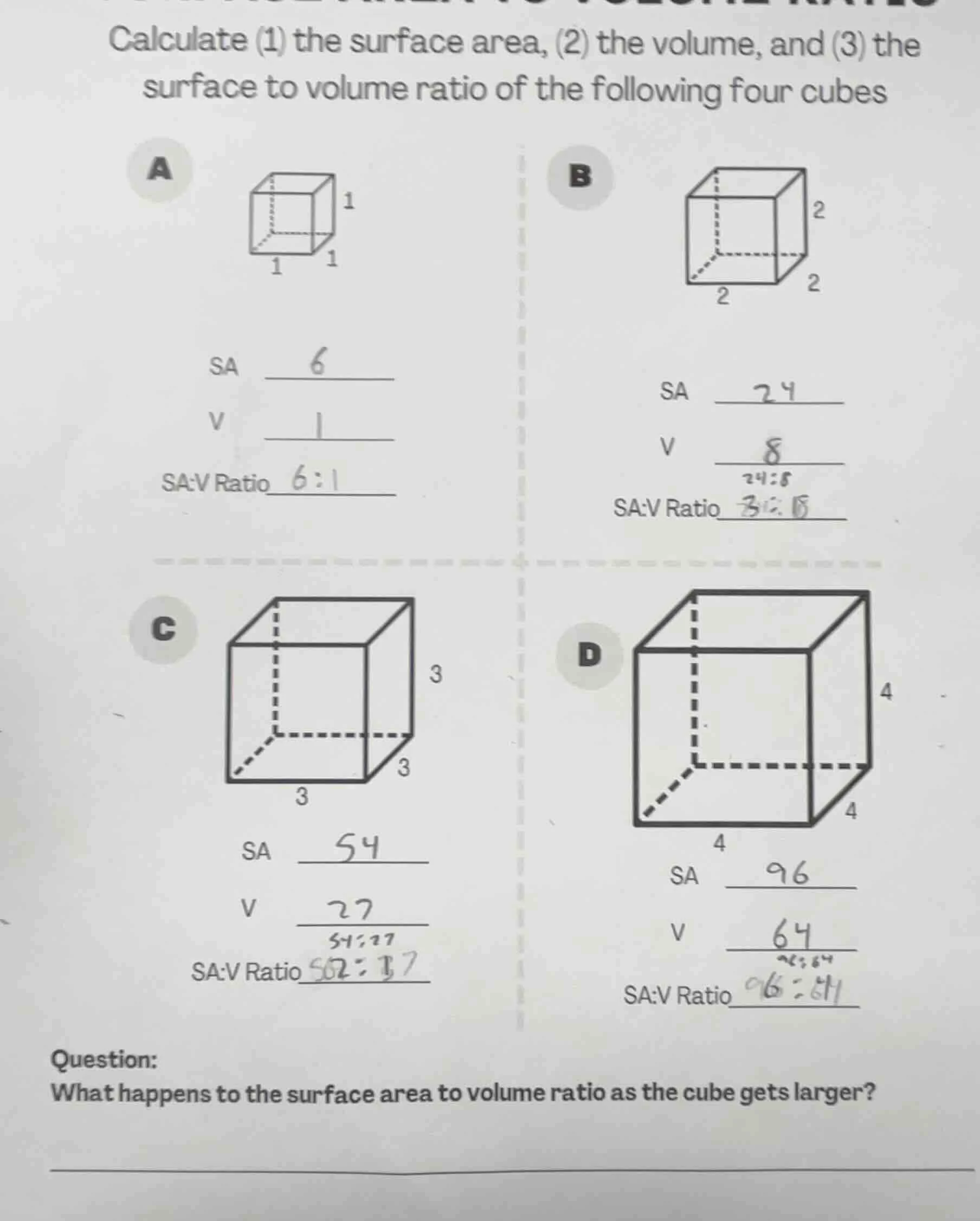
calculate (1) the surface area, (2) the volume, and (3) the surface to volume ratio of the following four cubes
a
sa $\boldsymbol{6}$
v $\boldsymbol{1}$
sa:v ratio $\boldsymbol{6:1}$
b
sa $\boldsymbol{24}$
v $\boldsymbol{8}$
sa:v ratio $\boldsymbol{3:1}$
c
sa $\boldsymbol{54}$
v $\boldsymbol{27}$
sa:v ratio $\boldsymbol{2:1}$
d
sa $\boldsymbol{96}$
v $\boldsymbol{64}$
sa:v ratio $\boldsymbol{3:2}$
question:
what happens to the surface area to volume ratio as the cube gets larger?
Step1: Verify Cube A values
Surface Area (SA): $6 \times 1^2 = 6$
Volume (V): $1^3 = 1$
SA:V Ratio: $\frac{6}{1} = 6:1$
Step2: Verify Cube B values
Surface Area (SA): $6 \times 2^2 = 24$
Volume (V): $2^3 = 8$
SA:V Ratio: $\frac{24}{8} = 3:1$
Step3: Verify Cube C values
Surface Area (SA): $6 \times 3^2 = 54$
Volume (V): $3^3 = 27$
SA:V Ratio: $\frac{54}{27} = 2:1$
Step4: Verify Cube D values
Surface Area (SA): $6 \times 4^2 = 96$
Volume (V): $4^3 = 64$
SA:V Ratio: $\frac{96}{64} = 1.5:1$
Step5: Analyze ratio trend
Compare ratios: $6:1 > 3:1 > 2:1 > 1.5:1$

Snap & solve any problem in the app
Get step-by-step solutions on Sovi AI
Photo-based solutions with guided steps
Explore more problems and detailed explanations
As the cube gets larger, the surface area to volume ratio decreases (becomes smaller).