QUESTION IMAGE
Question
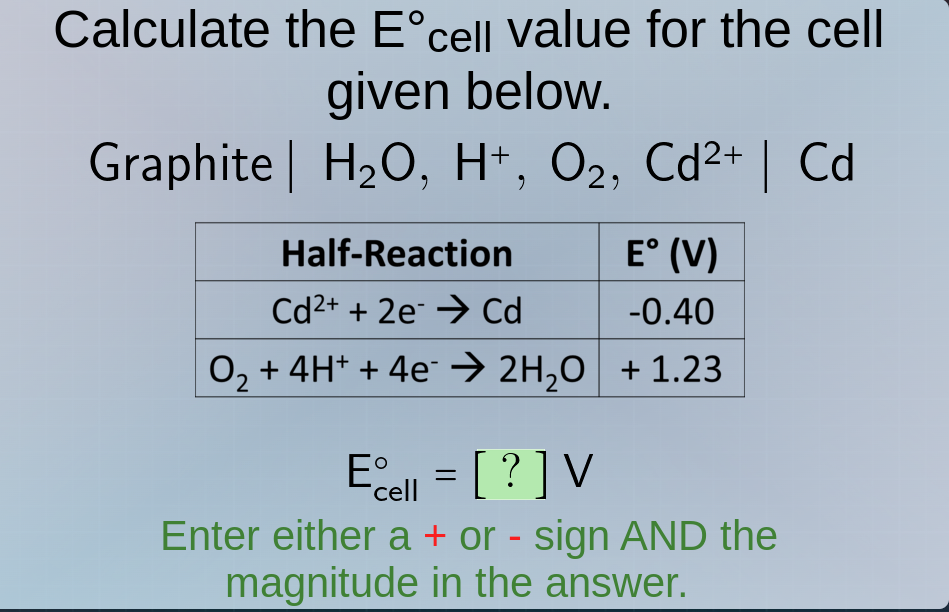
calculate the $\mathrm{e^\circ_{cell}}$ value for the cell given below.
graphite $\mid$ $\mathrm{h_2o}$, $\mathrm{h^+}$, $\mathrm{o_2}$, $\mathrm{cd^{2+}}$ $\mid$ $\mathrm{cd}$
half-reaction | $\mathrm{e^\circ}$ (v)
$\mathrm{cd^{2+} + 2e^- \
ightarrow cd}$ | -0.40
$\mathrm{o_2 + 4h^+ + 4e^- \
ightarrow 2h_2o}$ | + 1.23
$\mathrm{e^\circ_{cell} = ?}$ v
enter either a + or - sign and the magnitude in the answer.
Step1: Identify anode and cathode
In a galvanic cell, the cathode is where reduction occurs (higher \( E^\circ \)) and the anode is where oxidation occurs (reverse of reduction, lower \( E^\circ \)).
Reduction: \( \ce{O2 + 4H+ + 4e- -> 2H2O} \) (\( E^\circ_{\text{cathode}} = +1.23 \, \text{V} \))
Oxidation: \( \ce{Cd -> Cd^{2+} + 2e-} \) (reverse of \( \ce{Cd^{2+} + 2e- -> Cd} \), so \( E^\circ_{\text{anode}} = +0.40 \, \text{V} \) for oxidation, but we use reduction potentials for calculation: \( E^\circ_{\text{anode (reduction)}} = -0.40 \, \text{V} \))
Step2: Calculate \( E^\circ_{\text{cell}} \)
Formula: \( E^\circ_{\text{cell}} = E^\circ_{\text{cathode (reduction)}} - E^\circ_{\text{anode (reduction)}} \)
Substitute values: \( E^\circ_{\text{cell}} = 1.23 - (-0.40) = 1.23 + 0.40 = 1.63 \, \text{V} \) (Wait, no—correct formula: \( E^\circ_{\text{cell}} = E^\circ_{\text{cathode}} + E^\circ_{\text{anode (oxidation)}} \). Oxidation of Cd: \( E^\circ_{\text{oxidation}} = +0.40 \, \text{V} \) (since reduction is -0.40, oxidation is reverse). Cathode reduction: \( +1.23 \, \text{V} \). But to balance electrons, multiply Cd half-reaction by 2: \( \ce{2Cd -> 2Cd^{2+} + 4e-} \) (oxidation, \( E^\circ = +0.40 \, \text{V} \)), and O₂ reaction is \( \ce{O2 + 4H+ + 4e- -> 2H2O} \) (reduction, \( E^\circ = +1.23 \, \text{V} \)). Now, electrons are balanced (4e⁻ each).
So \( E^\circ_{\text{cell}} = E^\circ_{\text{cathode (reduction)}} + E^\circ_{\text{anode (oxidation)}} \)
\( E^\circ_{\text{cell}} = 1.23 + 0.40 = 1.63 \, \text{V} \). Wait, no—correct method: \( E^\circ_{\text{cell}} = E^\circ_{\text{cathode (reduction)}} - E^\circ_{\text{anode (reduction)}} \).
\( E^\circ_{\text{cathode (reduction)}} = 1.23 \, \text{V} \), \( E^\circ_{\text{anode (reduction)}} = -0.40 \, \text{V} \).
Thus, \( E^\circ_{\text{cell}} = 1.23 - (-0.40) = 1.23 + 0.40 = 1.63 \, \text{V} \). Wait, but let's check again. The standard cell potential is calculated as \( E^\circ_{\text{cell}} = E^\circ_{\text{cathode (reduction)}} - E^\circ_{\text{anode (reduction)}} \). So cathode reduction: 1.23 V, anode reduction: -0.40 V. So \( 1.23 - (-0.40) = 1.63 \, \text{V} \). Yes, that's correct.

Snap & solve any problem in the app
Get step-by-step solutions on Sovi AI
Photo-based solutions with guided steps
Explore more problems and detailed explanations
\( +1.63 \)