QUESTION IMAGE
Question
calculating the standard deviation of a discrete random variable
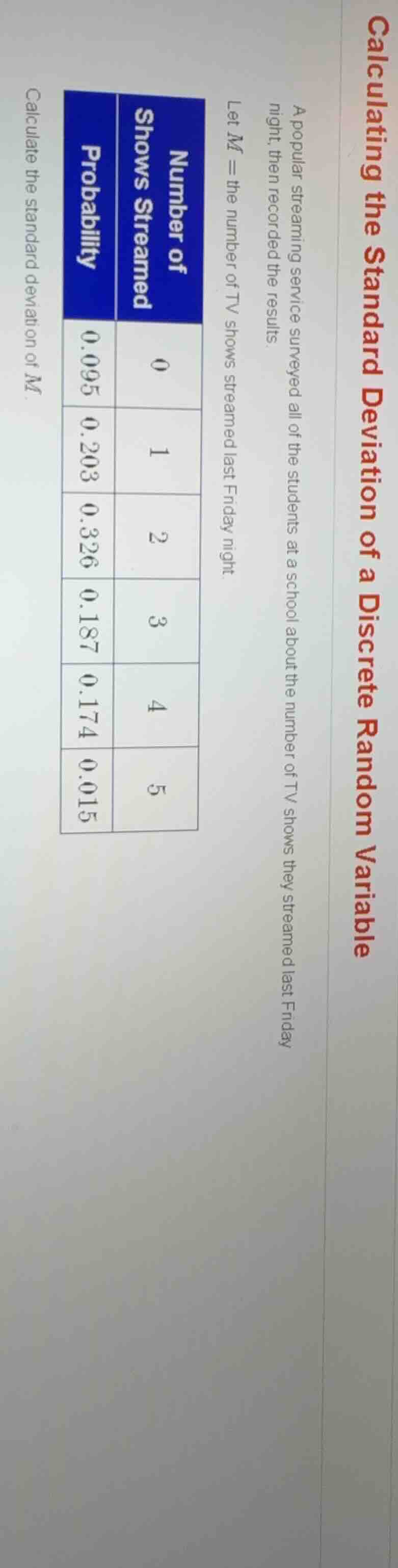
a popular streaming service surveyed all of the students at a school about the number of tv shows they streamed last friday night, then recorded the results.
let ( m ) = the number of tv shows streamed last friday night.
| number of shows streamed | probability |
|---|---|
| 1 | 0.203 |
| 2 | 0.326 |
| 3 | 0.187 |
| 4 | 0.174 |
| 5 | 0.015 |
calculate the standard deviation of ( m ).
Step1: Calculate the expected value \( E(M) \)
The formula for the expected value of a discrete random variable is \( E(M) = \sum_{i} m_i \cdot P(m_i) \), where \( m_i \) is the value of the random variable and \( P(m_i) \) is its corresponding probability.
\[
\]
Step2: Calculate the variance \( \text{Var}(M) \)
The formula for the variance of a discrete random variable is \( \text{Var}(M) = \sum_{i} (m_i - E(M))^2 \cdot P(m_i) \).
First, calculate \( (m_i - E(M))^2 \) for each \( m_i \):
- For \( m = 0 \): \( (0 - 2.187)^2 = (-2.187)^2 = 4.782969 \), then \( 4.782969 \cdot 0.095 \approx 0.454382 \)
- For \( m = 1 \): \( (1 - 2.187)^2 = (-1.187)^2 = 1.408969 \), then \( 1.408969 \cdot 0.203 \approx 0.286021 \)
- For \( m = 2 \): \( (2 - 2.187)^2 = (-0.187)^2 = 0.034969 \), then \( 0.034969 \cdot 0.326 \approx 0.011400 \)
- For \( m = 3 \): \( (3 - 2.187)^2 = (0.813)^2 = 0.660969 \), then \( 0.660969 \cdot 0.187 \approx 0.123601 \)
- For \( m = 4 \): \( (4 - 2.187)^2 = (1.813)^2 = 3.286969 \), then \( 3.286969 \cdot 0.174 \approx 0.571933 \)
- For \( m = 5 \): \( (5 - 2.187)^2 = (2.813)^2 = 7.912969 \), then \( 7.912969 \cdot 0.015 \approx 0.118695 \)
Now, sum these values to get the variance:
\[
\]
Step3: Calculate the standard deviation \( \sigma \)
The standard deviation is the square root of the variance, so \( \sigma = \sqrt{\text{Var}(M)} \).
\[
\sigma = \sqrt{1.566032} \approx 1.251
\]

Snap & solve any problem in the app
Get step-by-step solutions on Sovi AI
Photo-based solutions with guided steps
Explore more problems and detailed explanations
The standard deviation of \( M \) is approximately \( 1.25 \) (rounded to two decimal places) or more precisely \( \approx 1.251 \).