QUESTION IMAGE
Question
calculator
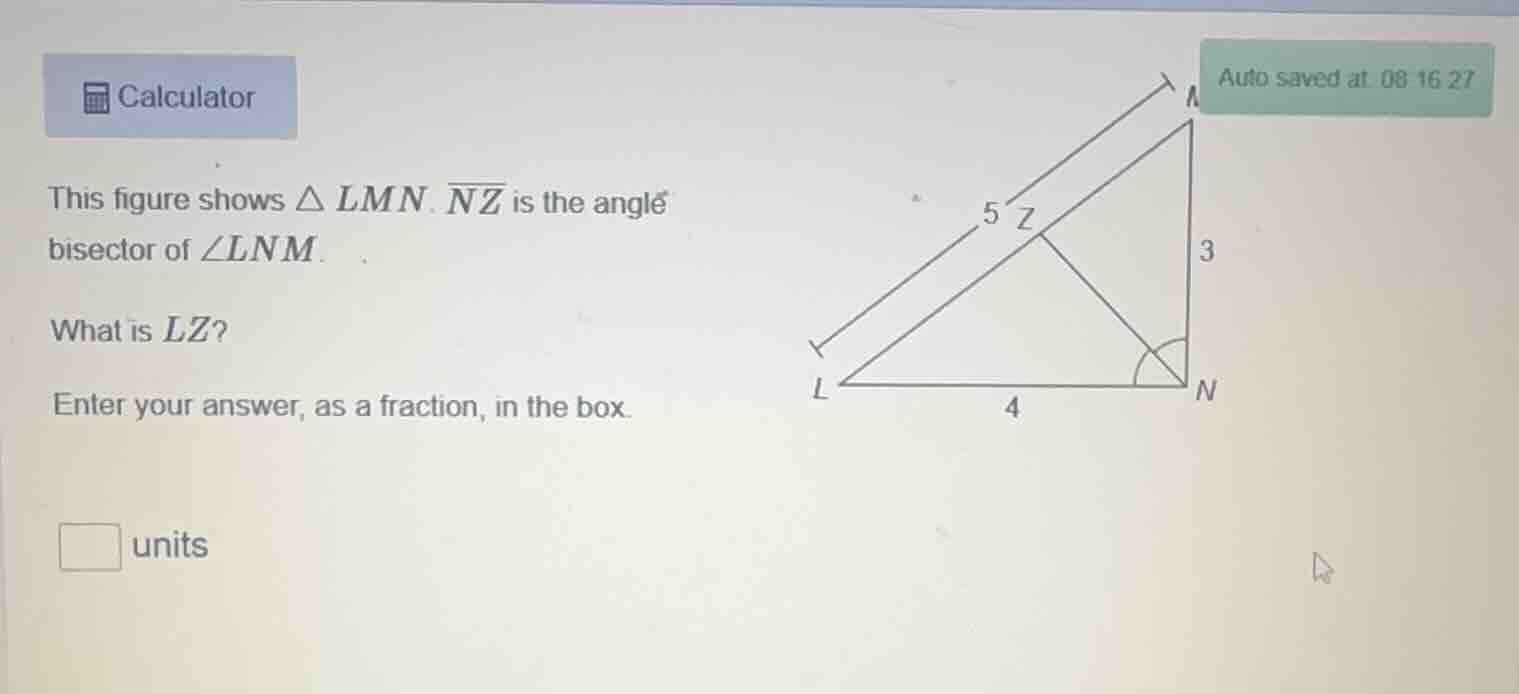
this figure shows △ lmn. ¯nz is the angle bisector of ∠lnm.
what is lz?
enter your answer, as a fraction, in the box.
□ units
5 z
3
l
4
n
auto saved at 08:16:27
Step1: Recall Angle Bisector Theorem
The Angle Bisector Theorem states that if a bisector of an angle of a triangle divides the opposite side into segments proportional to the adjacent sides. In $\triangle LMN$, $NZ$ is the angle bisector of $\angle LNM$, so $\frac{LZ}{ZM}=\frac{LN}{MN}$.
Step2: Identify Known Lengths
We know that $LM = 5$, let $LZ = x$, then $ZM=5 - x$. Also, $LN = 4$ and $MN = 3$.
Step3: Apply Angle Bisector Theorem
Substitute the values into the proportion: $\frac{x}{5 - x}=\frac{4}{3}$.
Step4: Solve the Proportion
Cross - multiply: $3x=4(5 - x)$.
Expand the right - hand side: $3x = 20-4x$.
Add $4x$ to both sides: $3x + 4x=20$, so $7x = 20$.
Wait, no, wait. Wait, actually, in $\triangle LMN$, the sides adjacent to $\angle LNM$ are $LN = 4$ and $MN = 3$, and the side $LM$ is split into $LZ$ and $ZM$ by the angle bisector $NZ$. Wait, maybe I mixed up the sides. Wait, the Angle Bisector Theorem is: In a triangle, the angle bisector divides the opposite side into segments proportional to the adjacent sides. So the angle at $N$, the angle bisector $NZ$ meets $LM$ at $Z$. So the opposite side is $LM$, and the adjacent sides are $LN$ and $MN$. So $\frac{LZ}{ZM}=\frac{LN}{MN}$. Let $LZ=x$, $ZM = 5 - x$, $LN = 4$, $MN = 3$. So $\frac{x}{5 - x}=\frac{4}{3}$. Cross - multiply: $3x=4(5 - x)\Rightarrow3x = 20-4x\Rightarrow3x + 4x=20\Rightarrow7x=20\Rightarrow x=\frac{20}{7}$? Wait, no, that can't be. Wait, wait, maybe the triangle is a right triangle? Let's check the lengths. $LN = 4$, $MN = 3$, $LM$: by Pythagoras, $LN^{2}+MN^{2}=4^{2}+3^{2}=16 + 9 = 25$, so $LM=\sqrt{25}=5$, which matches the given length of $LM = 5$. So $\triangle LMN$ is a right triangle with right angle at $N$. Now, applying the Angle Bisector Theorem correctly: the angle bisector of $\angle LNM$ (at $N$) meets $LM$ at $Z$. So the Angle Bisector Theorem states that $\frac{LZ}{ZM}=\frac{LN}{MN}$. So $LN = 4$, $MN = 3$, $LM = 5$. Let $LZ=x$, then $ZM = 5 - x$. So $\frac{x}{5 - x}=\frac{4}{3}$. Cross - multiply: $3x=4(5 - x)\Rightarrow3x=20 - 4x\Rightarrow7x = 20\Rightarrow x=\frac{20}{7}$? Wait, no, that seems wrong. Wait, maybe I got the sides reversed. Wait, $LN = 4$, $MN = 3$, so the ratio is $LN:MN = 4:3$, so $LZ:ZM = 4:3$. And $LZ+ZM=LM = 5$. Let $LZ = 4k$, $ZM = 3k$. Then $4k+3k=5\Rightarrow7k = 5\Rightarrow k=\frac{5}{7}$. Then $LZ = 4k=\frac{20}{7}$? Wait, but let's verify. Alternatively, maybe the formula for the length of the segment created by the angle bisector: the length of $LZ$ can be calculated as $\frac{LN\times LM}{LN + MN}$. Wait, no, the Angle Bisector Theorem ratio: $\frac{LZ}{LM - LZ}=\frac{LN}{MN}$. So $\frac{LZ}{5 - LZ}=\frac{4}{3}$. Cross - multiply: $3LZ=20 - 4LZ\Rightarrow7LZ = 20\Rightarrow LZ=\frac{20}{7}$? Wait, but let's check the triangle. $LN = 4$, $MN = 3$, $LM = 5$, so it's a right triangle (since $3^{2}+4^{2}=5^{2}$). The angle bisector of the right angle at $N$. Let's use the angle bisector length formula or coordinate geometry. Let's place $N$ at the origin $(0,0)$, $L$ at $(4,0)$, $M$ at $(0,3)$. Then the angle bisector of $\angle LNM$ (the right angle) will have a slope of 1 (since it bisects the right angle between the x - axis and y - axis). The line $LM$ goes from $(4,0)$ to $(0,3)$, its equation is $y=-\frac{3}{4}x + 3$. The angle bisector from $N(0,0)$ with slope 1 is $y = x$. Find the intersection $Z$ of $y = x$ and $y=-\frac{3}{4}x + 3$. Set $x=-\frac{3}{4}x + 3\Rightarrow x+\frac{3}{4}x=3\Rightarrow\frac{7}{4}x=3\Rightarrow x=\frac{12}{7}$, $y=\frac{12}{7}$. Now, the distance from $L(4,0)$ to $Z(\f…

Snap & solve any problem in the app
Get step-by-step solutions on Sovi AI
Photo-based solutions with guided steps
Explore more problems and detailed explanations
$\frac{20}{7}$