QUESTION IMAGE
Question
calculator
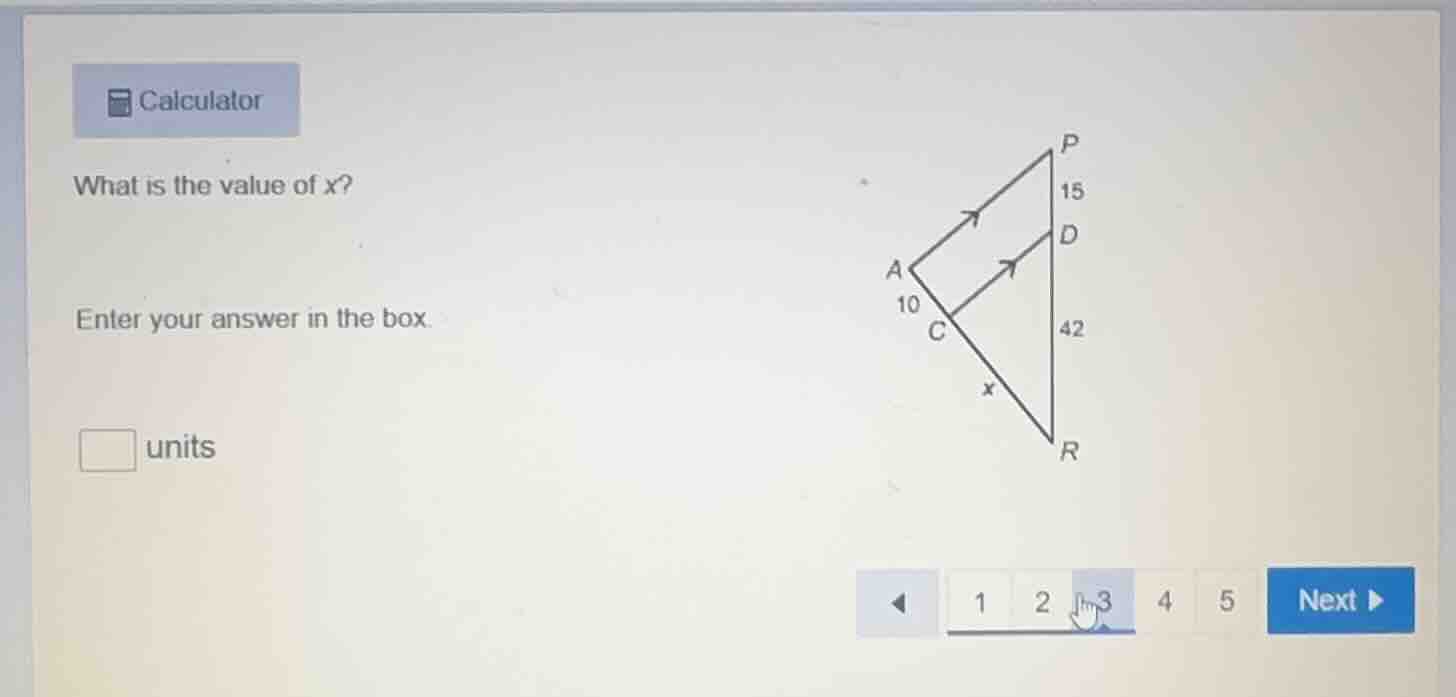
what is the value of x?
enter your answer in the box.
□ units
triangle with points a, p, r, c, d; ap and cd have arrows (parallel); ac=10, pd=15, dr=42, cr=x
Step1: Identify Similar Triangles
Since \( AC \parallel PD \) (indicated by the arrows), triangles \( \triangle ACR \) and \( \triangle PDR \) are similar by the Basic Proportionality Theorem (Thales' theorem).
Step2: Set Up Proportion
For similar triangles, the ratios of corresponding sides are equal. So, \(\frac{AC}{PD}=\frac{CR}{DR}\). Wait, actually, the sides are \( AC = 10 \), \( AP \) is parallel to \( CD \)? Wait, no, looking at the diagram: \( AC = 10 \), \( PD \) is part of \( PR \) where \( PD = 15 \), \( DR = 42 \), and \( CR = x \)? Wait, no, maybe the segments are \( AC \) and \( PD \), and \( CR \) and \( PR \)? Wait, no, let's re-express. Let's see: \( AC \) is parallel to \( PD \), so \( \triangle ACR \sim \triangle PDR \). So the ratio of \( AC \) to \( PD \) should equal the ratio of \( CR \) to \( DR \)? Wait, no, maybe \( AC \) corresponds to \( PD \), and \( AR \) corresponds to \( PR \). Wait, \( AR = AC + CR = 10 + x \)? No, wait, \( AC = 10 \), \( PD = 15 \), \( DR = 42 \), and \( CR = x \). Wait, maybe the correct proportion is \(\frac{AC}{PD}=\frac{CR}{DR}\)? Wait, no, let's check the lengths. Wait, \( AC = 10 \), \( PD = 15 \), \( CR = x \), \( DR = 42 \). Wait, no, actually, the sides adjacent to the parallel lines: \( AC \parallel PD \), so the triangles \( \triangle ACD \) and \( \triangle PDD \)? No, maybe the correct proportion is \(\frac{AC}{PD}=\frac{CR}{DR}\)? Wait, no, let's do it properly.
Wait, the two triangles are similar, so the ratio of the smaller triangle's side to the larger triangle's side is equal. So \( AC = 10 \), \( PD = 15 \), and the other sides: \( CR \) and \( DR \)? No, wait, \( PR = PD + DR = 15 + 42 = 57 \)? No, that can't be. Wait, maybe \( AC \) is parallel to \( PD \), so \( \frac{AC}{PD}=\frac{CR}{DR} \)? Wait, no, \( AC = 10 \), \( PD = 15 \), \( CR = x \), \( DR = 42 \). Wait, that would be \(\frac{10}{15}=\frac{x}{42}\)? No, that gives \( x = \frac{10 \times 42}{15} = 28 \). Wait, but that doesn't seem right. Wait, maybe the segments are \( AC = 10 \), \( AP \) is parallel to \( CD \), no, the arrows are on \( AP \) and \( CD \). Wait, the diagram has \( A \) connected to \( C \) (length 10), \( C \) connected to \( R \) (length \( x \)), \( A \) connected to \( P \) (parallel to \( C \) connected to \( D \)), \( P \) connected to \( D \) (length 15), \( D \) connected to \( R \) (length 42). So \( AP \parallel CD \), so triangles \( \triangle APR \) and \( \triangle CDR \) are similar. Then, \(\frac{AP}{CD}=\frac{PR}{DR}\)? No, \( AP \) is length \( 10 + x \)? No, \( AC = 10 \), \( CR = x \), so \( AR = 10 + x \)? No, \( AP \) is parallel to \( CD \), so \( \frac{AC}{PD}=\frac{CR}{DR} \). Wait, \( AC = 10 \), \( PD = 15 \), \( CR = x \), \( DR = 42 \). So \(\frac{10}{15}=\frac{x}{42}\)? Wait, solving that: \( 15x = 10 \times 42 \), \( 15x = 420 \), \( x = \frac{420}{15} = 28 \). Wait, but that seems low. Wait, maybe the proportion is \(\frac{AC}{PD}=\frac{AR}{PR}\), where \( AR = 10 + x \), \( PR = 15 + 42 = 57 \). Then \(\frac{10}{15}=\frac{10 + x}{57}\). Solving: \( 15(10 + x) = 10 \times 57 \), \( 150 + 15x = 570 \), \( 15x = 420 \), \( x = 28 \). Oh, that's the same result. So regardless of the proportion, we get \( x = 28 \).
Wait, let's verify. If \( x = 28 \), then \( AR = 10 + 28 = 38 \), \( PR = 15 + 42 = 57 \). Then \( \frac{10}{15}=\frac{38}{57} \). Simplify \( \frac{10}{15}=\frac{2}{3} \), and \( \frac{38}{57}=\frac{2}{3} \) (dividing numerator and denominator by 19: \( 38 \div 19 = 2 \), \( 57 \div 19 = 3 \)). So that works. So the proportion is co…

Snap & solve any problem in the app
Get step-by-step solutions on Sovi AI
Photo-based solutions with guided steps
Explore more problems and detailed explanations
28