QUESTION IMAGE
Question
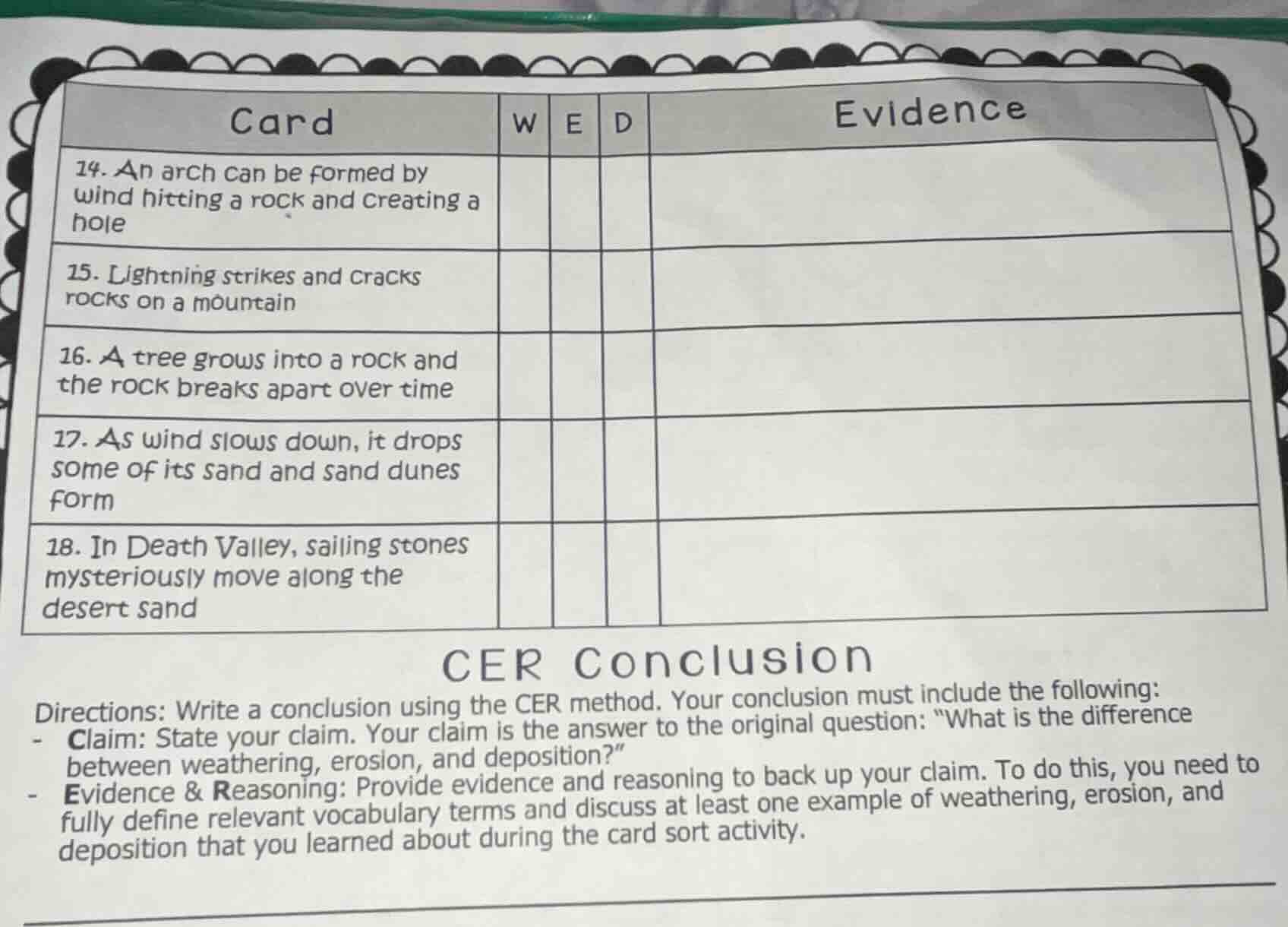
card w e d evidence 14. an arch can be formed by wind hitting a rock and creating a hole 15. lightning strikes and cracks rocks on a mountain 16. a tree grows into a rock and the rock breaks apart over time 17. as wind slows down, it drops some of its sand and sand dunes form 18. in death valley, sailing stones mysteriously move along the desert sand cer conclusion directions: write a conclusion using the cer method. your conclusion must include the following: - claim: state your claim. your claim is the answer to the original question: \what is the difference between weathering, erosion, and deposition?\ - evidence & reasoning: provide evidence and reasoning to back up your claim. to do this, you need to fully define relevant vocabulary terms and discuss at least one example of weathering, erosion, and deposition that you learned about during the card sort activity.
First, define each process clearly, then match the provided examples to each category, and tie them to the claim about the differences between the three processes.
- Claim: Weathering, erosion, and deposition are distinct sequential processes that shape Earth's surface: weathering breaks down rocks in place, erosion moves the broken material, and deposition drops the moved material in a new location.
- Vocabulary Definitions:
- Weathering: The breakdown of rocks, soil, or minerals into smaller pieces without moving the material from its original location.
- Erosion: The movement of weathered rock or soil material by natural forces like wind, water, or ice.
- Deposition: The process where eroded material is dropped or laid down in a new location when the transporting force loses energy.
- Evidence & Reasoning:
- Weathering Example: Card 16 (a tree growing into a rock and breaking it apart over time) is weathering. The tree's roots exert force that breaks the rock, but the rock fragments stay in their original spot, fitting the definition of breaking down material in place. Card 15 (lightning cracking mountain rocks) is also weathering, as it breaks rocks without moving them.
- Erosion Example: Card 18 (sailing stones moving across Death Valley sand) is erosion. The stones (weathered rock material) are being moved across the desert by natural forces (wind-driven ice/slush), which matches the definition of transporting weathered material.
- Deposition Example: Card 17 (wind slowing down and dropping sand to form dunes) is deposition. The wind loses energy, so it can no longer carry the sand, and deposits it to build sand dunes, fitting the definition of laying down eroded material in a new area. Card 14 (wind forming an arch by creating a hole) is a combination, but the initial rock breakdown is weathering, while the wind carrying away small rock particles is erosion; the end result of the arch is shaped by both, but the core breakdown is weathering.

Snap & solve any problem in the app
Get step-by-step solutions on Sovi AI
Photo-based solutions with guided steps
Explore more problems and detailed explanations
CER Conclusion
Claim:
Weathering, erosion, and deposition are distinct, interconnected Earth surface processes: weathering breaks down rocks in place, erosion moves the broken material, and deposition deposits the moved material in a new location.
Evidence & Reasoning:
- Weathering is the breakdown of rocks without moving them. Evidence: Card 16 (a tree's roots break a rock over time) – the rock fragments stay in their original position, fitting the definition of in-place breakdown. Card 15 (lightning cracking mountain rocks) also fits, as it only breaks rocks, not moves them.
- Erosion is the movement of weathered material. Evidence: Card 18 (sailing stones moving across Death Valley sand) – the stones (weathered rock) are transported across the desert by natural forces, matching the definition of moving weathered material.
- Deposition is the laying down of eroded material when the transporting force loses energy. Evidence: Card 17 (wind slowing to drop sand and form dunes) – the wind loses energy, can no longer carry sand, and deposits it to build dunes, which aligns with the definition of depositing eroded material in a new area.