QUESTION IMAGE
Question
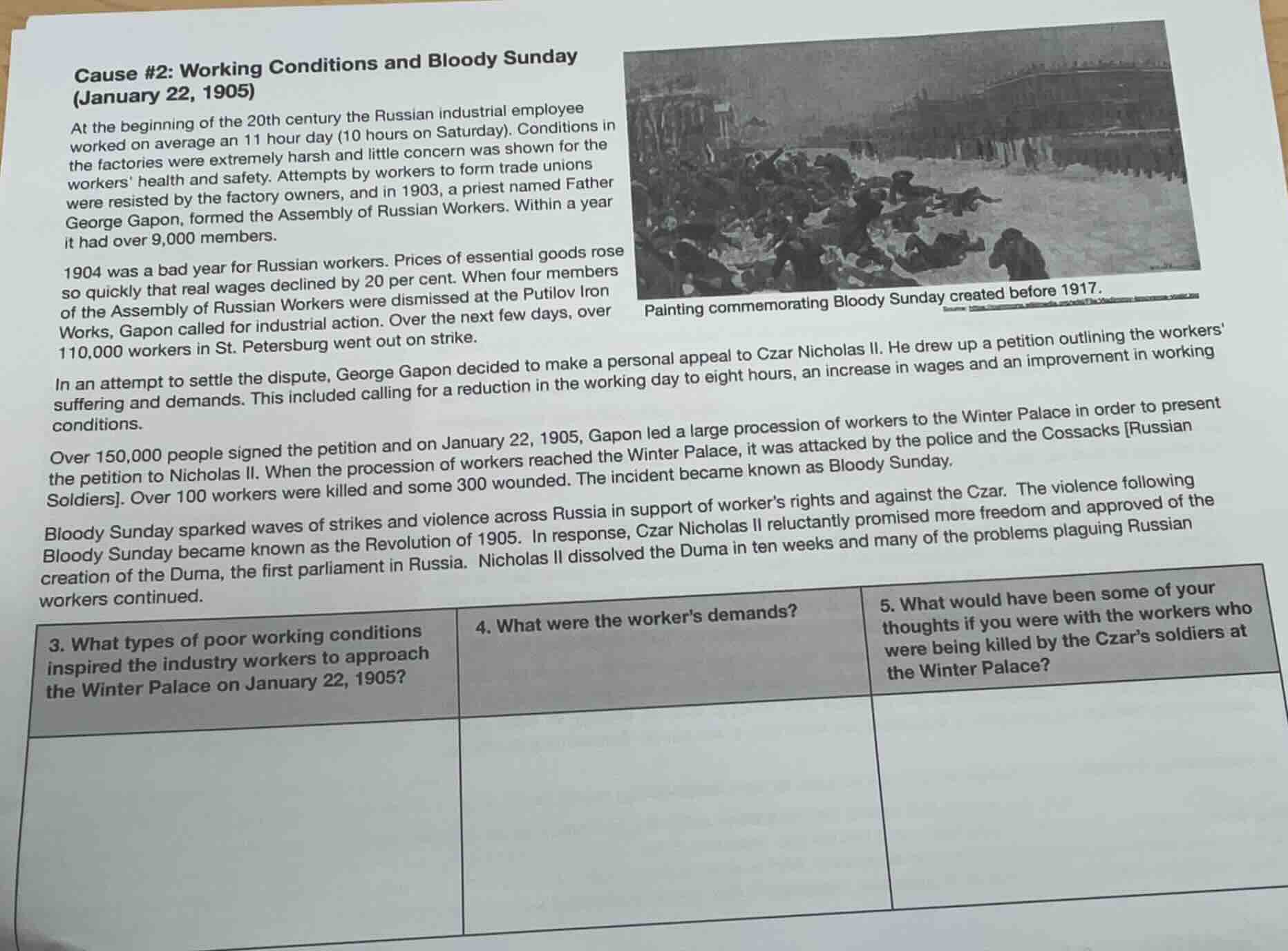
cause #2: working conditions and bloody sunday (january 22, 1905) at the beginning of the 20th century the russian industrial employee worked on average an 11 hour day (10 hours on saturday). conditions in the factories were extremely harsh and little concern was shown for the workers health and safety. attempts by workers to form trade unions were resisted by the factory owners, and in 1903, a priest named father george gapon, formed the assembly of russian workers. within a year it had over 9,000 members. 1904 was a bad year for russian workers. prices of essential goods rose so quickly that real wages declined by 20 per cent. when four members of the assembly of russian workers were dismissed at the putilov iron works, gapon called for industrial action. over the next few days, over 110,000 workers in st. petersburg went out on strike. in an attempt to settle the dispute, george gapon decided to make a personal appeal to czar nicholas ii. he drew up a petition outlining the workers suffering and demands. this included calling for a reduction in the working day to eight hours, an increase in wages and an improvement in working conditions. over 150,000 people signed the petition and on january 22, 1905, gapon led a large procession of workers to the winter palace in order to present the petition to nicholas ii. when the procession of workers reached the winter palace, it was attacked by the police and the cossacks russian soldiers. over 100 workers were killed and some 300 wounded. the incident became known as bloody sunday. bloody sunday sparked waves of strikes and violence across russia in support of workers rights and against the czar. the violence following bloody sunday became known as the revolution of 1905. in response, czar nicholas ii reluctantly promised more freedom and approved of the creation of the duma, the first parliament in russia. nicholas ii dissolved the duma in ten weeks and many of the problems plaguing russian workers continued. 3. what types of poor working conditions inspired the industry workers to approach the winter palace on january 22, 1905? 4. what were the workers demands? 5. what would have been some of your thoughts if you were with the workers who were being killed by the czars soldiers at the winter palace?
- The poor conditions include long daily shifts (11 hours on average, 10 on Saturdays), extremely harsh factory environments with no concern for worker health/safety, restricted ability to form trade unions, a 20% decline in real wages due to rising essential goods prices in 1904, and unfair dismissals of union members.
- The workers' demands came from their petition: an 8-hour workday, wage increases, improved working conditions, and greater rights/freedoms from the czar.
- Being in that situation would likely bring overwhelming shock at the unprovoked violence, anger toward the czar and authorities for attacking peaceful protesters, grief for the killed and wounded, and a growing sense of betrayal and resolve to fight against the oppressive regime.

Snap & solve any problem in the app
Get step-by-step solutions on Sovi AI
Photo-based solutions with guided steps
Explore more problems and detailed explanations
- Long work hours (11-hour average days, 10 on Saturdays), harsh factory conditions with no health/safety protections, blocked trade union formation, 20% real wage decline, and unfair dismissals of union workers.
- An 8-hour workday, wage increases, improved working conditions, and greater freedoms from the czar.
- Shock at the unprovoked attack, anger toward the czar's forces, grief for the victims, and a feeling of betrayal that would fuel resolve to oppose the oppressive government.