QUESTION IMAGE
Question
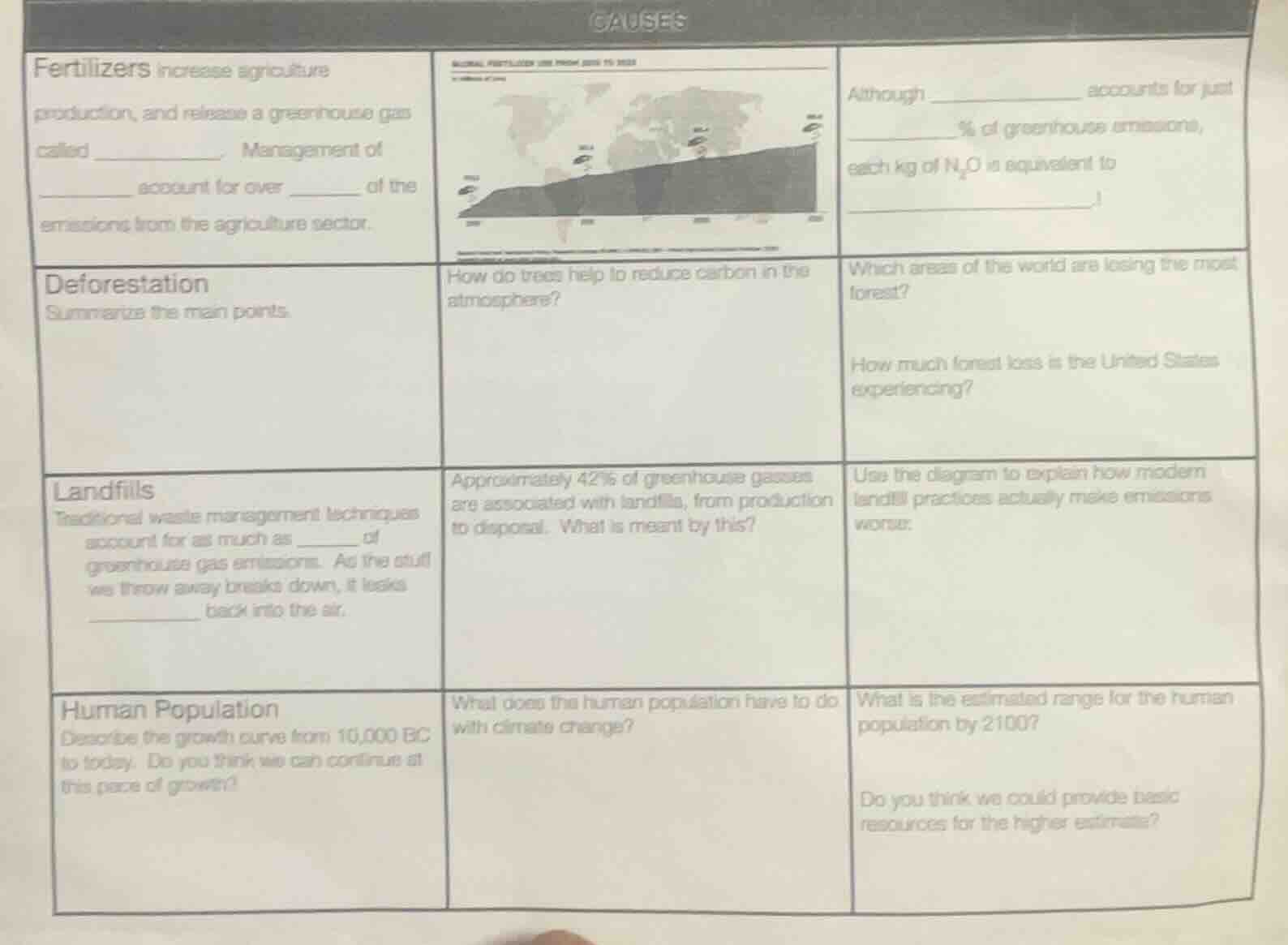
causes
fertilizers increase agriculture
production, and release a greenhouse gas
called _________. management of
______ account for over ____ of the
emissions from the agriculture sector.
chart: global fertilizer use from 1960 to 2020
although __________ accounts for just
______% of greenhouse emissions,
each kg of n₂o is equivalent to
____________!
deforestation
summarize the main points.
how do trees help to reduce carbon in the
atmosphere?
which areas of the world are losing the most
forest?
how much forest loss is the united states
experiencing?
landfills
traditional waste management techniques
account for as much as ______ of
greenhouse gas emissions. as the stuff
we throw away breaks down, it leaks
_________ back into the air.
approximately 42% of greenhouse gasses
are associated with landfills, from production
to disposal. what is meant by this?
use the diagram to explain how modern
landfill practices actually make emissions
worse.
human population
describe the growth curve from 10,000 bc
to today. do you think we can continue at
this pace of growth?
what does the human population have to do
with climate change?
what is the estimated range for the human
population by 2100?
do you think we could provide basic
resources for the higher estimates?
Part 1: Fertilizers Section (Filling Blanks)
- Fertilizers release nitrous oxide ($N_2O$), a greenhouse gas. Management of nitrogen (from fertilizers, like in manure or synthetic fertilizers) accounts for over 70% (approximate value for agricultural $N_2O$ emissions) of agriculture - sector emissions. $N_2O$ accounts for about 6 - 8% of greenhouse emissions (commonly around 6 - 7% is cited), and each kg of $N_2O$ is equivalent to 298 kg of $CO_2$ (global warming potential).
Deforestation is the removal of forests. Main points include: loss of forested areas (impacting biodiversity, climate regulation), drivers like agriculture expansion, logging, urbanization; consequences like reduced carbon sequestration (trees absorb $CO_2$), increased $CO_2$ in atmosphere, soil erosion, disrupted water cycles, and loss of habitats for species.
Trees perform photosynthesis: they take in carbon dioxide ($CO_2$) from the atmosphere, use energy from sunlight to convert $CO_2$ and water into glucose (chemical energy) and release oxygen ($O_2$). The carbon from $CO_2$ is stored in the tree's biomass (trunks, branches, roots, leaves) and in the soil (when leaves/roots decompose), thus removing $CO_2$ from the atmosphere.

Snap & solve any problem in the app
Get step-by-step solutions on Sovi AI
Photo-based solutions with guided steps
Explore more problems and detailed explanations
- Fertilizers increase agriculture production, and release a greenhouse gas called $\boldsymbol{N_2O}$ (nitrous oxide). Management of $\boldsymbol{nitrogen}$ (e.g., manure, synthetic fertilizers) account for over $\boldsymbol{70\%}$ (approximate) of the emissions from the agriculture sector.
- Although $\boldsymbol{N_2O}$ (nitrous oxide) accounts for just $\boldsymbol{6 - 8\%}$ (commonly ~6 - 7%) of greenhouse emissions, each kg of $N_2O$ is equivalent to $\boldsymbol{298\ kg\ of\ CO_2}$ (in terms of global warming potential).