QUESTION IMAGE
Question
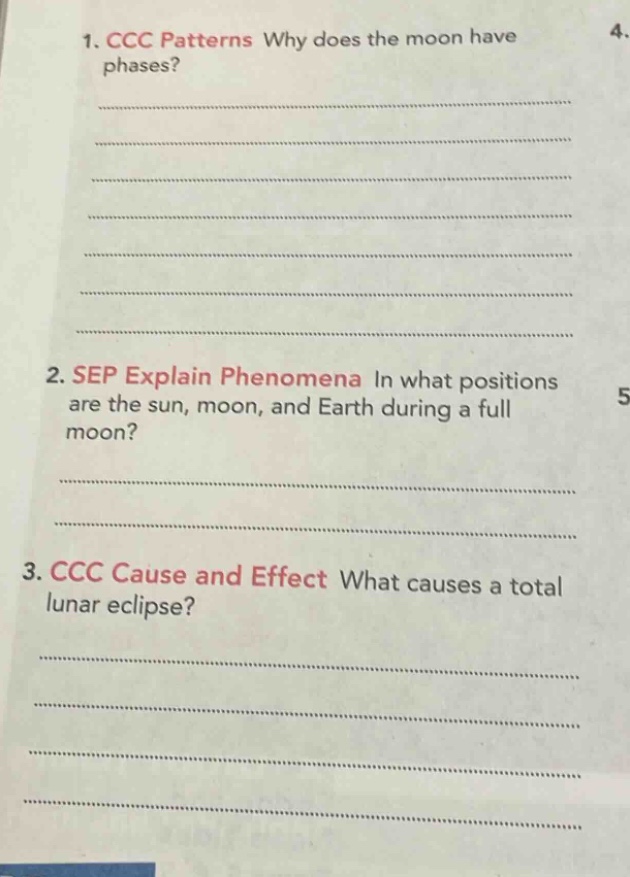
- ccc patterns why does the moon have phases?
- sep explain phenomena in what positions are the sun, moon, and earth during a full moon?
- ccc cause and effect what causes a total lunar eclipse?
Question 1
The moon has phases because as it orbits Earth, the portion of its sun - lit side that we can see from Earth changes. The moon doesn't produce its own light; it reflects sunlight. As the moon moves around Earth in its approximately 29.5 - day orbital period, different amounts of the sun - lit hemisphere are visible from our perspective on Earth. For example, during a new moon, the side of the moon facing Earth is not lit (or almost not lit) because the moon is between the sun and Earth, and during a full moon, the side of the moon facing Earth is fully lit as Earth is between the sun and the moon.
During a full moon, the sun, Earth, and moon are aligned in a straight line (or nearly straight line) with Earth in the middle. So the order is Sun - Earth - Moon (with Earth between the sun and the moon). This alignment means that the entire sun - lit side of the moon is facing Earth, which is why we see a full moon.
A total lunar eclipse occurs when the Earth comes directly between the sun and the moon, and the Earth's shadow (umbra) completely covers the moon. For this to happen, the sun, Earth, and moon must be in a straight line (or nearly straight line) with Earth in the middle. The Earth's atmosphere can also bend some sunlight (a process called refraction), which can give the moon a reddish hue during a total lunar eclipse (sometimes called a "blood moon").

Snap & solve any problem in the app
Get step-by-step solutions on Sovi AI
Photo-based solutions with guided steps
Explore more problems and detailed explanations
The moon has phases because its orbital motion around Earth changes the portion of its sun - lit surface visible from Earth (it reflects sunlight, and our view of the sun - lit part changes as it orbits Earth).