QUESTION IMAGE
Question
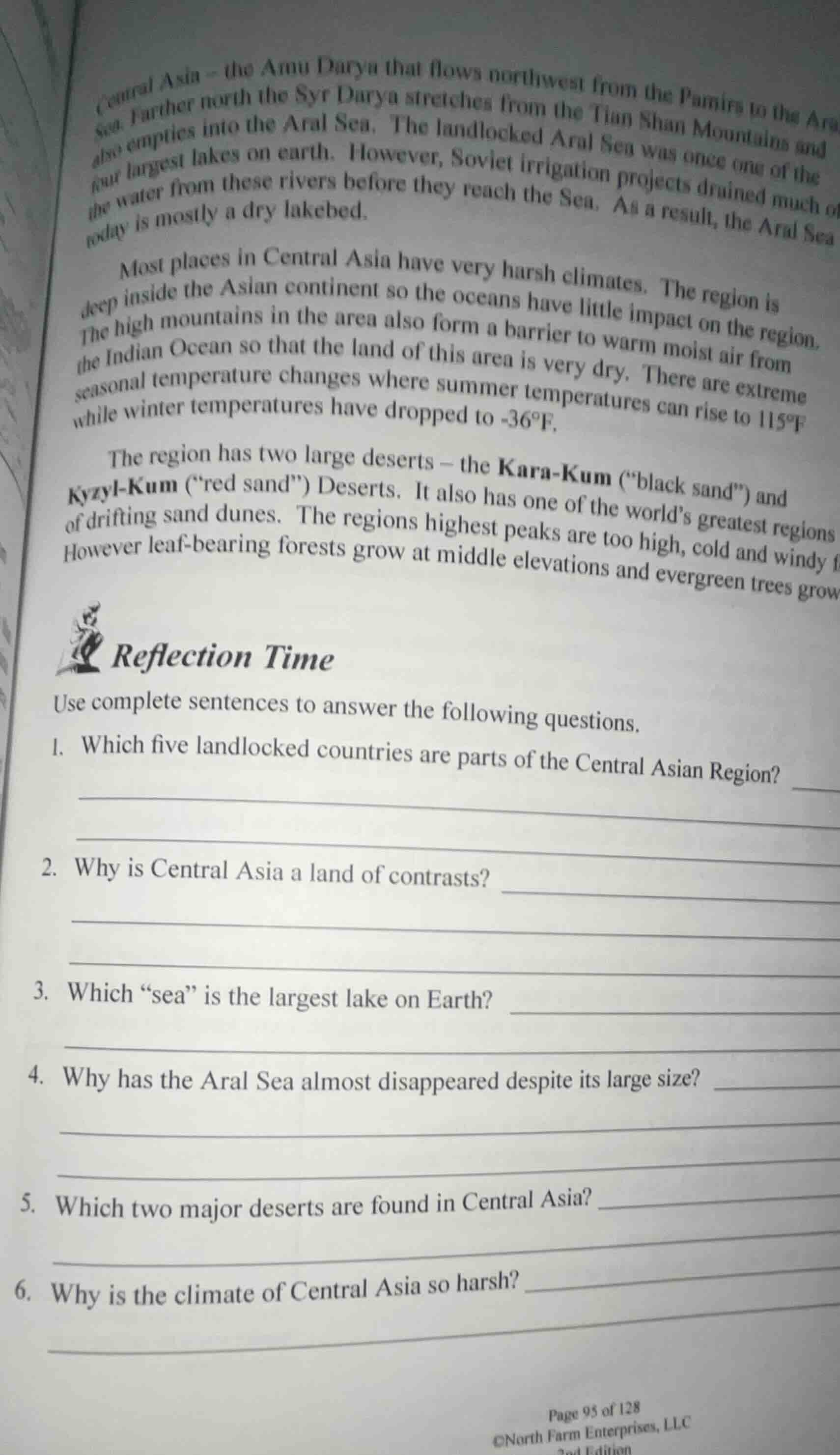
central asia - the amu darya that flows northwest from the pamirs to the ara sea. farther north the syr darya stretches from the tian shan mountains and also empties into the aral sea. the landlocked aral sea was once one of the four largest lakes on earth. however, soviet irrigation projects drained much of the water from these rivers before they reach the sea. as a result, the aral sea today is mostly a dry lakebed.
most places in central asia have very harsh climates. the region is deep inside the asian continent so the oceans have little impact on the region. the high mountains in the area also form a barrier to warm moist air from the indian ocean so that the land of this area is very dry. there are extreme seasonal temperature changes where summer temperatures can rise to 115°f while winter temperatures have dropped to -36°f.
the region has two large deserts - the kara - kum (\black sand\) and kyzyl - kum (
ed sand\) deserts. it also has one of the worlds greatest regions of drifting sand dunes. the regions highest peaks are too high, cold and windy. however leaf - bearing forests grow at middle elevations and evergreen trees grow
reflection time
use complete sentences to answer the following questions.
- which five landlocked countries are parts of the central asian region?
- why is central asia a land of contrasts?
- which \sea\ is the largest lake on earth?
- why has the aral sea almost disappeared despite its large size?
- which two major deserts are found in central asia?
- why is the climate of central asia so harsh?
- These are the five core landlocked nations defining the Central Asian region.
- The region has extreme environmental differences, from harsh deserts and frigid high peaks to forested middle elevations, plus extreme seasonal temperature swings.
- This body of water is classified as a lake but referred to as a "sea" due to its massive size.
- The text explicitly states this human-caused diversion as the cause of the Aral Sea's decline.
- These are the two named major deserts in the provided text about Central Asia.
- The region's inland location and mountain barriers block moist ocean air, creating dry conditions, and it experiences extreme seasonal temperature shifts.

Snap & solve any problem in the app
Get step-by-step solutions on Sovi AI
Photo-based solutions with guided steps
Explore more problems and detailed explanations
- The five landlocked countries in Central Asia are Kazakhstan, Kyrgyzstan, Tajikistan, Turkmenistan, and Uzbekistan.
- Central Asia is a land of contrasts because it has vast, sandy deserts, extremely high, cold, and windy mountain peaks, forested middle elevations, and extreme seasonal temperature swings from 115°F in summer to -36°F in winter.
- The Caspian Sea is the largest lake on Earth.
- The Aral Sea has almost disappeared because Soviet irrigation projects drained much of the water from the Amu Darya and Syr Darya rivers before they could reach the sea.
- The two major deserts in Central Asia are the Kara-Kum ("black sand") and Kyzyl-Kum ("red sand") Deserts.
- Central Asia has a harsh climate because it is deep inside the Asian continent with little ocean influence, high mountains block warm moist air from the Indian Ocean making the land very dry, and it has extreme seasonal temperature changes.