QUESTION IMAGE
Question
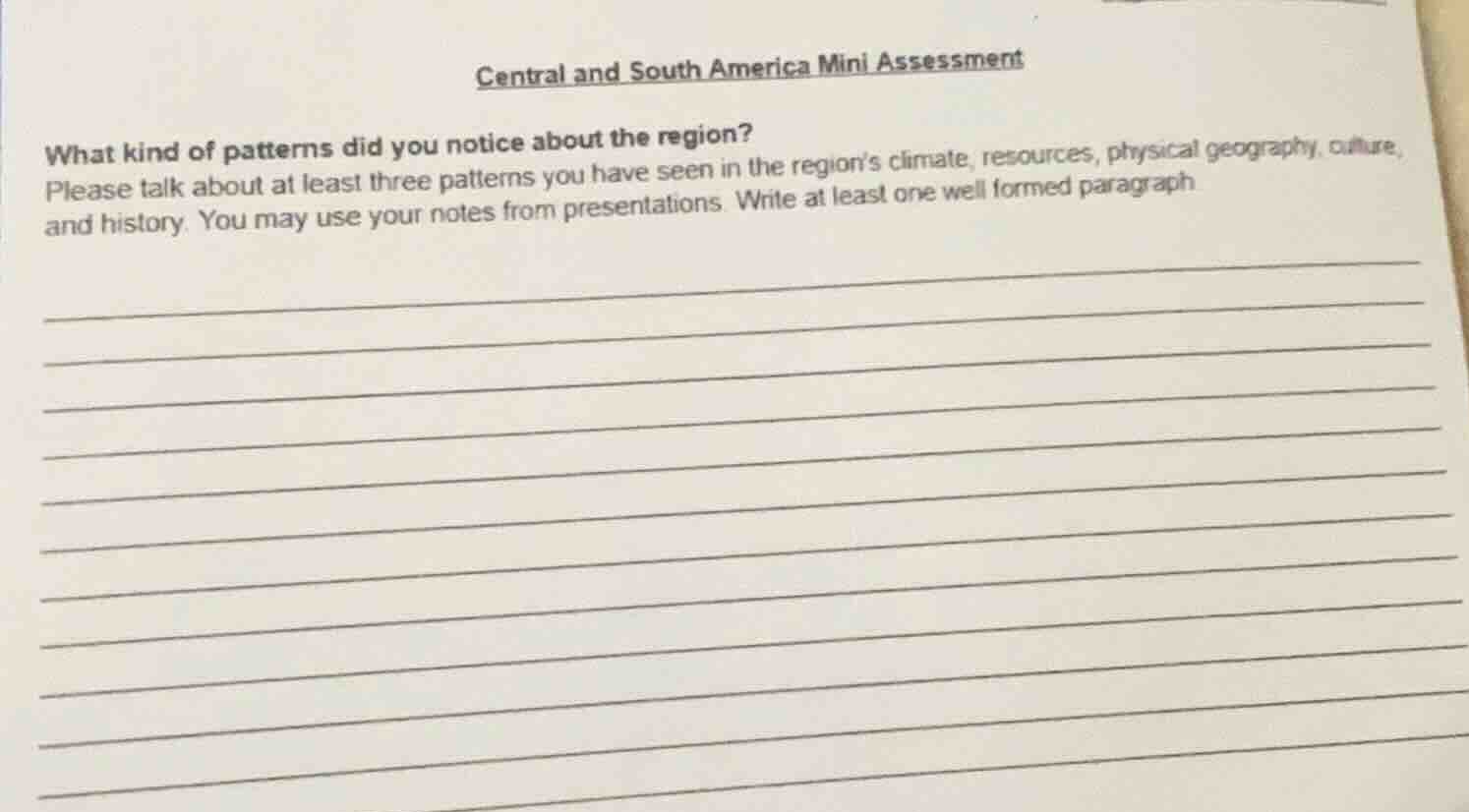
central and south america mini assessment
what kind of patterns did you notice about the region?
please talk about at least three patterns you have seen in the region’s climate, resources, physical geography, culture,
and history. you may use your notes from presentations. write at least one well formed paragraph
First, a climate pattern: most of Central and South America has a tropical or subtropical climate, with cooler, drier conditions concentrated in the mountainous Andean regions and southern tip of South America, creating a clear latitudinal and elevation-based climate gradient. Second, a cultural pattern: the dominance of Spanish and Portuguese languages, along with Roman Catholicism, stems from colonial history, with Indigenous cultural practices (like maize farming, textile crafts, and communal land systems) persisting most strongly in rural and highland areas, creating a mix of colonial and Indigenous cultural landscapes. Third, a physical geography and resource pattern: major river systems (such as the Amazon, Orinoco, and Paraná) are concentrated in lowland basins, which are also the regions with the most abundant rainforest resources, while mountainous areas are rich in mineral resources like silver, copper, and lithium, leading to economic activity clustering around these resource-rich zones.

Snap & solve any problem in the app
Get step-by-step solutions on Sovi AI
Photo-based solutions with guided steps
Explore more problems and detailed explanations
A clear set of interconnected patterns defines Central and South America. A key climate pattern is the latitudinal and elevation-driven gradient: most of the region falls within tropical or subtropical zones, with warm, wet conditions supporting the Amazon rainforest, while the Andean mountain range and southern South America have cooler, drier climates that support grasslands and alpine ecosystems. Culturally, the region shows a persistent blend of colonial and Indigenous influences: Spanish and Portuguese are the dominant languages, and Roman Catholicism is the primary religion, legacies of European colonization, yet Indigenous practices like maize-centric agriculture, traditional textile weaving, and communal land management remain vibrant in rural highland areas such as the Andes and parts of Central America. Finally, a physical geography and resource pattern links landforms to economic activity: large lowland river basins (including the Amazon and Paraná) hold the world's most extensive rainforest resources, driving logging and agroforestry, while the Andean mountain chain is rich in high-value minerals like copper, lithium, and silver, leading to concentrated mining and settlement in these elevated zones. Together, these patterns show how geography, history, and culture shape the region's identity and activity.