QUESTION IMAGE
Question
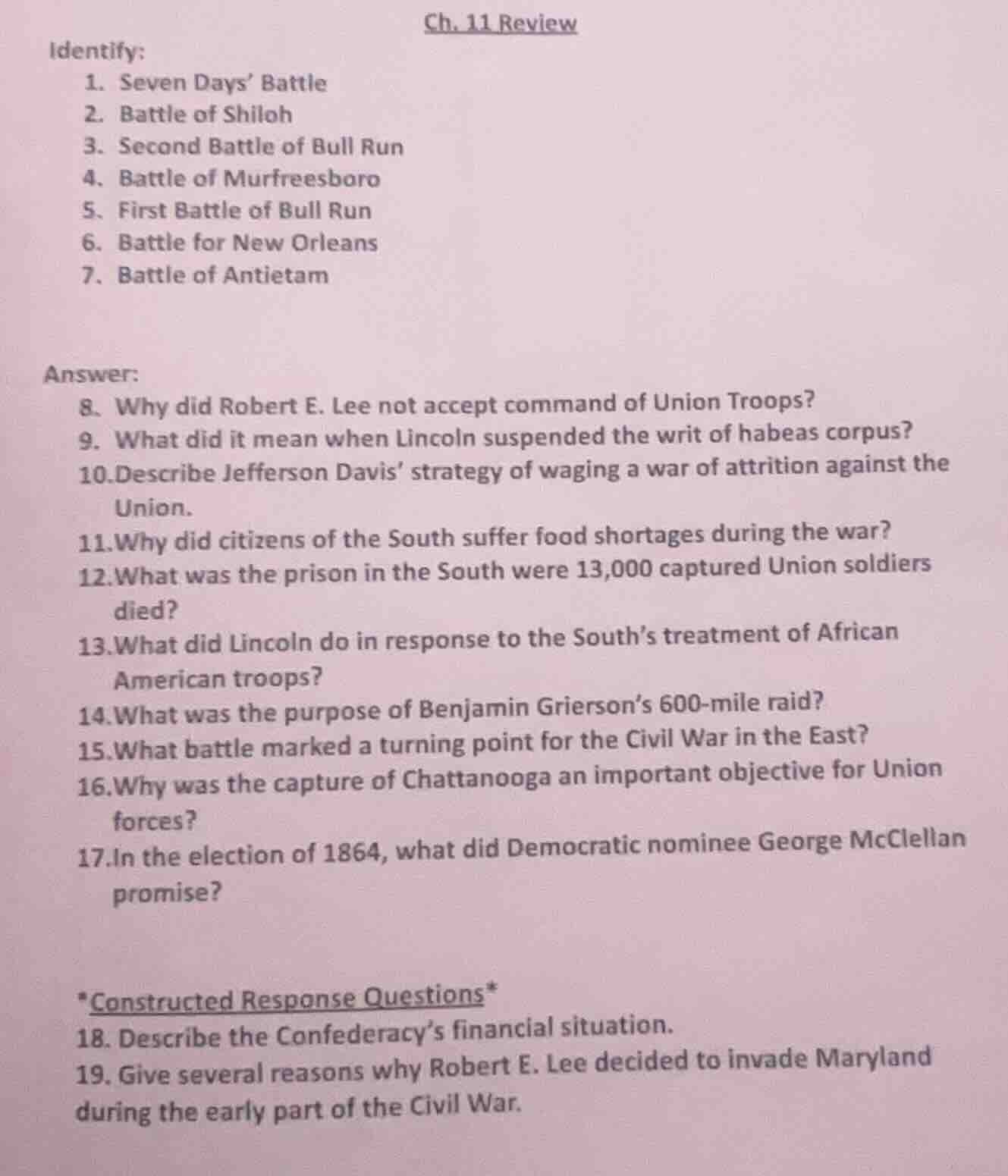
ch. 11 review
identify:
- seven days battle
- battle of shiloh
- second battle of bull run
- battle of murfreesboro
- first battle of bull run
- battle for new orleans
- battle of antietam
answer:
- why did robert e. lee not accept command of union troops?
- what did it mean when lincoln suspended the writ of habeas corpus?
10.describe jefferson davis strategy of waging a war of attrition against the union.
11.why did citizens of the south suffer food shortages during the war?
12.what was the prison in the south were 13,000 captured union soldiers died?
13.what did lincoln do in response to the souths treatment of african american troops?
14.what was the purpose of benjamin griersons 600-mile raid?
15.what battle marked a turning point for the civil war in the east?
16.why was the capture of chattanooga an important objective for union forces?
17.in the election of 1864, what did democratic nominee george mcclellan promise?
constructed response questions
- describe the confederacys financial situation.
- give several reasons why robert e. lee decided to invade maryland during the early part of the civil war.
Identify Section:
- Seven Days' Battle: A series of 1862 Civil War battles near Richmond, VA; Confederate victory that pushed Union forces back, saving the Confederate capital.
- Battle of Shiloh: 1862 Tennessee battle; costly Union victory that gave them control of the Tennessee River and opened access to the Confederate interior.
- Second Battle of Bull Run: 1862 Virginia battle; decisive Confederate victory that cleared the way for Lee's first invasion of the North.
- Battle of Murfreesboro (Stones River): 1862-1863 Tennessee battle; Union victory that stabilized their hold on the western theater.
- First Battle of Bull Run: 1861 Virginia battle; first major Civil War battle, Confederate victory that showed the war would be long and bloody.
- Battle for New Orleans: 1862 Union naval capture of the key Confederate port, cutting off a major supply route and crippling Confederate trade.
- Battle of Antietam: 1862 Maryland battle; bloodiest single-day battle in U.S. history, Union tactical victory that allowed Lincoln to issue the Emancipation Proclamation.

Snap & solve any problem in the app
Get step-by-step solutions on Sovi AI
Photo-based solutions with guided steps
Explore more problems and detailed explanations
Section:
- Robert E. Lee was a Virginia native; he refused Union command out of loyalty to his home state after Virginia seceded.
- Suspending habeas corpus allowed the government to arrest and detain individuals without charging them with a crime, used to suppress dissent and prevent Confederate sympathizers from interfering with the war effort.
- Davis's attrition strategy focused on making the Union war so costly in lives and resources that Northern public opinion would turn against the war, forcing the Union to negotiate a peace that recognized Confederate independence.
- Southern food shortages stemmed from Union blockades cutting off imports, most farm labor being drafted into the Confederate army, crops being destroyed by battles, and the Confederate government prioritizing feeding its army over civilians.
- The prison was Andersonville (officially Camp Sumter), a Confederate prisoner-of-war camp where over 13,000 Union soldiers died from starvation, disease, and neglect.
- Lincoln issued an order that Confederate troops who captured or enslaved African American Union soldiers would face retaliation, including equal treatment of Confederate prisoners and possible execution of those who abused Black troops.
- Grierson's Raid (1863) was a diversionary tactic; it destroyed Confederate supply lines, disrupted communication, and drew Confederate troops away from the main Union attack on Vicksburg.
- The Battle of Gettysburg (1863) marked the turning point in the Eastern theater; it was a decisive Union victory that ended Lee's ability to launch large-scale invasions of the North.
- Chattanooga was a critical railroad hub and gateway to the Deep South; capturing it gave the Union control of key supply lines and allowed them to launch further invasions into Georgia and the heart of the Confederacy.
- In 1864, George McClellan promised to end the Civil War through a negotiated peace with the Confederacy, rather than continuing the military campaign to force reunification.
Constructed Response Questions:
- The Confederacy's financial situation was dire: it relied heavily on printing paper money, which caused massive inflation (prices rose over 9,000% by war's end). It also struggled with war bond sales, a collapsing economy, and Union blockades that destroyed its ability to raise revenue through exports. The government resorted to impressment (seizing civilian goods for the army) which further angered citizens.
- Lee invaded Maryland for several reasons: to move the war out of war-ravaged Virginia and gather supplies from Maryland's farms; to encourage pro-Confederate sentiment in Maryland (a border state) and potentially win foreign recognition for the Confederacy; to relieve pressure on Confederate forces in the west; and to deliver a decisive victory that would weaken Northern support for the war.