QUESTION IMAGE
Question
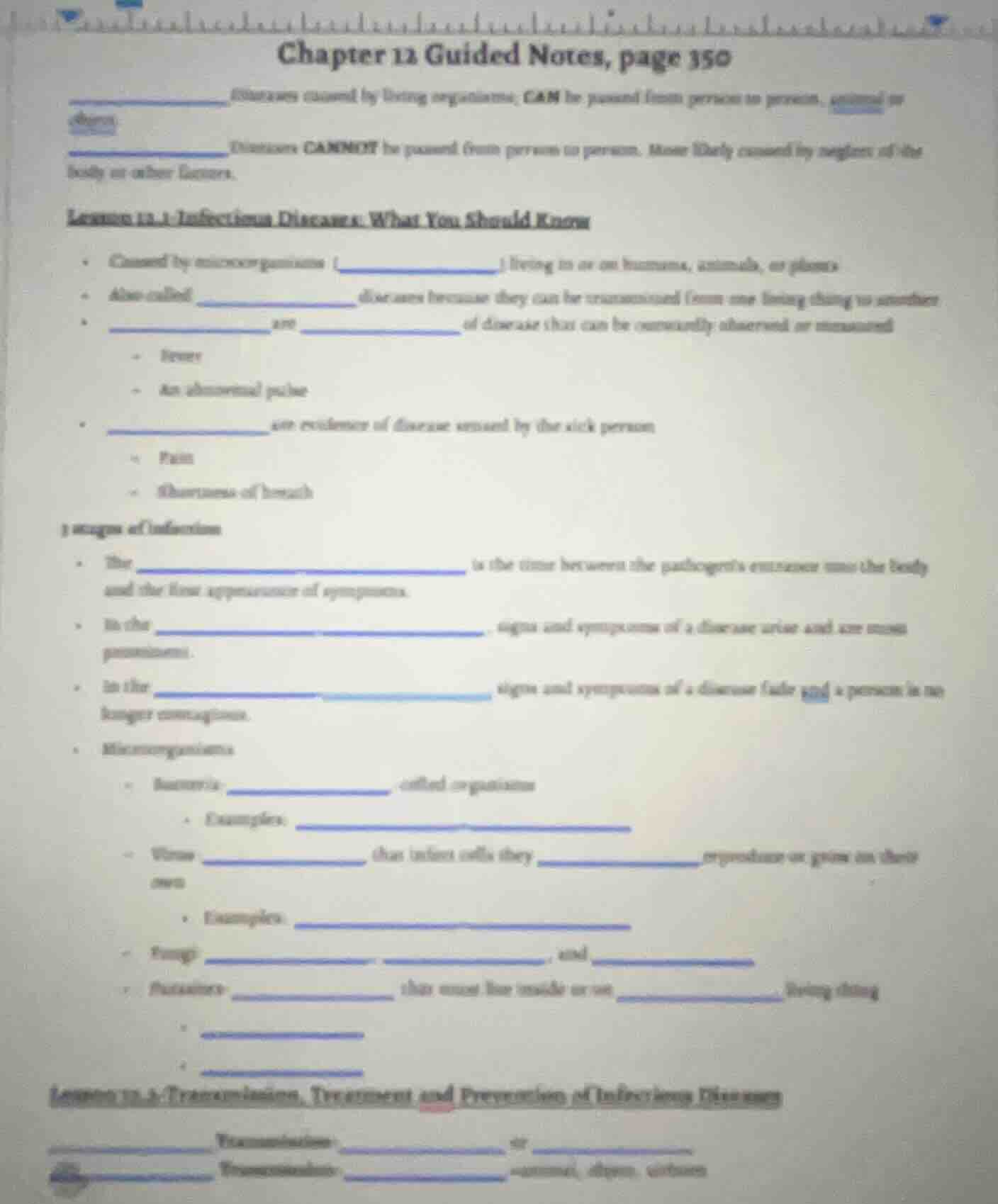
chapter 12 guided notes, page 150
__________: diseases caused by living organisms; can be passed from person to person, animal or object.
__________: diseases cannot be passed from person to person. most likely caused by neglect of the body or other factors.
lesson 12.1.1 infectious diseases: what you should know
- caused by microorganisms (__________) living in or on humans, animals, or plants
- also called __________ diseases because they can be transmitted (from one living thing to another
- ________ are ________ of disease that can be objectively observed or measured
- fever
- an abnormal pulse
- __________ are evidence of disease sensed by the sick person
- pain
- shortness of breath
3 stages of infection
- the __________ is the time between the pathogen’s entrance into the body and the first appearance of symptoms.
- in the __________, signs and symptoms of a disease arise and are most prominent.
- in the __________, signs and symptoms of a disease fade and a person is no longer contagious.
- microorganisms
- bacteria: __________ called pathogens
- examples: __________
- virus: ________ that infect cells they ________ reproduce or grow on their own
- examples: __________
- fungi: ________, ______, and ________
- parasites: ________ that must live inside or on ________ living thing
- __________
- __________
lesson 12.1.2: transmission, treatment and prevention of infectious diseases
________ transmission: ______ or ________
________ transmission: ________, animal, object, airborne
To solve the fill - in - the - blanks in these guided notes about infectious diseases, we analyze each blank based on the knowledge of infectious diseases (a subfield of Biology under Natural Science):
1. First blank (Caused by microorganisms (____) living in or on humans, animals, or plants)
Microorganisms that cause disease are called pathogens. So the answer here is "pathogens".
2. Second blank (Also called ____ diseases because they can be transmitted (from one living thing to another))
Infectious diseases are also known as communicable diseases as they can be passed from one organism to another. So the answer is "communicable".
3. Third and Fourth blanks (__ are __ of disease that can be objectively observed or measured)
Signs are the indicators (or "manifestations") of a disease that can be seen or measured (like fever, abnormal pulse). So the answers are "Signs" and "indicators" (or "manifestations").
4. Fifth blank (____ are evidence of disease sensed by the sick person)
Symptoms are what a patient feels (like pain, shortness of breath). So the answer is "Symptoms".
5. Sixth blank (The ____ is the time between the pathogen’s entrance into the body and the first appearance of symptoms)
The incubation period is the time from when a pathogen enters the body until symptoms start. So the answer is "incubation period".
6. Seventh blank (In the ____, signs and symptoms of a disease arise and are most prominent)
The prodromal period (or "acute phase" in some contexts, but "prodromal period" is more accurate for the time when symptoms become apparent and severe) is when symptoms are most noticeable. So the answer is "prodromal period" (or "acute phase").
7. Eighth blank (In the ____, signs and symptoms of a disease fade and a person is no longer contagious)
The convalescent period is when a person recovers and symptoms subside. So the answer is "convalescent period".
8. Ninth blank (Bacteria: ____ called pathogens)
Bacteria that cause disease are harmful (or "disease - causing") bacteria. So the answer is "harmful" (or "disease - causing").
9. Tenth blank (Examples: ____)
Examples of pathogenic bacteria include Streptococcus (strep throat), Escherichia coli (some strains cause illness), etc. A common example could be "Streptococcus (or E. coli, Salmonella, etc.)".
10. Eleventh and Twelfth blanks (Virus __ that infect cells they __ reproduce or grow on their own)
Viruses are non - living particles (they are not cells) that infect cells because they cannot reproduce or grow outside a host cell. So the answers are "non - living particles" and "cannot".
11. Thirteenth blank (Examples: ____)
Examples of viruses include the influenza virus (flu), HIV, etc. A common example is "Influenza virus (or HIV, COVID - 19 virus, etc.)".
12. Fourteenth, Fifteenth, and Sixteenth blanks (Fungi __, , and __)
Fungi can be yeasts, molds, and mushrooms (some pathogenic fungi are yeasts or molds). So the answers are "yeasts", "molds", and "mushrooms" (pathogenic fungi examples could be Candida (yeast), Aspergillus (mold)).
13. Seventeenth and Eighteenth blanks (Parasites __ that must live inside or on __ living thing)
Parasites are organisms that live on or in a host (another living thing) to survive. So the answers are "organisms" and "a".
14. Nineteenth and Twentieth blanks (Examples: ____)
Examples of parasites include tapeworms, lice, etc. So the answers could be "Tapeworms" and "Lice" (or other par…

Snap & solve any problem in the app
Get step-by-step solutions on Sovi AI
Photo-based solutions with guided steps
Explore more problems and detailed explanations
To solve the fill - in - the - blanks in these guided notes about infectious diseases, we analyze each blank based on the knowledge of infectious diseases (a subfield of Biology under Natural Science):
1. First blank (Caused by microorganisms (____) living in or on humans, animals, or plants)
Microorganisms that cause disease are called pathogens. So the answer here is "pathogens".
2. Second blank (Also called ____ diseases because they can be transmitted (from one living thing to another))
Infectious diseases are also known as communicable diseases as they can be passed from one organism to another. So the answer is "communicable".
3. Third and Fourth blanks (__ are __ of disease that can be objectively observed or measured)
Signs are the indicators (or "manifestations") of a disease that can be seen or measured (like fever, abnormal pulse). So the answers are "Signs" and "indicators" (or "manifestations").
4. Fifth blank (____ are evidence of disease sensed by the sick person)
Symptoms are what a patient feels (like pain, shortness of breath). So the answer is "Symptoms".
5. Sixth blank (The ____ is the time between the pathogen’s entrance into the body and the first appearance of symptoms)
The incubation period is the time from when a pathogen enters the body until symptoms start. So the answer is "incubation period".
6. Seventh blank (In the ____, signs and symptoms of a disease arise and are most prominent)
The prodromal period (or "acute phase" in some contexts, but "prodromal period" is more accurate for the time when symptoms become apparent and severe) is when symptoms are most noticeable. So the answer is "prodromal period" (or "acute phase").
7. Eighth blank (In the ____, signs and symptoms of a disease fade and a person is no longer contagious)
The convalescent period is when a person recovers and symptoms subside. So the answer is "convalescent period".
8. Ninth blank (Bacteria: ____ called pathogens)
Bacteria that cause disease are harmful (or "disease - causing") bacteria. So the answer is "harmful" (or "disease - causing").
9. Tenth blank (Examples: ____)
Examples of pathogenic bacteria include Streptococcus (strep throat), Escherichia coli (some strains cause illness), etc. A common example could be "Streptococcus (or E. coli, Salmonella, etc.)".
10. Eleventh and Twelfth blanks (Virus __ that infect cells they __ reproduce or grow on their own)
Viruses are non - living particles (they are not cells) that infect cells because they cannot reproduce or grow outside a host cell. So the answers are "non - living particles" and "cannot".
11. Thirteenth blank (Examples: ____)
Examples of viruses include the influenza virus (flu), HIV, etc. A common example is "Influenza virus (or HIV, COVID - 19 virus, etc.)".
12. Fourteenth, Fifteenth, and Sixteenth blanks (Fungi __, , and __)
Fungi can be yeasts, molds, and mushrooms (some pathogenic fungi are yeasts or molds). So the answers are "yeasts", "molds", and "mushrooms" (pathogenic fungi examples could be Candida (yeast), Aspergillus (mold)).
13. Seventeenth and Eighteenth blanks (Parasites __ that must live inside or on __ living thing)
Parasites are organisms that live on or in a host (another living thing) to survive. So the answers are "organisms" and "a".
14. Nineteenth and Twentieth blanks (Examples: ____)
Examples of parasites include tapeworms, lice, etc. So the answers could be "Tapeworms" and "Lice" (or other parasites like malaria - causing Plasmodium which is a protozoan parasite).
Final Answers (in order of blanks):
- pathogens
- communicable
- Signs; indicators (or manifestations)
- Symptoms
- incubation period
- prodromal period (or acute phase)
- convalescent period
- harmful (or disease - causing)
- Streptococcus (or E. coli, Salmonella, etc.)
- non - living particles; cannot
- Influenza virus (or HIV, COVID - 19 virus, etc.)
- yeasts; molds; mushrooms
- organisms; a
- Tapeworms; Lice (or other appropriate parasites)