QUESTION IMAGE
Question
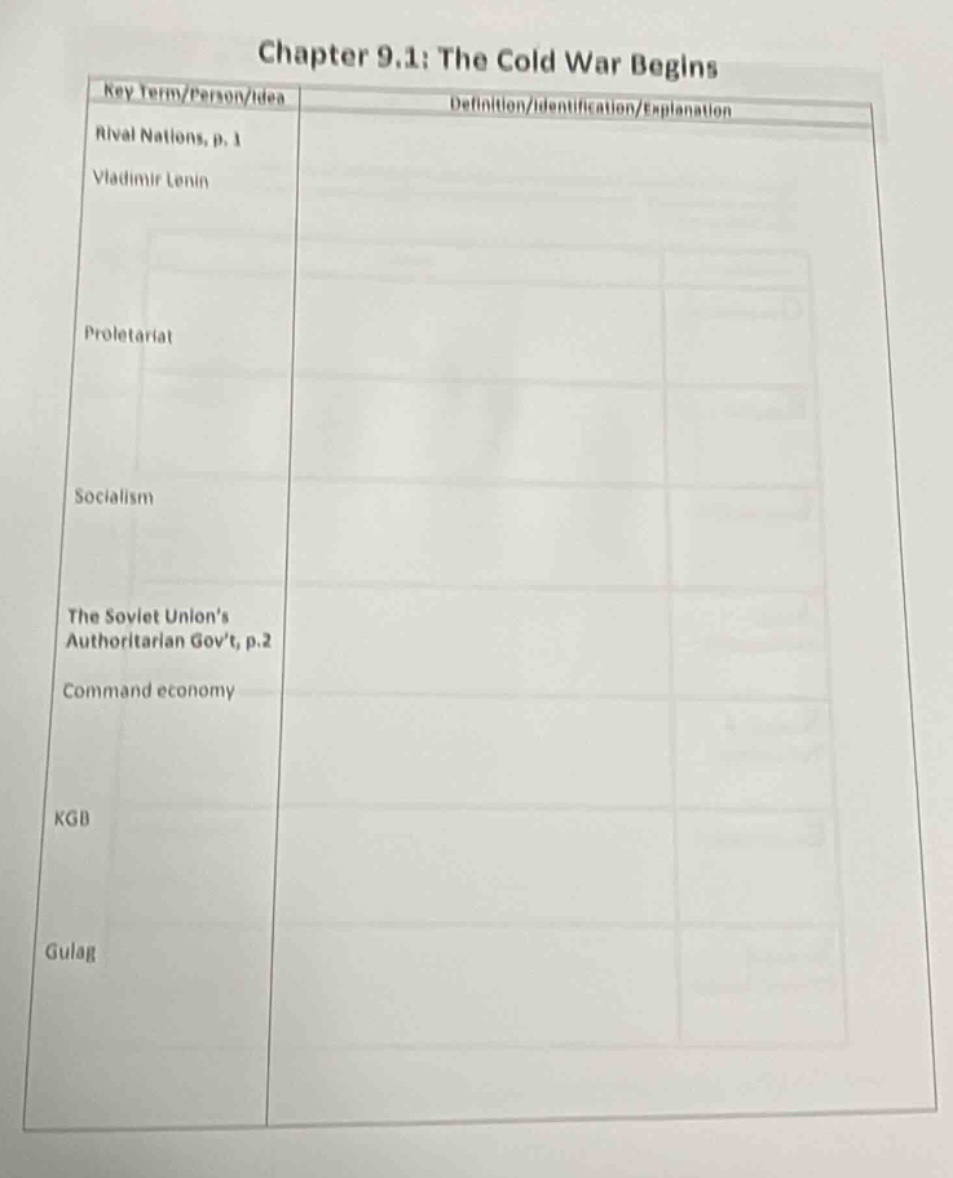
chapter 9.1: the cold war begins
key term/person/idea | definition/identification/explanation
rival nations, p. 1
vladimir lenin
proletariat
socialism
the soviet unions authoritarian govt, p.2
command economy
kgb
gulag
Brief Explanations
Each term is defined based on its core historical context related to pre-Cold War and early Soviet/Cold War history:
- Rival Nations (Cold War context): Refers to the U.S.-led capitalist bloc and Soviet-led communist bloc, the two opposing power blocs that emerged after WWII and drove Cold War tensions.
- Vladimir Lenin: The foundational leader of the Bolshevik Revolution (1917), who established the world's first communist state (the Soviet Union) and developed Marxist-Leninist ideology.
- Proletariat: In Marxist theory, the working class who do not own the means of production, seen as the revolutionary force to overthrow capitalism.
- Socialism: An economic/political system where the means of production are owned collectively (by the state or community), focused on reducing class inequality and prioritizing collective welfare over private profit.
- Command economy: A central economic system where the state controls all production, resource allocation, and pricing, used by the Soviet Union to industrialize rapidly.
- KGB: The Soviet Union's primary security and intelligence agency, responsible for internal surveillance, counterintelligence, and overseas espionage, a key tool of Soviet authoritarian control.
- Gulag: A system of forced labor camps in the Soviet Union, used to imprison political dissidents, criminals, and other marginalized groups, characterized by harsh conditions and mass incarceration.

Snap & solve any problem in the app
Get step-by-step solutions on Sovi AI
Photo-based solutions with guided steps
Explore more problems and detailed explanations
| Key Term/Person/Idea | Definition/Identification/Explanation |
|---|---|
| Vladimir Lenin | Leader of the 1917 Bolshevik Revolution; founded the Soviet Union and developed Marxist-Leninist ideology. |
| Proletariat | In Marxist theory, the working class without ownership of production means, the revolutionary force against capitalism. |
| Socialism | System with collective ownership of production, focused on reducing inequality and collective welfare. |
| Command economy | Soviet economic system where the state controls all production, resource allocation, and pricing. |
| KGB | Soviet security/intelligence agency; handled surveillance, counterintelligence, and overseas espionage. |
| Gulag | Soviet system of forced labor camps for political dissidents, criminals, and marginalized groups, marked by harsh conditions. |