QUESTION IMAGE
Question
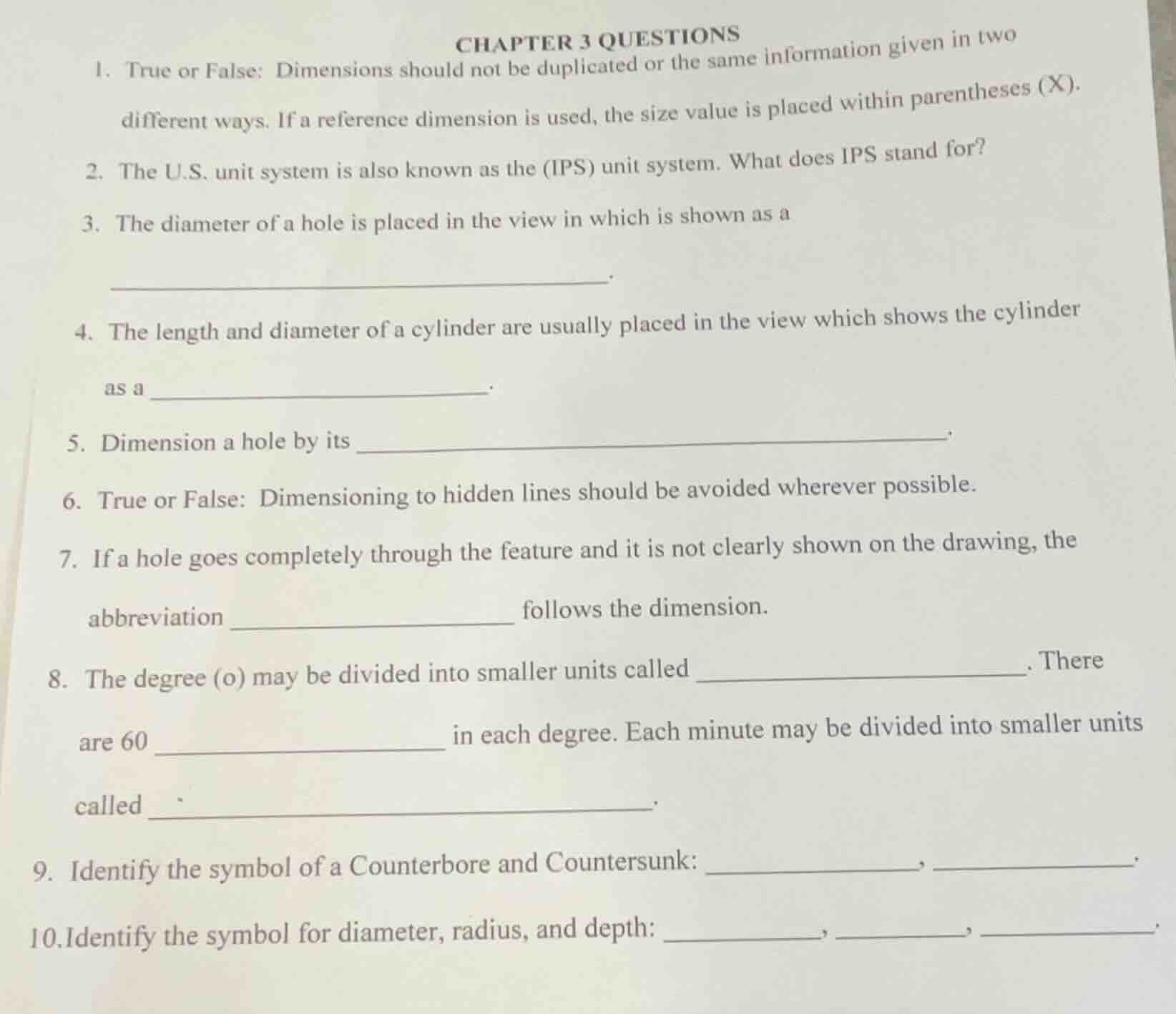
chapter 3 questions
- true or false: dimensions should not be duplicated or the same information given in two different ways. if a reference dimension is used, the size value is placed within parentheses (x).
- the u.s. unit system is also known as the (ips) unit system. what does ips stand for?
- the diameter of a hole is placed in the view in which is shown as a ____________.
- the length and diameter of a cylinder are usually placed in the view which shows the cylinder as a ____________.
- dimension a hole by its ____________.
- true or false: dimensioning to hidden lines should be avoided wherever possible.
- if a hole goes completely through the feature and it is not clearly shown on the drawing, the abbreviation ____________ follows the dimension.
- the degree (o) may be divided into smaller units called __________. there are 60 ________ in each degree. each minute may be divided into smaller units called __________.
- identify the symbol of a counterbore and countersunk: __________, __________.
10.identify the symbol for diameter, radius, and depth: __________, ________, __________.
Brief Explanations
- This is a standard rule in technical dimensioning to avoid confusion; reference dimensions are marked with parentheses.
- IPS is the standard acronym for the U.S. customary unit system for engineering.
- Hole diameters are dimensioned in their circular (true shape) view for clarity.
- Cylinders are dimensioned in their rectangular (length + diameter) view for readability.
- Holes are defined by their diameter as the key circular measurement.
- Dimensioning to hidden lines creates ambiguity, so it is avoided.
- "THRU" is the standard abbreviation for a through hole when not visually clear.
- Degrees use a base-60 subdivision system for angular measurements.
- These are the standard GD&T symbols for counterbore and countersunk features.
- These are the universally accepted symbols for diameter, radius, and depth in technical drawing.

Snap & solve any problem in the app
Get step-by-step solutions on Sovi AI
Photo-based solutions with guided steps
Explore more problems and detailed explanations
- True
- Inch-Pound-Second
- circle (true circular shape)
- rectangle (rectangular outline)
- diameter
- True
- THRU
- minutes; minutes; seconds
- ⌴, ∇
- ∅, R, ↧