QUESTION IMAGE
Question
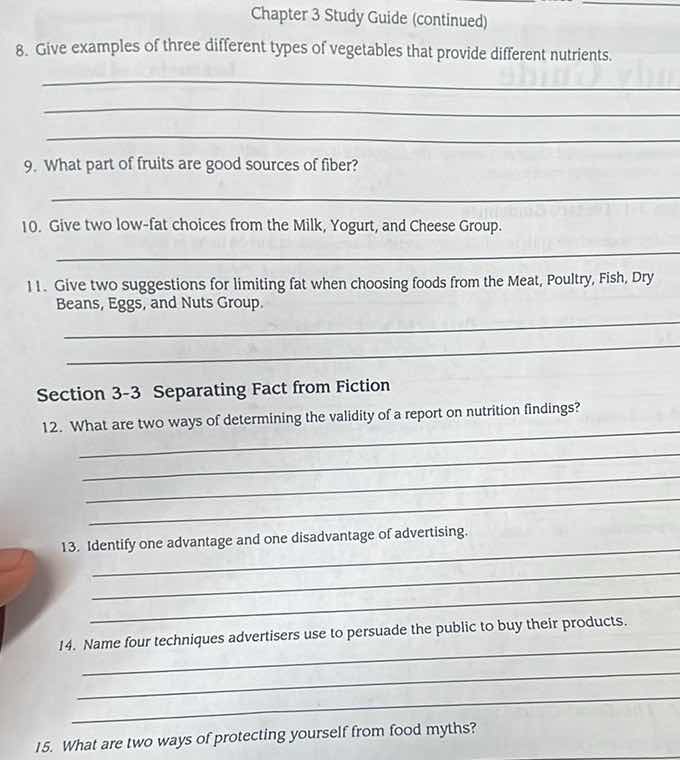
chapter 3 study guide (continued)
- give examples of three different types of vegetables that provide different nutrients.
- what part of fruits are good sources of fiber?
- give two low - fat choices from the milk, yogurt, and cheese group.
- give two suggestions for limiting fat when choosing foods from the meat, poultry, fish, dry beans, eggs, and nuts group.
section 3 - 3 separating fact from fiction
- what are two ways of determining the validity of a report on nutrition findings?
- identify one advantage and one disadvantage of advertising.
- name four techniques advertisers use to persuade the public to buy their products.
- what are two ways of protecting yourself from food myths?
Question 8
To answer this, we consider different vegetables and their key nutrients. Spinach is rich in iron and vitamins (like vitamin A, C, K), carrots are high in beta - carotene (which converts to vitamin A), and broccoli is a good source of vitamin C, vitamin K, and folate.
Fruits' fiber content is mainly in their skins (for fruits with edible skins like apples) and also in the pulp, especially the fibrous parts. The skin (peel) of many fruits and the pulp (especially the non - juicy, fibrous parts) are good sources. For example, the skin of an apple and the pulp of a pear. But generally, the skin (and the pulp in some cases) of fruits are good sources of fiber. The most common part is the skin (for fruits with edible skins) and the pulp (especially in fruits like pears, apples). The primary part is the skin (for fruits like apples, pears) and the pulp. But the main part is the skin (for many fruits) and the pulp. The correct answer is that the skin (peel) and the pulp (especially the fibrous parts) of fruits are good sources of fiber. For many fruits, the skin (edible peel) and the pulp (the fleshy part, especially the more fibrous parts) are good sources. The main part is the skin (for fruits with edible skins) and the pulp. But the typical answer is that the skin (peel) of fruits (like apples, pears) and the pulp (especially in fruits with more fibrous pulp) are good sources. The key part is the skin (and the pulp in some fruits). The answer is that the skin (peel) and the pulp (especially the fibrous parts) of fruits are good sources of fiber. More precisely, the skin (edible peel) of fruits (e.g., apples, pears) and the pulp (the fleshy part, including the fibrous components) are good sources. The main part is the skin (for fruits with edible skins) and the pulp. But the standard answer is that the skin (peel) of fruits (such as apples, pears) and the pulp (especially in fruits like pears) are good sources of fiber. The correct answer is that the skin (peel) and the pulp (the fleshy part, including the fibrous parts) of fruits are good sources of fiber. For example, the skin of an apple and the pulp of a pear. So the answer is the skin (peel) and the pulp (especially the fibrous parts) of fruits are good sources of fiber. But the most common answer is that the skin (peel) of fruits (like apples, pears) and the pulp (the fleshy part) are good sources. The answer is that the skin (peel) and the pulp (the fleshy part, including the fibrous components) of fruits are good sources of fiber. The primary part is the skin (for fruits with edible skins) and the pulp. But the typical answer is that the skin (peel) of fruits (e.g., apples, pears) and the pulp (especially the fibrous parts) are good sources of fiber. The answer is that the skin (peel) and the pulp (the fleshy part, including the fibrous parts) of fruits are good sources of fiber.
In the Milk, Yogurt, and Cheese Group, low - fat options are those with reduced fat content. Skim milk (fat - free or very low fat) and low - fat yogurt (like 1% or 2% fat yogurt) are two low - fat choices. Also, low - fat cheese (like low - fat cottage cheese or low - fat mozzarella) is a choice. So two low - fat choices are skim milk and low - fat yogurt (or low - fat cottage cheese).

Snap & solve any problem in the app
Get step-by-step solutions on Sovi AI
Photo-based solutions with guided steps
Explore more problems and detailed explanations
- Spinach (provides iron, vitamins A, C, K)
- Carrots (provide beta - carotene/vitamin A)
- Broccoli (provides vitamin C, vitamin K, folate)