QUESTION IMAGE
Question
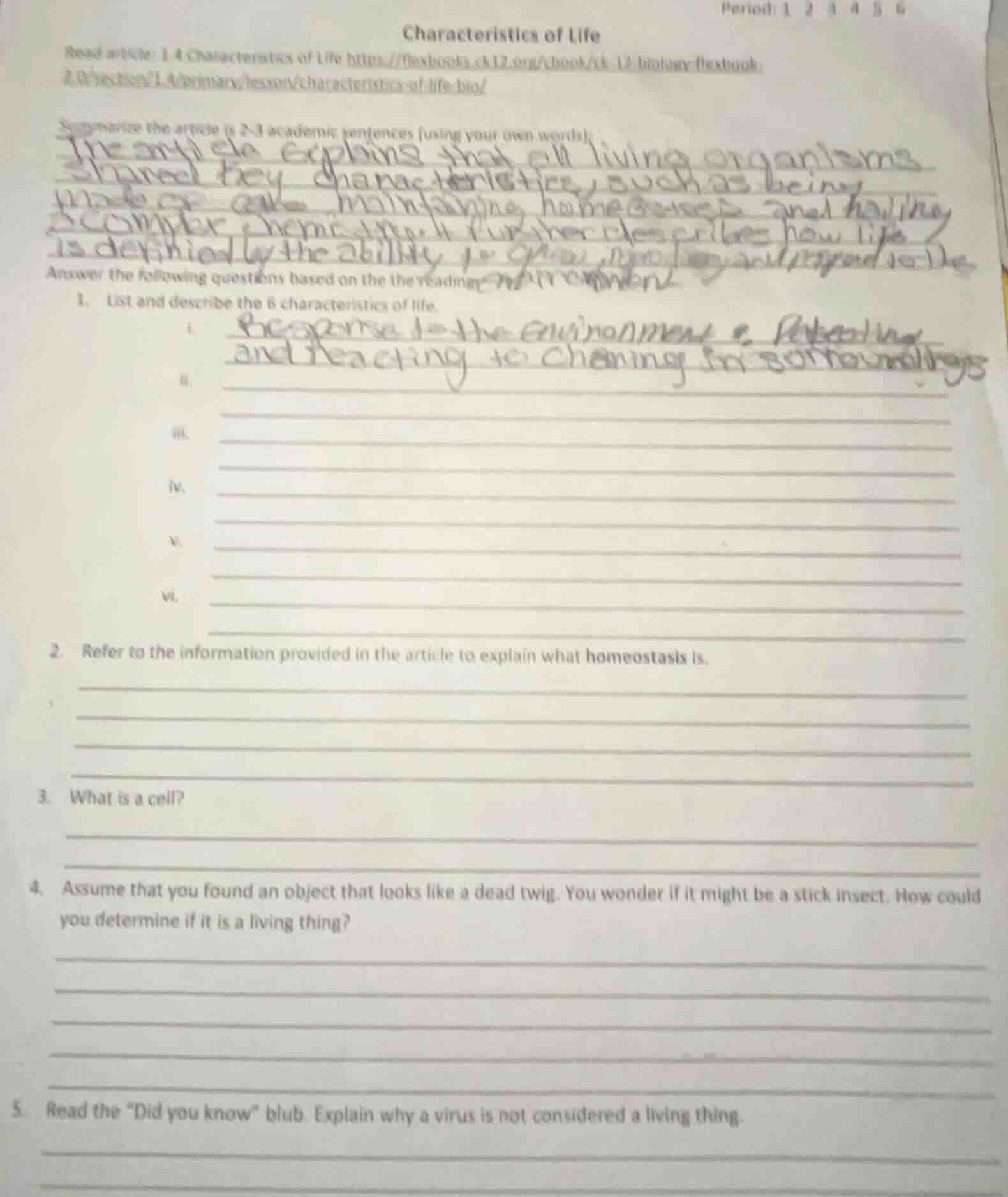
characteristics of life
read article: 1.4 characteristics of life https://flexbooks.ck12.org/book/ck-12-biology-flexbook/2.0/section/1.4/primary/lesson/characteristics-of-life-bio/
summarize the article in 2-3 academic sentences (using your own words).
answer the following questions based on the the reading material.
- list and describe the 6 characteristics of life.
i.
ii.
iii.
iv.
v.
vi.
- refer to the information provided in the article to explain what homeostasis is.
- what is a cell?
- assume that you found an object that looks like a dead twig. you wonder if it might be a stick insect. how could you determine if it is a living thing?
- read the “did you know” blub. explain why a virus is not considered a living thing.
Question 1: List and describe the 6 characteristics of life (assuming the standard 6 characteristics from biology)
- Made of Cells: All living things are composed of one or more cells. Unicellular organisms have a single cell, while multicellular organisms have many cells with specialized functions.
- Reproduction: Living organisms can produce offspring. Sexual reproduction involves two parents, while asexual reproduction (like binary fission in bacteria) involves one parent.
- Growth and Development: Organisms grow (increase in size/number of cells) and develop (change in form/function over time, e.g., a tadpole becoming a frog).
- Obtain and Use Energy: They take in energy (e.g., plants via photosynthesis, animals via eating) and use it for metabolic processes like respiration to sustain life.
- Respond to Stimuli: Living things react to changes in their environment (stimuli), such as a plant bending toward light (phototropism) or an animal fleeing from danger.
- Maintain Homeostasis: They regulate internal conditions (like body temperature in humans, water balance in plants) to stay stable despite external changes.
Homeostasis is the process by which living organisms maintain stable internal conditions (like temperature, water balance, or pH) even when external conditions change. For example, humans sweat to cool down and shiver to warm up, keeping body temperature near 37°C. Organisms use feedback mechanisms to detect and correct deviations from optimal internal states, ensuring survival and proper function.
A cell is the basic structural and functional unit of all living organisms. It is the smallest entity that can perform all life processes (like metabolism, growth, response to stimuli). Cells can be prokaryotic (simple, no nucleus, e.g., bacteria) or eukaryotic (complex, with a nucleus and organelles, e.g., plant/animal cells). They are enclosed by a membrane and contain genetic material (DNA/RNA) to direct their activities.

Snap & solve any problem in the app
Get step-by-step solutions on Sovi AI
Photo-based solutions with guided steps
Explore more problems and detailed explanations
i. Made of Cells: All living organisms are composed of one or more cells, the basic unit of life. Unicellular organisms have a single cell, multicellular ones have specialized cells.
ii. Reproduction: Organisms produce offspring; sexual (two parents) or asexual (one parent) to pass on genetic material.
iii. Growth and Development: Organisms increase in size (growth) and undergo structural/functional changes (development) over their life cycle.
iv. Obtain and Use Energy: They acquire energy (e.g., photosynthesis, eating) and use it for metabolism (e.g., respiration) to power life processes.
v. Respond to Stimuli: Living things react to environmental changes (e.g., light, temperature, chemicals), like plants growing toward light.
vi. Maintain Homeostasis: They regulate internal conditions (e.g., body temperature, pH) to stay stable despite external fluctuations.