QUESTION IMAGE
Question
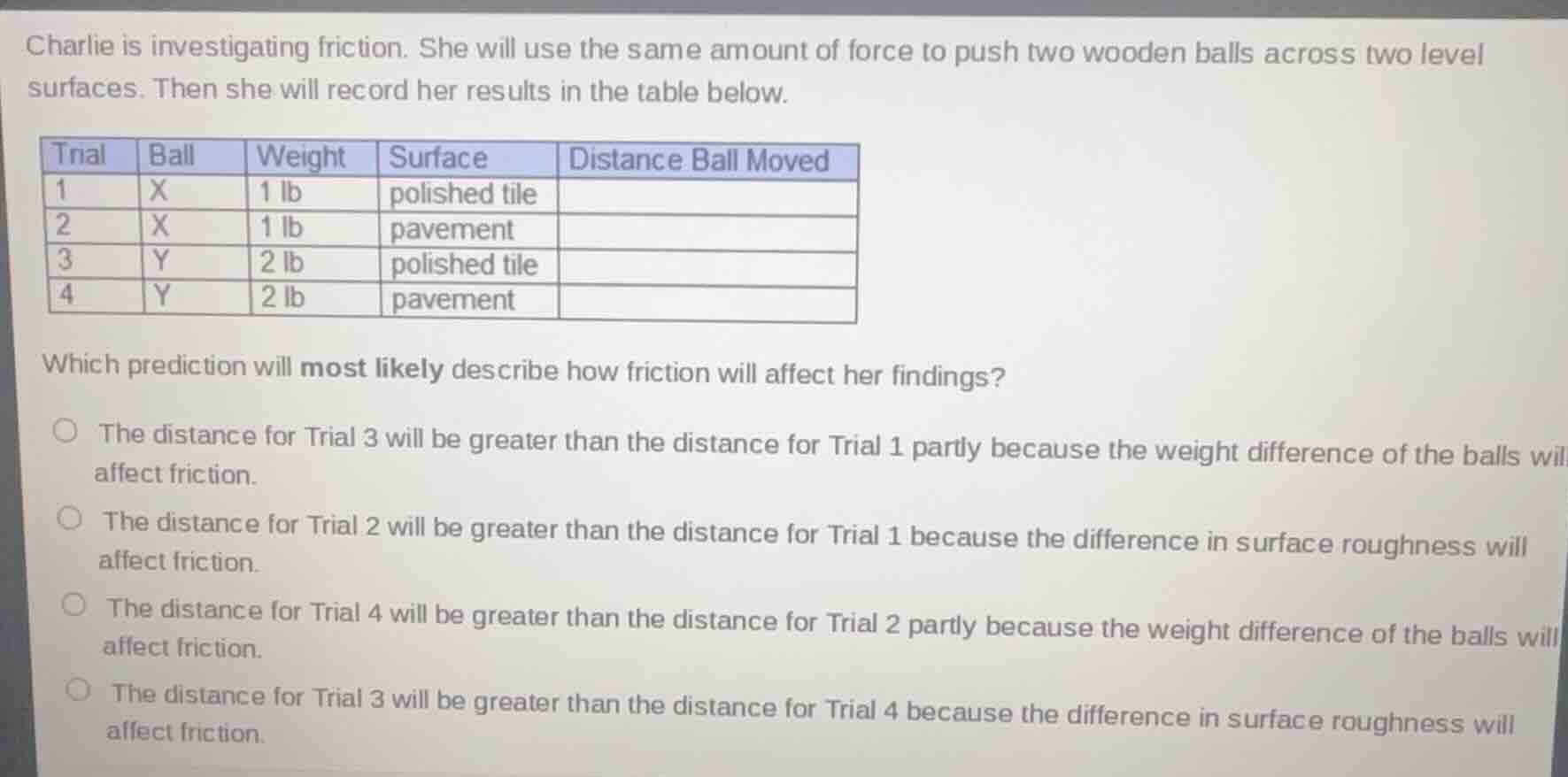
charlie is investigating friction. she will use the same amount of force to push two wooden balls across two level surfaces. then she will record her results in the table below.
| trial | ball | weight | surface | distance ball moved |
|---|---|---|---|---|
| 2 | x | 1 lb | pavement | |
| 3 | y | 2 lb | polished tile | |
| 4 | y | 2 lb | pavement |
which prediction will most likely describe how friction will affect her findings?
- the distance for trial 3 will be greater than the distance for trial 1 partly because the weight difference of the balls will affect friction.
- the distance for trial 2 will be greater than the distance for trial 1 because the difference in surface roughness will affect friction.
- the distance for trial 4 will be greater than the distance for trial 2 partly because the weight difference of the balls will affect friction.
- the distance for trial 3 will be greater than the distance for trial 4 because the difference in surface roughness will affect friction.
Brief Explanations
Friction increases with greater surface roughness and higher weight (normal force). More friction reduces the distance an object moves with the same applied force:
- For Trials 1 & 3: Same surface, Trial 3 has a heavier ball (more friction), so its distance will be less than Trial 1.
- For Trials 1 & 2: Same weight, pavement is rougher (more friction) than polished tile, so Trial 2's distance will be less than Trial 1.
- For Trials 2 & 4: Same surface, Trial 4 has a heavier ball (more friction), so its distance will be less than Trial 2.
- For Trials 3 & 4: Same weight, polished tile is smoother (less friction) than pavement, so Trial 3's distance will be greater than Trial 4, which matches the final option.

Snap & solve any problem in the app
Get step-by-step solutions on Sovi AI
Photo-based solutions with guided steps
Explore more problems and detailed explanations
The distance for Trial 3 will be greater than the distance for Trial 4 because the difference in surface roughness will affect friction.