QUESTION IMAGE
Question
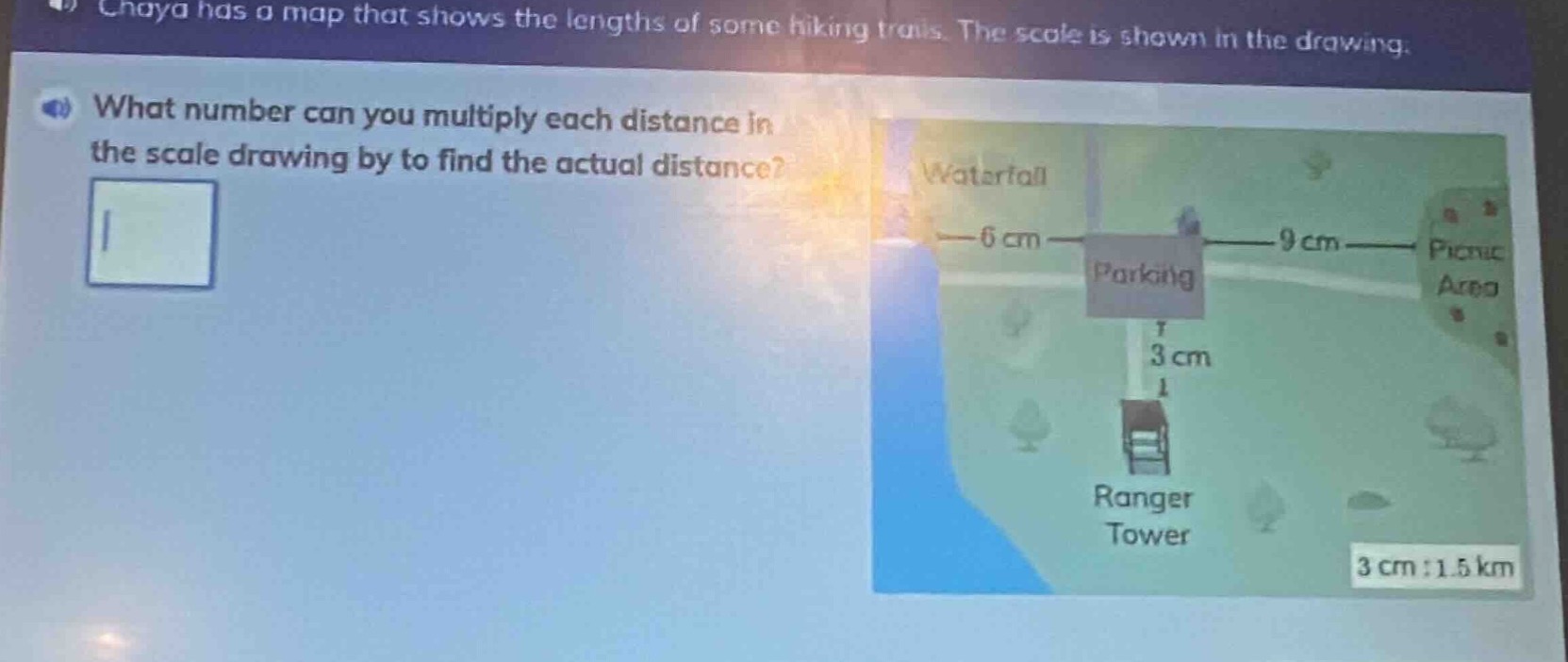
chaya has a map that shows the lengths of some hiking trails. the scale is shown in the drawing. what number can you multiply each distance in the scale drawing by to find the actual distance? there is a scale drawing with a scale of 3 cm : 1.5 km, and some distances on the map: from waterfall to parking is 6 cm, parking to picnic area is 9 cm, parking to ranger tower is 3 cm.
Step1: Analyze the scale
The scale given is \(3\) cm : \(1.5\) km. We need to find the number (let's call it \(k\)) such that when we multiply the distance on the drawing (in cm) by \(k\), we get the actual distance (in km). So we can set up the equation \(3\times k = 1.5\).
Step2: Solve for \(k\)
To find \(k\), we divide both sides of the equation \(3k = 1.5\) by \(3\). So \(k=\frac{1.5}{3}= 0.5\) km per cm. Wait, no, actually, the scale is \(3\) cm represents \(1.5\) km, so to find the multiplier, we can calculate \(\frac{1.5\space km}{3\space cm}= 0.5\space km/cm\). But actually, if we consider the scale factor, for each cm on the drawing, the actual distance is \(0.5\) km? Wait, no, wait \(3\) cm is \(1.5\) km, so \(1\) cm is \(1.5\div3 = 0.5\) km? Wait, no, that can't be. Wait, maybe I made a mistake. Wait, \(3\) cm corresponds to \(1.5\) km, so to find the multiplier, we can find how much \(1\) cm corresponds to. So \(1.5\) km divided by \(3\) cm is \(0.5\) km per cm. But actually, the question is "what number can you multiply each distance in the scale drawing by to find the actual distance". So if the distance on the drawing is \(d\) (in cm), then actual distance \(D\) (in km) is \(D = d\times k\), where \(k\) is the multiplier. From the scale \(3\) cm \(= 1.5\) km, so \(k=\frac{1.5\space km}{3\space cm}= 0.5\space km/cm\). Wait, but let's check with the given scale. Wait, maybe the scale is \(3\) cm to \(1.5\) km, so the multiplier is \(1.5\div3 = 0.5\) km per cm? Wait, no, that would mean \(1\) cm is \(0.5\) km, \(2\) cm is \(1\) km, \(3\) cm is \(1.5\) km. Yes, that works. So the multiplier is \(0.5\) km per cm? Wait, but maybe the units are different. Wait, the question is about the number, so maybe the scale is in km and cm, but the multiplier is a number (with units, but the question says "what number", so probably the value. Wait, let's re - express. The scale is \(3\) cm : \(1.5\) km. So to find the multiplier, we can calculate \(\frac{1.5\space km}{3\space cm}=0.5\space km/cm\). But if we consider the scale factor, the multiplier is \(0.5\) (in km per cm). Wait, but maybe the question is expecting the multiplier as a number where the units are consistent. Wait, maybe the scale is \(3\) cm represents \(1.5\) km, so the conversion factor is \(1.5\div3 = 0.5\) km per cm. So when you multiply the distance in cm (on the drawing) by \(0.5\) (km/cm), you get the actual distance in km. Alternatively, maybe the scale is \(1\) cm : \(0.5\) km, so the multiplier is \(0.5\) (with units km per cm). But the question says "what number", so the numerical value is \(0.5\) (if we consider km per cm) or maybe \(500\) (if we convert to meters, since \(0.5\) km is \(500\) meters). Wait, no, the scale is \(3\) cm : \(1.5\) km. Let's do unit conversion. \(1.5\) km \( = 1500\) meters, \(3\) cm \( = 0.03\) meters. Then the scale factor is \(1500\div0.03 = 50000\). Wait, that's a big difference. Oh! I see my mistake. I confused km and cm. Let's convert everything to the same unit. Let's convert km to cm. \(1\) km \( = 100000\) cm, so \(1.5\) km \( = 1.5\times100000 = 150000\) cm. So the scale is \(3\) cm (drawing) : \(150000\) cm (actual). So the scale factor (multiplier) is \(150000\div3 = 50000\). Ah! That's the correct way. Because when dealing with scale drawings, the scale factor is usually a ratio of actual length to drawing length, and we need to have the same units. So let's redo this.
Step1: Convert actual distance to cm
The actual distance for \(3\) cm on the drawing is \(1.5\) km. Convert \(1.5\) km to cm. Since \(1\) km…

Snap & solve any problem in the app
Get step-by-step solutions on Sovi AI
Photo-based solutions with guided steps
Explore more problems and detailed explanations
\(0.5\) (or \(50000\) if considering cm to cm, but based on the scale \(3\) cm : \(1.5\) km, the multiplier is \(0.5\) km per cm, so the number is \(0.5\))