QUESTION IMAGE
Question
check your understanding
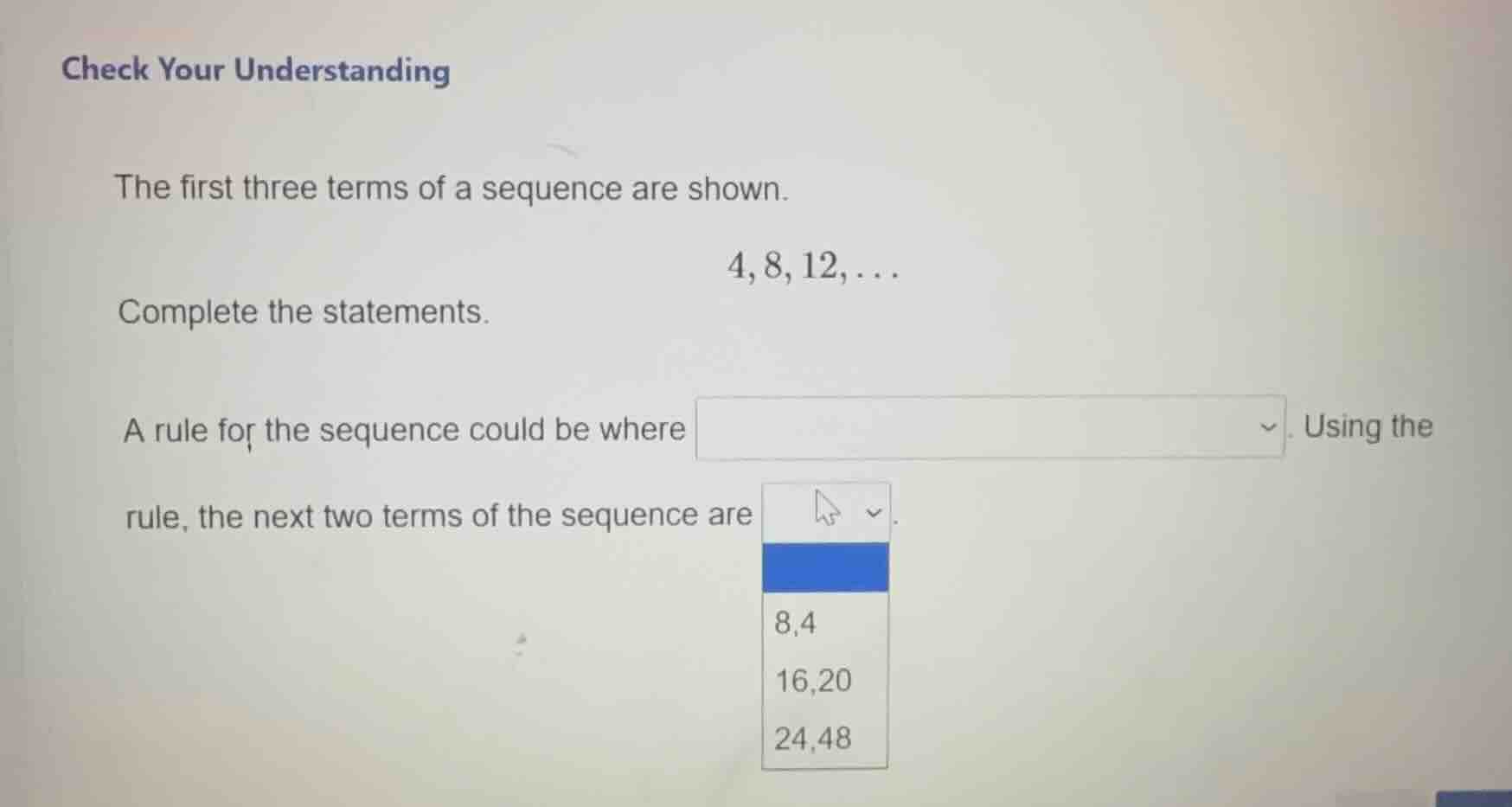
the first three terms of a sequence are shown.
4, 8, 12, …
complete the statements.
a rule for the sequence could be where
using the rule, the next two terms of the sequence are
8,4
16,20
24,48
Step1: Identify the sequence type
The given sequence is \(4, 8, 12, \dots\). Let's check the difference between consecutive terms. \(8 - 4 = 4\) and \(12 - 8 = 4\). So, it is an arithmetic sequence with a common difference \(d = 4\).
Step2: Find the rule for the sequence
The general formula for the \(n\)-th term of an arithmetic sequence is \(a_n = a_1 + (n - 1)d\), where \(a_1\) is the first term and \(d\) is the common difference. Here, \(a_1 = 4\) and \(d = 4\). Substituting these values, we get \(a_n = 4 + (n - 1) \times 4\). Simplifying this, \(a_n = 4 + 4n - 4 = 4n\). So, the rule for the sequence is \(a_n = 4n\) (where \(n\) is the term number, starting from \(n = 1\)).
Step3: Find the next two terms
To find the 4th term, substitute \(n = 4\) into the formula: \(a_4 = 4 \times 4 = 16\). To find the 5th term, substitute \(n = 5\) into the formula: \(a_5 = 4 \times 5 = 20\). So, the next two terms are \(16\) and \(20\).

Snap & solve any problem in the app
Get step-by-step solutions on Sovi AI
Photo-based solutions with guided steps
Explore more problems and detailed explanations
The rule for the sequence could be \(a_n = 4n\) (where \(n\) is the term number). Using the rule, the next two terms of the sequence are \(16, 20\).