QUESTION IMAGE
Question
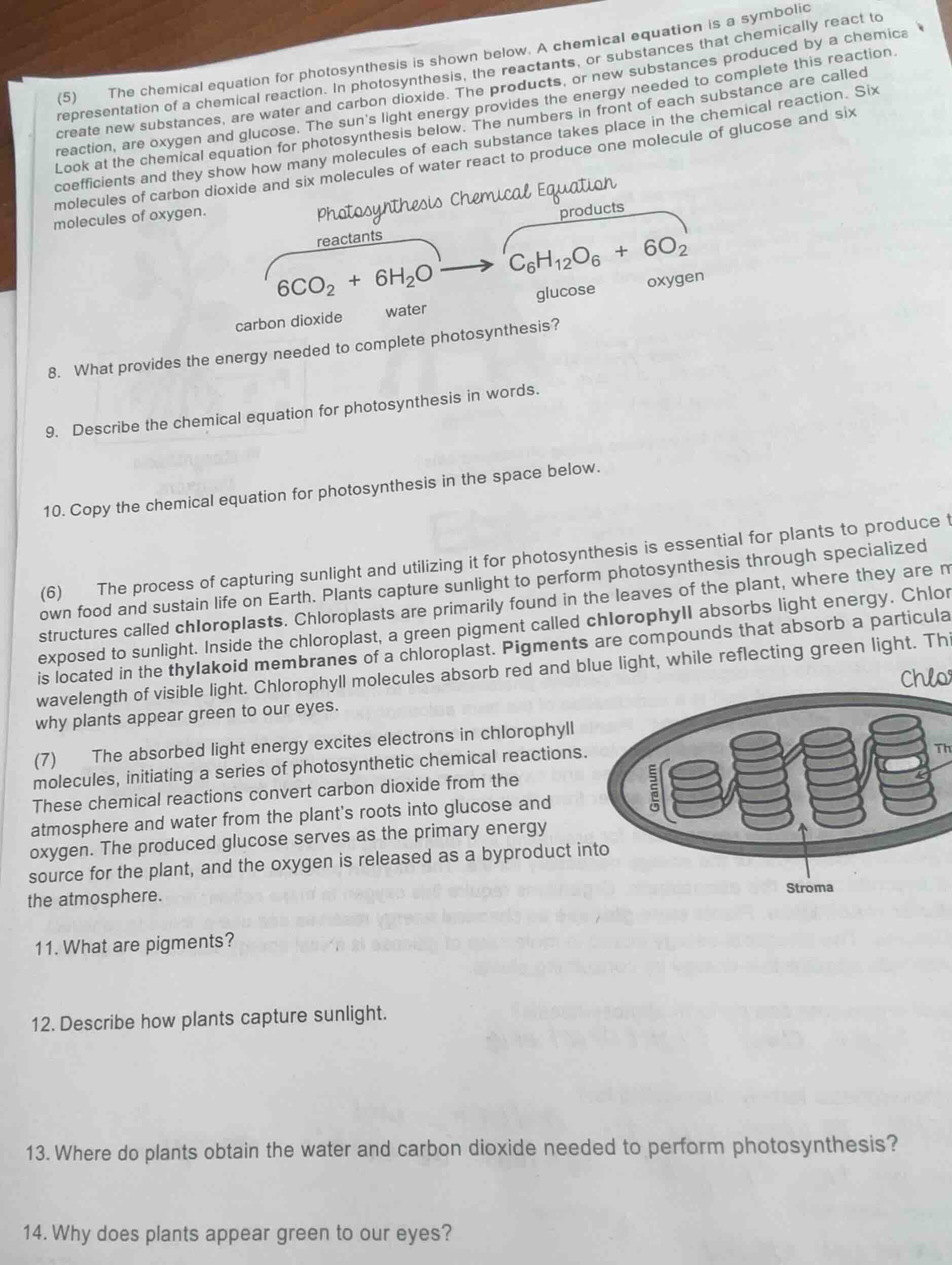
(5) the chemical equation for photosynthesis is shown below. a chemical equation is a symbolic representation of a chemical reaction. in photosynthesis, the reactants, or substances that chemically react to create new substances, are water and carbon dioxide. the products, or new substances produced by a chemical reaction, are oxygen and glucose. the sun’s light energy provides the energy needed to complete this reaction. look at the chemical equation for photosynthesis below. the numbers in front of each substance are called coefficients and they show how many molecules of each substance takes place in the chemical reaction. six molecules of carbon dioxide and six molecules of water react to produce one molecule of glucose and six molecules of oxygen.
- what provides the energy needed to complete photosynthesis?
- describe the chemical equation for photosynthesis in words.
- copy the chemical equation for photosynthesis in the space below.
(6) the process of capturing sunlight and utilizing it for photosynthesis is essential for plants to produce their own food and sustain life on earth. plants capture sunlight to perform photosynthesis through specialized structures called chloroplasts. chloroplasts are primarily found in the leaves of the plant, where they are exposed to sunlight. inside the chloroplast, a green pigment called chlorophyll absorbs light energy. chlorophyll is located in the thylakoid membranes of a chloroplast. pigments are compounds that absorb a particular wavelength of visible light. chlorophyll molecules absorb red and blue light, while reflecting green light. this is why plants appear green to our eyes.
(7) the absorbed light energy excites electrons in chlorophyll molecules, initiating a series of photosynthetic chemical reactions. these chemical reactions convert carbon dioxide from the atmosphere and water from the plant’s roots into glucose and oxygen. the produced glucose serves as the primary energy source for the plant, and the oxygen is released as a byproduct into the atmosphere.
- what are pigments?
- describe how plants capture sunlight.
- where do plants obtain the water and carbon dioxide needed to perform photosynthesis?
- why do plants appear green to our eyes?
For Q8:
The provided text explicitly states the energy source for photosynthesis.
For Q9:
Translate the chemical equation's reactants, coefficients, and products into plain language using the given context.
For Q10:
Copy the exact chemical equation provided in the text.
For Q11:
Define pigments using the direct description from the text.
For Q12:
Summarize the structure and process plants use to capture sunlight as outlined.
For Q13:
Identify the sources of water and carbon dioxide from the provided passage.
For Q14:
Explain the color appearance based on chlorophyll's light absorption properties from the text.

Snap & solve any problem in the app
Get step-by-step solutions on Sovi AI
Photo-based solutions with guided steps
Explore more problems and detailed explanations
- The sun's light energy provides the energy needed to complete photosynthesis.
- Six molecules of carbon dioxide react with six molecules of water (using light energy) to produce one molecule of glucose and six molecules of oxygen.
- $6\text{CO}_2 + 6\text{H}_2\text{O}
ightarrow \text{C}_6\text{H}_{12}\text{O}_6 + 6\text{O}_2$
- Pigments are compounds that absorb a particular wavelength of visible light.
- Plants capture sunlight through specialized structures called chloroplasts (primarily in leaves). Inside chloroplasts, the green pigment chlorophyll, located in thylakoid membranes, absorbs the light energy.
- Plants obtain water from their roots, and carbon dioxide from the atmosphere.
- Chlorophyll molecules absorb red and blue light, while reflecting green light, which is why plants appear green to our eyes.