QUESTION IMAGE
Question
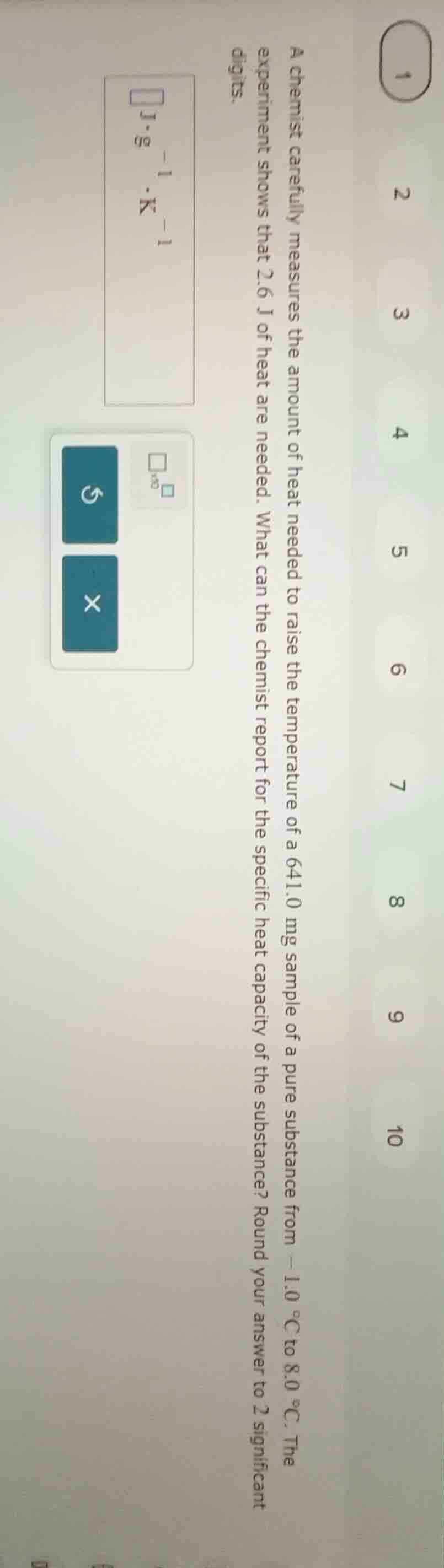
a chemist carefully measures the amount of heat needed to raise the temperature of a 641.0 mg sample of a pure substance from -1.0 °c to 8.0 °c. the experiment shows that 2.6 j of heat are needed. what can the chemist report for the specific heat capacity of the substance? round your answer to 2 significant digits.
□ j·g⁻¹·k⁻¹
Step1: Recall the formula for specific heat capacity
The formula for heat \( q \) is \( q = mc\Delta T \), where \( m \) is mass, \( c \) is specific heat capacity, and \( \Delta T \) is the change in temperature. We need to solve for \( c \), so rearrange the formula: \( c=\frac{q}{m\Delta T} \).
Step2: Determine the values
- \( q = 2.6 \, \text{J} \)
- Mass \( m = 641.0 \, \text{mg} \). Convert to grams: \( m = 641.0 \, \text{mg} \times \frac{1 \, \text{g}}{1000 \, \text{mg}} = 0.6410 \, \text{g} \)
- Initial temperature \( T_i = -1.0^\circ \text{C} \), final temperature \( T_f = 8.0^\circ \text{C} \). Change in temperature \( \Delta T = T_f - T_i = 8.0 - (-1.0) = 9.0 \, \text{K} \) (since a change in Celsius is the same as a change in Kelvin)
Step3: Calculate specific heat capacity
Substitute into the formula: \( c=\frac{2.6 \, \text{J}}{0.6410 \, \text{g} \times 9.0 \, \text{K}} \)
First, calculate the denominator: \( 0.6410 \times 9.0 = 5.769 \)
Then, \( c=\frac{2.6}{5.769} \approx 0.4507 \, \text{J·g}^{-1}·\text{K}^{-1} \)
Round to 2 significant digits: \( c \approx 0.45 \, \text{J·g}^{-1}·\text{K}^{-1} \) (Wait, wait, 2.6 has 2 significant digits, 641.0 has 4, 9.0 has 2. So the result should have 2 significant digits. Wait, 2.6 / (0.6410 9.0) = 2.6 / 5.769 ≈ 0.4507, which rounds to 0.45? Wait, no, 2.6 is two sig figs, 0.6410 is four, 9.0 is two. When multiplying/dividing, the result should have the least number of sig figs, which is two. Wait, 0.6410 is 0.6410 g (four sig figs), 9.0 K (two sig figs). So 0.6410 9.0 = 5.769 (but we take it as 5.8? No, 9.0 has two sig figs, so 0.6410 9.0 = 5.769, but we should consider 9.0 as two sig figs, so 0.6410 9.0 = 5.8 (two sig figs)? Wait, no, the rule is that when multiplying, the number of sig figs is determined by the least precise measurement. 9.0 has two, 0.6410 has four, so the product should have two? Wait, no, 9.0 is two decimal places? No, significant figures: 9.0 has two significant figures (the 9 and the 0). 0.6410 has four (the 6,4,1,0). So when multiplying 0.6410 (four) by 9.0 (two), the result should have two significant figures? Wait, no, the rule is that the number of significant figures in the result is equal to the number of significant figures in the least precise measurement. So 9.0 has two, so 0.6410 9.0 = 5.8 (two sig figs). Then 2.6 (two sig figs) divided by 5.8 (two sig figs) is 0.448, which rounds to 0.45? Wait, no, 2.6 / 5.769 (if we keep more digits during calculation) is approximately 0.4507, which with two sig figs is 0.45? Wait, 0.45 has two sig figs. Wait, but let's check again. Wait, 641.0 mg is 0.6410 g (four sig figs), 9.0 K is two sig figs, 2.6 J is two sig figs. So the formula: q/(mΔT). q is two, m is four, ΔT is two. So the limiting factor is two sig figs. So 2.6 / (0.6410 9.0) = 2.6 / 5.769 ≈ 0.4507, which rounds to 0.45 (two sig figs). Wait, but maybe I made a mistake in sig figs. Wait, 641.0 mg: the trailing zero after the decimal is significant, so 641.0 has four sig figs. 9.0 K: the zero after the decimal is significant, so two sig figs. 2.6 J: two sig figs. So when multiplying m and ΔT: 0.6410 (four) 9.0 (two) = 5.769, but we should consider 9.0 as two sig figs, so 5.8 (two sig figs). Then 2.6 (two) / 5.8 (two) = 0.448, which is 0.45 when rounded to two sig figs. Alternatively, if we keep more digits during calculation: 0.6410 9.0 = 5.769, 2.6 / 5.769 ≈ 0.4507, which is 0.45 when rounded to two significant digits.
Wait, but let's recalculate: 2.6 divided by (0.641 9). 0.641 9 = 5.769. 2.6 / 5.769 ≈ 0.45068. Rounded…

Snap & solve any problem in the app
Get step-by-step solutions on Sovi AI
Photo-based solutions with guided steps
Explore more problems and detailed explanations
\boxed{0.45} (in units of \(\text{J·g}^{-1}·\text{K}^{-1}\))