QUESTION IMAGE
Question
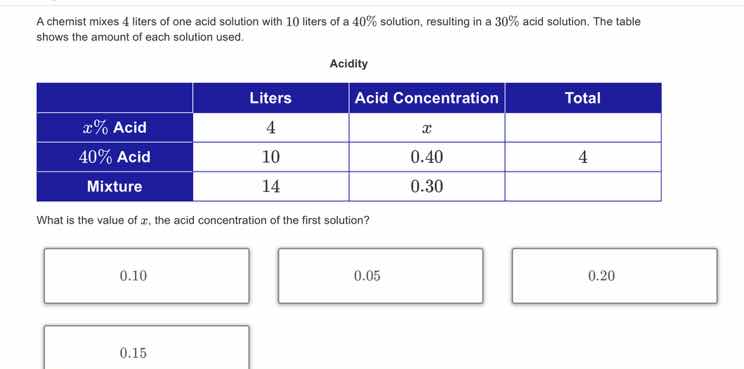
a chemist mixes 4 liters of one acid solution with 10 liters of a 40% solution, resulting in a 30% acid solution. the table shows the amount of each solution used.
| liters | acid concentration | total | |
|---|---|---|---|
| 40% acid | 10 | 0.40 | 4 |
| mixture | 14 | 0.30 |
what is the value of $x$, the acid concentration of the first solution?
options: 0.10, 0.05, 0.20, 0.15
Step1: Set up the equation for acid amount
The amount of acid in the first solution is \(4\times x\) (since it's 4 liters of \(x\%\) acid, which is \(x/100\) in decimal, so \(4\times\frac{x}{100}\)). The amount of acid in the 40% solution is \(10\times0.40\). The total amount of acid in the mixture is \(14\times0.30\). So the equation is \(4\times\frac{x}{100}+ 10\times0.40=14\times0.30\).
Step2: Simplify the equation
First, calculate the known products: \(10\times0.40 = 4\) and \(14\times0.30 = 4.2\). So the equation becomes \(\frac{4x}{100}+4 = 4.2\).
Step3: Solve for x
Subtract 4 from both sides: \(\frac{4x}{100}=4.2 - 4=0.2\). Then multiply both sides by 100: \(4x = 0.2\times100 = 20\). Finally, divide both sides by 4: \(x=\frac{20}{4}=5\)? Wait, no, wait. Wait, the concentration is in decimal? Wait, no, the table has \(x\%\) acid, so when we write the equation, the acid amount from the first solution is \(4\times\frac{x}{100}\) (since \(x\%\) is \(x/100\) in decimal). Wait, let's re - do the equation correctly.
The correct equation for the amount of acid (in liters) is:
Amount of acid in first solution + Amount of acid in 40% solution = Amount of acid in mixture.
Amount of acid in first solution: \(4\times\frac{x}{100}\) (because it's 4 liters of a solution with \(x\%\) acid, so the acid content is \(4\times(x/100)\) liters).
Amount of acid in 40% solution: \(10\times0.40 = 4\) liters.
Amount of acid in mixture: \(14\times0.30=4.2\) liters.
So the equation is:
\(4\times\frac{x}{100}+10\times0.40 = 14\times0.30\)
\(\frac{4x}{100}+4 = 4.2\)
Subtract 4 from both sides:
\(\frac{4x}{100}=4.2 - 4=0.2\)
Multiply both sides by 100:
\(4x=0.2\times100 = 20\)
Divide both sides by 4:
\(x = 5\)? But 5% is 0.05 in decimal. Wait, the options are 0.10, 0.05, 0.20, 0.15. Oh! Wait, maybe the \(x\) in the table is the decimal concentration, not the percentage. Let's re - interpret. If \(x\) is the decimal concentration (not percentage), then the amount of acid in the first solution is \(4x\), the amount in the 40% solution is \(10\times0.4 = 4\), and the amount in the mixture is \(14\times0.3 = 4.2\). Then the equation is \(4x+4 = 4.2\). Then \(4x=0.2\), so \(x = 0.2/4=0.05\). Ah, that's the mistake! I thought \(x\) was a percentage, but looking at the options (0.05, 0.10, etc.), \(x\) is the decimal concentration. So let's re - do the equation with \(x\) as the decimal concentration (not percentage).
So the correct equation:
\(4x+10\times0.40 = 14\times0.30\)
\(4x + 4=4.2\)
Subtract 4 from both sides:
\(4x=4.2 - 4 = 0.2\)
Divide both sides by 4:
\(x=\frac{0.2}{4}=0.05\)

Snap & solve any problem in the app
Get step-by-step solutions on Sovi AI
Photo-based solutions with guided steps
Explore more problems and detailed explanations
0.05