QUESTION IMAGE
Question
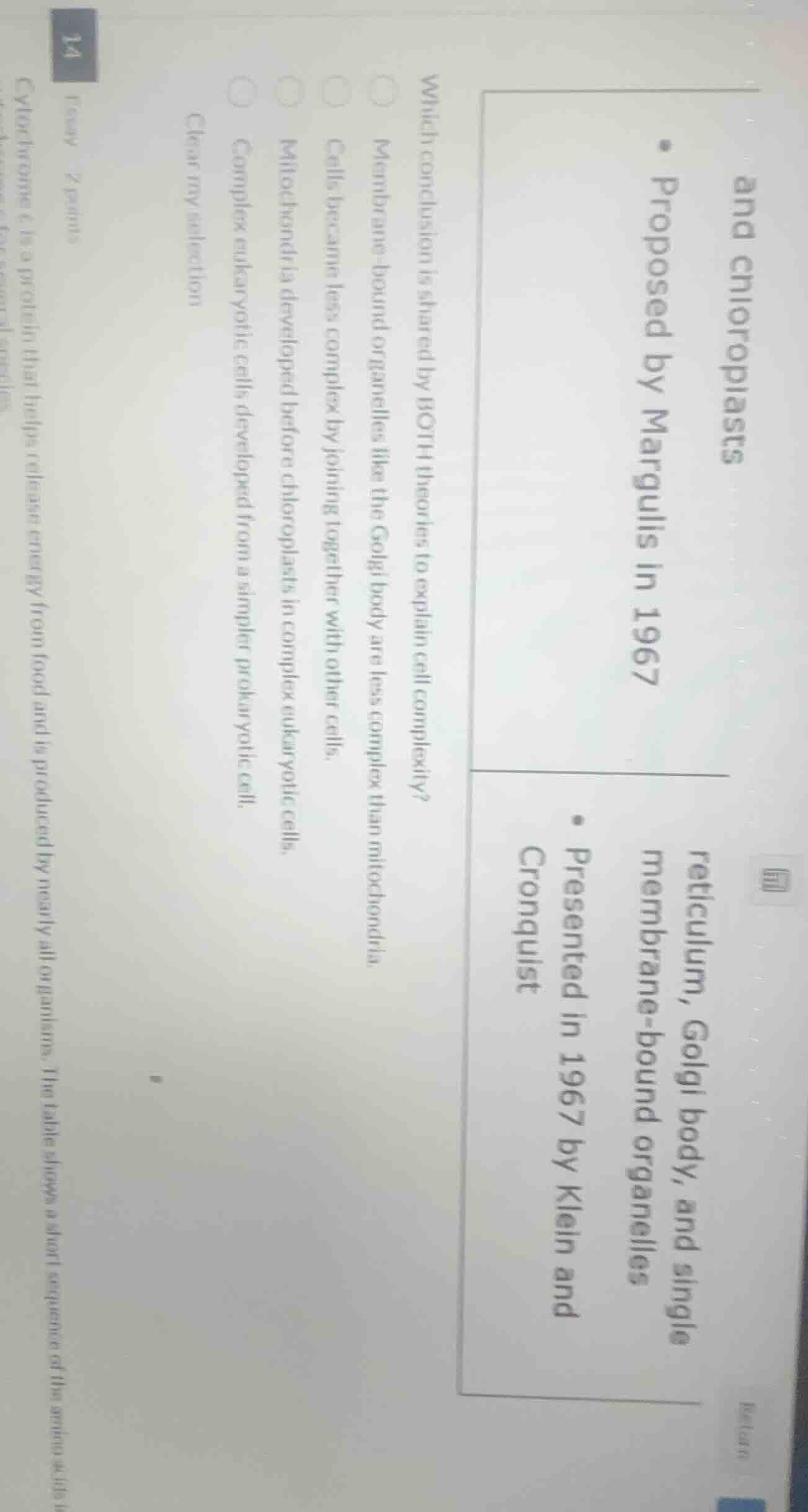
and chloroplasts - proposed by margulis in 1967 - reticulum, golgi body, and single membrane - bound organelles - presented in 1967 by klein and cronquist which conclusion is shared by both theories to explain cell complexity? - membrane - bound organelles like the golgi body are less complex than mitochondria. - cells became less complex by joining together with other cells. - mitochondria developed before chloroplasts in complex eukaryotic cells. - complex eukaryotic cells developed from a simpler prokaryotic cell. clear my selection
To determine the conclusion shared by both theories (likely endosymbiotic theory and the theory about membrane - bound organelles' development), we analyze each option:
- Option 1: Comparing the complexity of Golgi body and mitochondria is not a core conclusion of theories explaining cell complexity.
- Option 2: The idea of cells joining with others is more related to endosymbiosis but not a shared conclusion with the other theory (about membrane - bound organelles' development).
- Option 3: The order of development of mitochondria and chloroplasts in complex eukaryotic cells is specific to endosymbiotic theory and not a shared conclusion.
- Option 4: Both theories related to cell complexity (endosymbiotic theory and the theory of membrane - bound organelles' development) support the idea that complex eukaryotic cells evolved from simpler prokaryotic cells.

Snap & solve any problem in the app
Get step-by-step solutions on Sovi AI
Photo-based solutions with guided steps
Explore more problems and detailed explanations
Complex eukaryotic cells developed from a simpler prokaryotic cell.