QUESTION IMAGE
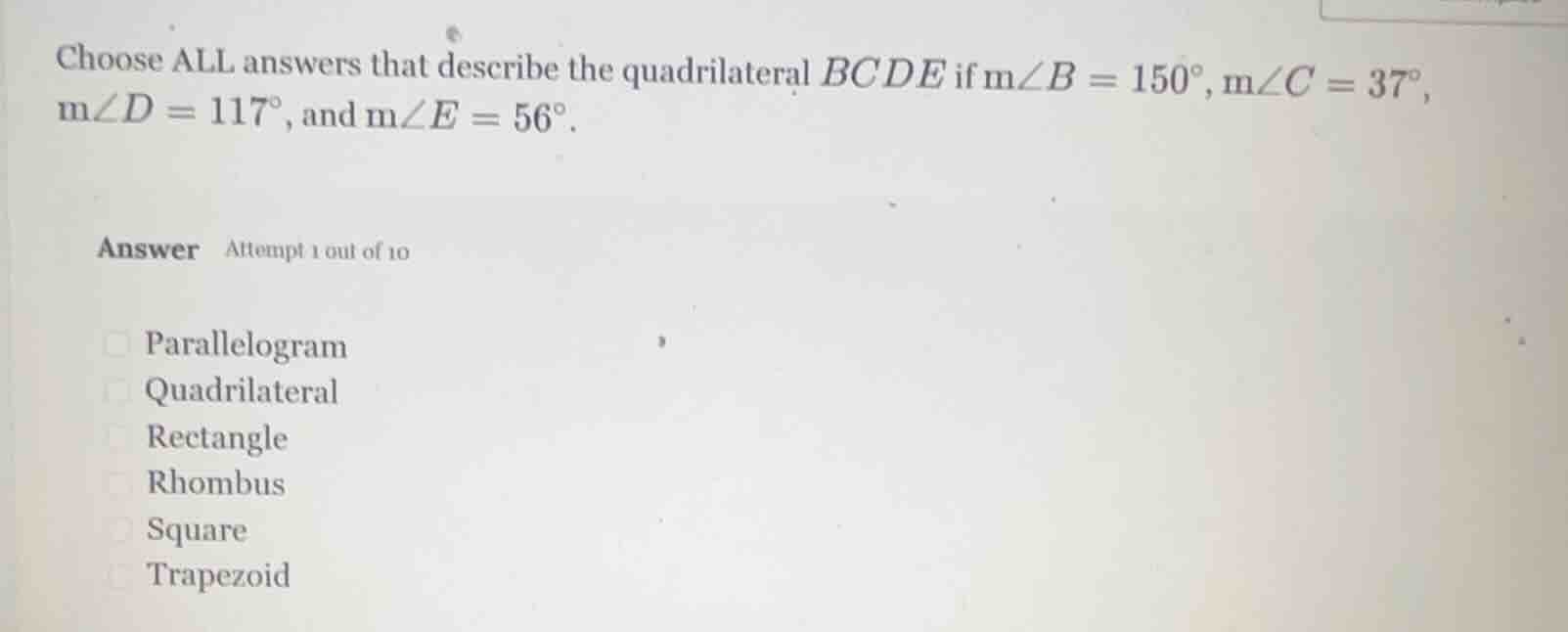
Question
choose all answers that describe the quadrilateral bcde if m∠b = 150°, m∠c = 37°, m∠d = 117°, and m∠e = 56°. answer attempt 1 out of 10 parallelogram quadrilateral rectangle rhombus square trapezoid
Step1: Verify quadrilateral angle sum
First, confirm the sum of interior angles equals the quadrilateral total of $360^\circ$.
$\angle B + \angle C + \angle D + \angle E = 150^\circ + 37^\circ + 117^\circ + 56^\circ = 360^\circ$
Step2: Check parallelogram criteria
Parallelograms have opposite angles equal. Here, $150^\circ
eq 117^\circ$ and $37^\circ
eq 56^\circ$, so it is not a parallelogram.
Step3: Check rectangle/rhombus/square criteria
These are all types of parallelograms, so they are also eliminated (rectangles/squares have 4 right angles, rhombuses are parallelograms with equal sides).
Step4: Check trapezoid criteria
A trapezoid has at least one pair of parallel sides (consecutive angles between parallel sides are supplementary). Check angle pairs:
$150^\circ + 37^\circ = 187^\circ
eq 180^\circ$, $37^\circ + 117^\circ = 154^\circ
eq 180^\circ$, $117^\circ + 56^\circ = 173^\circ
eq 180^\circ$, $56^\circ + 150^\circ = 206^\circ
eq 180^\circ$. No supplementary consecutive angles, so no parallel sides.

Snap & solve any problem in the app
Get step-by-step solutions on Sovi AI
Photo-based solutions with guided steps
Explore more problems and detailed explanations
Quadrilateral