QUESTION IMAGE
Question
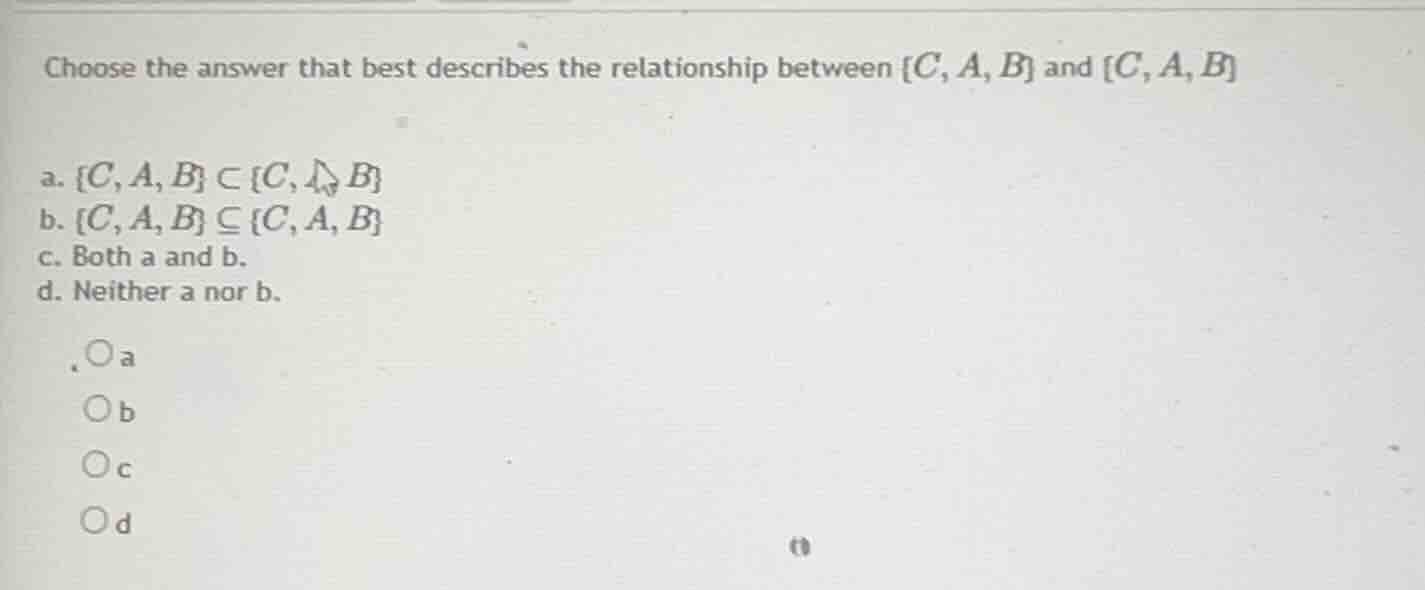
choose the answer that best describes the relationship between {c, a, b} and {c, a, b}
a. {c, a, b} ⊂ {c, a, b}
b. {c, a, b} ⊆ {c, a, b}
c. both a and b.
d. neither a nor b.
○a
○b
○c
○d
- Recall the definitions of subset ($\subseteq$) and proper subset ($\subset$):
- A set \( X \) is a subset of a set \( Y \) (denoted \( X\subseteq Y \)) if every element of \( X \) is also an element of \( Y \).
- A set \( X \) is a proper subset of a set \( Y \) (denoted \( X\subset Y \)) if \( X\subseteq Y \) and \( X
eq Y \).
- Analyze the given sets: Both sets are \(\{C, A, B\}\), so they are equal (i.e., every element of the first set is in the second, and vice versa, and they have the same elements).
- Check option a: \(\{C, A, B\} \subset \{C, A, B\}\) would require \(\{C, A, B\}
eq \{C, A, B\}\), which is false.
- Check option b: \(\{C, A, B\} \subseteq \{C, A, B\}\) is true because every element of the set is in itself.
- Since option a is false and option b is true, we need to see the options. Wait, actually, wait: Wait, the two sets are identical. So \( X\subseteq Y \) is true when \( X = Y \), and \( X\subset Y \) is false when \( X = Y \). But let's re - evaluate:
- For \( X=\{C,A,B\} \) and \( Y = \{C,A,B\} \):
- \( X\subseteq Y \) is true (all elements of \( X \) are in \( Y \)).
- \( X\subset Y \) is false because \( X = Y \) (a proper subset requires \( X\) to be a subset and \( X
eq Y \)). But wait, the first option in the problem has a typo? Wait, the first option is written as \(\{C,A,B\} \subset \{C,A,B\}\) (maybe a typo, but as per the given options). But let's check the options again.
- Wait, the two sets are the same. So:
- \( \{C,A,B\} \subseteq \{C,A,B\} \) is true (by definition of subset, every set is a subset of itself).
- \( \{C,A,B\} \subset \{C,A,B\} \) is false (because a proper subset needs the subset to be different from the superset). But the option c says "Both a and b". But wait, maybe there is a misprint, and the first set in option a was supposed to be a different set? No, as per the problem, both sets are \(\{C,A,B\}\). Wait, no, maybe I made a mistake. Wait, the definition of proper subset: If \( X\) is a proper subset of \( Y\), then \( X\) is a subset of \( Y\) and \( Y\) has at least one element that \( X\) does not have. Since \( X = Y=\{C,A,B\} \), \( X\) is not a proper subset of \( Y\). But \( X\) is a subset of \( Y\) (because \( X = Y\)). So option a is false, option b is true. But wait, the options are:
- a. \(\{C,A,B\} \subset \{C,A,B\}\) (false)
- b. \(\{C,A,B\} \subseteq \{C,A,B\}\) (true)
- c. Both a and b. (false, since a is false)
- d. Neither a nor b. (false, since b is true)
- Wait, this is a contradiction. Wait, no, maybe the first set in option a was a different set? Wait, no, the problem says "the relationship between \(\{C,A,B\}\) and \(\{C,A,B\}\)". So:
- The correct analysis is:
- A set is always a subset of itself (\( X\subseteq X \) for any set \( X \)).
- A set is not a proper subset of itself (\( X
ot\subset X \) for any set \( X \), because a proper subset requires \( X
eq Y \) when \( X\subset Y \) and \( X\subseteq Y \)).
- So option a is false, option b is true. But looking at the options, the answer should be b? Wait, but let's check again. Wait, maybe the original problem had a different set, but as per the given problem, both sets are the same. So:
- Option b: \(\{C,A,B\} \subseteq \{C,A,B\}\) is correct.
- Option a: \(\{C,A,B\} \subset \{C,A,B\}\) is incorrect.
- So the correct answer is b.

Snap & solve any problem in the app
Get step-by-step solutions on Sovi AI
Photo-based solutions with guided steps
Explore more problems and detailed explanations
b. \(\{C, A, B\} \subseteq \{C, A, B\}\)