QUESTION IMAGE
Question
choose the best answer from the four choices given. answers are on page 281.
- the number of rabbits in a certain population doubles every 3 months. currently, there are 5 rabbits in the population. how many rabbits will there be 3 years from now?
a. 64
b. 4,096
c. 9,064
d. 20,480
- hannah took out a simple interest loan of $1,000. the interest rate on the loan is 5%. if no payments are made, how much money, in dollars, will she owe at the end of 7 years?
a. (1.05)^7
b. 7(1.05)
c. 1,000 + (1,000)(0.05)^7
d. 1,000 + 7(0.05)(1,000)
- the number of bacteria in a certain culture doubles every 15 minutes. if the number was initially 10^3, what was the number in the population 1 hour later?
a. (10^3)2^(15/60)
b. (10^3)4^(15/60)
c. 2^(60/15)(10^3)
d. 2^3(10)(60/15)
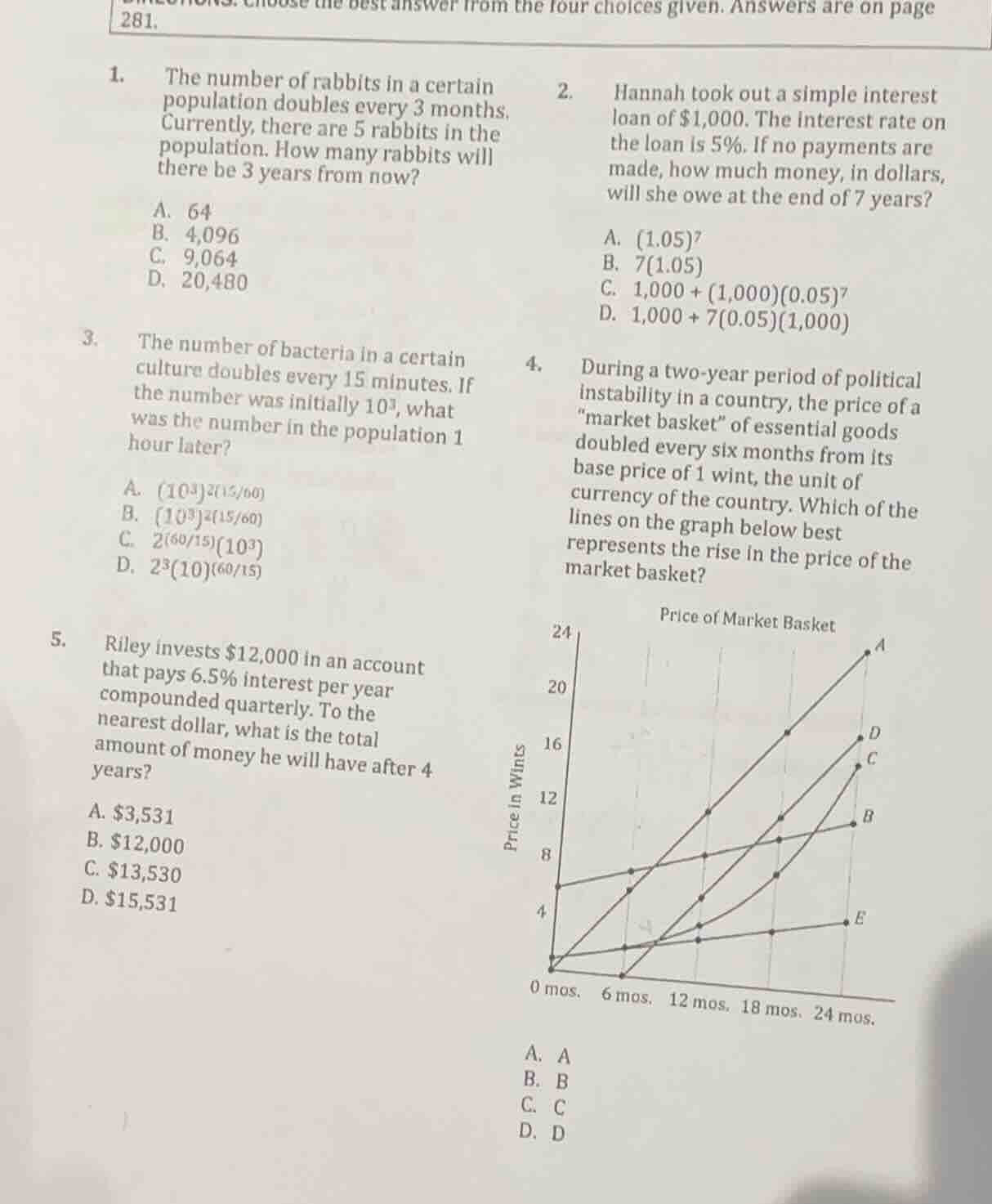
- during a two - year period of political instability in a country, the price of a \market basket\ of essential goods doubled every six months from its base price of 1 wint, the unit of currency of the country. which of the lines on the graph below best represents the rise in the price of the market basket?
graph: price of market basket, x - axis: 0 mos., 6 mos., 12 mos., 18 mos., 24 mos.; y - axis: price in wints (0 - 24). lines: a (steep straight), b (shallow straight), c (curved up), d (moderate straight), e (very shallow straight)
a. a
b. b
c. c
d. d
- riley invests $12,000 in an account that pays 6.5% interest per year compounded quarterly. to the nearest dollar, what is the total amount of money he will have after 4 years?
a. $3,531
b. $12,000
c. $13,530
d. $15,531
Question 1
Step1: Determine the number of doubling periods.
3 years is equal to \( 3 \times 12 = 36 \) months. Each doubling period is 3 months, so the number of periods \( n = \frac{36}{3}=12 \).
Step2: Use the exponential growth formula.
The formula for exponential growth when doubling is \( N = N_0 \times 2^n \), where \( N_0 = 5 \) (initial number of rabbits) and \( n = 12 \). So \( N = 5\times2^{12} \).
Calculate \( 2^{12}=4096 \), then \( 5\times4096 = 20480 \)? Wait, no, wait: Wait, \( 2^{12}=4096 \), \( 5\times4096 = 20480 \)? But let's check again. Wait, 3 years is 36 months, 36 divided by 3 is 12. So initial is 5, after 12 doublings: \( 5\times2^{12}=5\times4096 = 20480 \)? But the options have D as 20,480. Wait, but let's check the options again. Wait, maybe I made a mistake. Wait, 3 years is 12 quarters of 3 months. Wait, 5 rabbits, double every 3 months. So after 1 period (3 months): 10, 2 periods:20, 3:40, 4:80, 5:160, 6:320, 7:640, 8:1280, 9:2560, 10:5120, 11:10240, 12:20480. Yes, so the answer is D.
Step1: Recall the simple interest formula.
The formula for simple interest is \( A = P(1 + rt) \), where \( P \) is the principal amount, \( r \) is the annual interest rate (in decimal), and \( t \) is the time in years.
Here, \( P = 1000 \), \( r = 0.05 \), and \( t = 7 \).
Step2: Substitute the values into the formula.
\( A = 1000+1000\times0.05\times7=1000 + 7\times0.05\times1000 \), which matches option D.
Step1: Determine the number of doubling periods.
1 hour is 60 minutes. Each doubling period is 15 minutes, so the number of periods \( n=\frac{60}{15} = 4 \). Wait, no: Wait, the formula for exponential growth when doubling is \( N = N_0\times2^n \), where \( n \) is the number of doubling periods. The initial number \( N_0 = 10^3 \). The number of 15 - minute periods in 1 hour (60 minutes) is \( \frac{60}{15}=4 \). So \( N = 10^3\times2^4 \). But let's look at the options. Option C is \( 2^{(60/15)}(10^3)=2^4\times10^3 \), which is correct. Let's check the options:
Option A: \( (10^3)2^{(15/60)} \) is wrong. Option B: \( (10^3)2^{(15/60)} \) same as A. Option C: \( 2^{(60/15)}(10^3)=2^4\times10^3 \), correct. Option D: \( 2^3(10)(60/15) \) is wrong. So the answer is C.

Snap & solve any problem in the app
Get step-by-step solutions on Sovi AI
Photo-based solutions with guided steps
Explore more problems and detailed explanations
D. 20,480