QUESTION IMAGE
Question
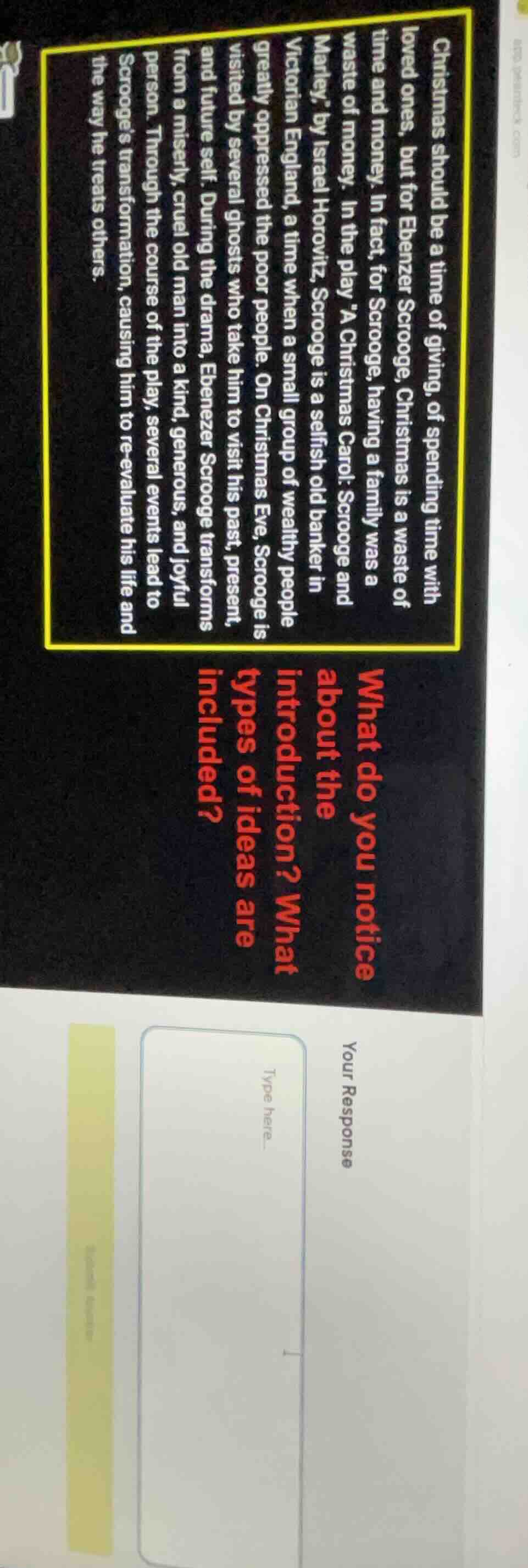
christmas should be a time of giving, of spending time with loved ones, but for ebenezer scrooge, christmas is a waste of time and money. in fact, for scrooge, having a family was a waste of money. in the play a christmas carol: scrooge and marley, by israel horovitz, scrooge is a selfish old banker in victorian england, a time when a small group of wealthy people greatly oppressed the poor people. on christmas eve, scrooge is visited by several ghosts who take him to visit his past, present, and future self. during the drama, ebenezer scrooge transforms from a miserly, cruel old man into a kind, generous, and joyful person. through the course of the play, several events lead to scrooge’s transformation, causing him to re - evaluate his life and the way he treats others.
what do you notice about the introduction? what types of ideas are included?
This introduction uses a contrast between the typical meaning of Christmas and Scrooge's initial cynical view to hook readers. It includes core contextual details: the play's title, author, setting (Victorian England), the central character's initial selfish identity, the inciting event (ghostly visits), and the character's transformative arc. Key ideas include thematic framing of generosity vs. greed, character transformation, and the historical context of class inequality in Victorian society.

Snap & solve any problem in the app
Get step-by-step solutions on Sovi AI
Photo-based solutions with guided steps
Explore more problems and detailed explanations
- Noticeable structural trait: It opens with a universal Christmas ideal, then contrasts it with Scrooge's opposing perspective to create tension and introduce the core conflict.
- Included ideas:
- The traditional, communal meaning of Christmas (giving, connection)
- Scrooge's initial selfish, money-focused worldview
- Basic contextual details: play title, author, Victorian England setting
- The inciting plot device (ghostly visits to past/present/future)
- The central character arc: Scrooge's transformation from miser to kind person
- The backdrop of class inequality in Victorian England