QUESTION IMAGE
Question
chromosome challenge
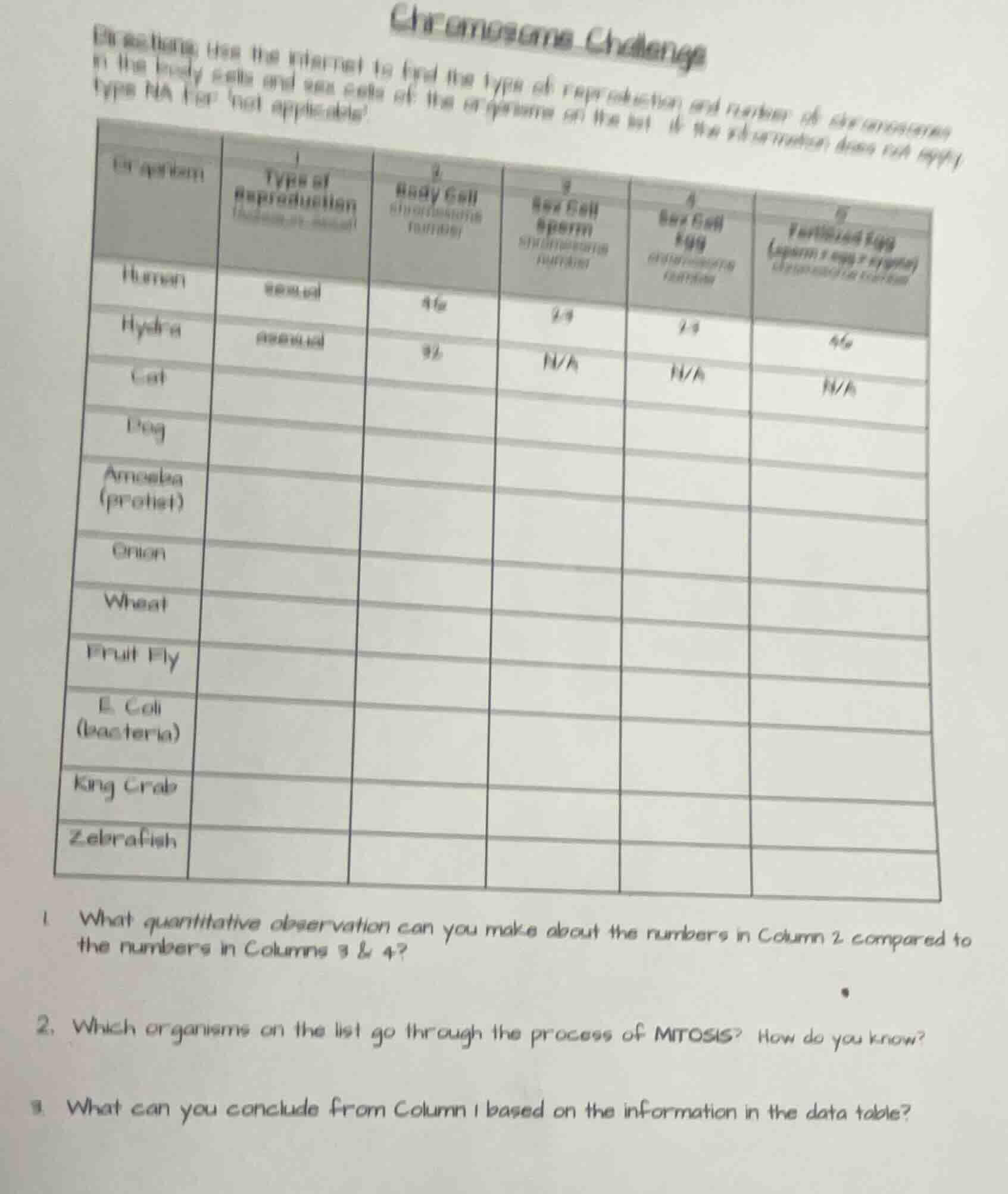
directions: use the internet to find the type of reproduction and number of chromosomes in the body cells and sex cells of the organisms on the list. if the information does not apply, type n/a for not applicable.
- what quantitative observation can you make about the numbers in column 2 compared to the numbers in columns 3 & 4?
- which organisms on the list go through the process of mitosis? how do you know?
- what can you conclude from column 1 based on the information in the data table?
First, we complete the chromosome table, then answer the questions:
---
Completed Chromosome Table
| Organism | Type of Reproduction | Body Cell Chromosome Number | Sex Cell (sperm) Chromosome Number | Sex Cell (egg) Chromosome Number | Fertilized Egg Chromosome Number |
|---|---|---|---|---|---|
| Hydra | asexual | 32 | N/A | N/A | N/A |
| Cat | sexual | 38 | 19 | 19 | 38 |
| Dog | sexual | 78 | 39 | 39 | 78 |
| Amoeba (protist) | asexual | 50 (typical) | N/A | N/A | N/A |
| Onion | sexual/asexual | 16 | 8 | 8 | 16 |
| Wheat | sexual/asexual | 42 | 21 | 21 | 42 |
| Fruit Fly | sexual | 8 | 4 | 4 | 8 |
| E. Coli (bacteria) | asexual | 1 (circular chromosome) | N/A | N/A | N/A |
| King Crab | sexual | 208 | 104 | 104 | 208 |
| Zebrafish | sexual | 52 | 26 | 26 | 52 |
---
Question 1
Step1: Compare column values
For sexually reproducing organisms, body cell chromosome count = $2 \times$ sex cell chromosome count.
Step2: State quantitative pattern
Column 2 numbers are exactly double Columns 3 & 4 numbers.
Mitosis is cell division for growth/repair, used by all eukaryotic organisms to make body cells. Prokaryotes (E. Coli) use binary fission, not mitosis. All listed eukaryotes use mitosis to produce diploid body cells.
Column 1 shows two reproduction categories: sexual (requires sex cells, fertilization) and asexual (no sex cells, offspring are clones). Organisms use one or both strategies based on their biology.

Snap & solve any problem in the app
Get step-by-step solutions on Sovi AI
Photo-based solutions with guided steps
Explore more problems and detailed explanations
For sexually reproducing organisms, the number of chromosomes in body cells (Column 2) is twice the number of chromosomes in sex cells (Columns 3 & 4).
---