QUESTION IMAGE
Question
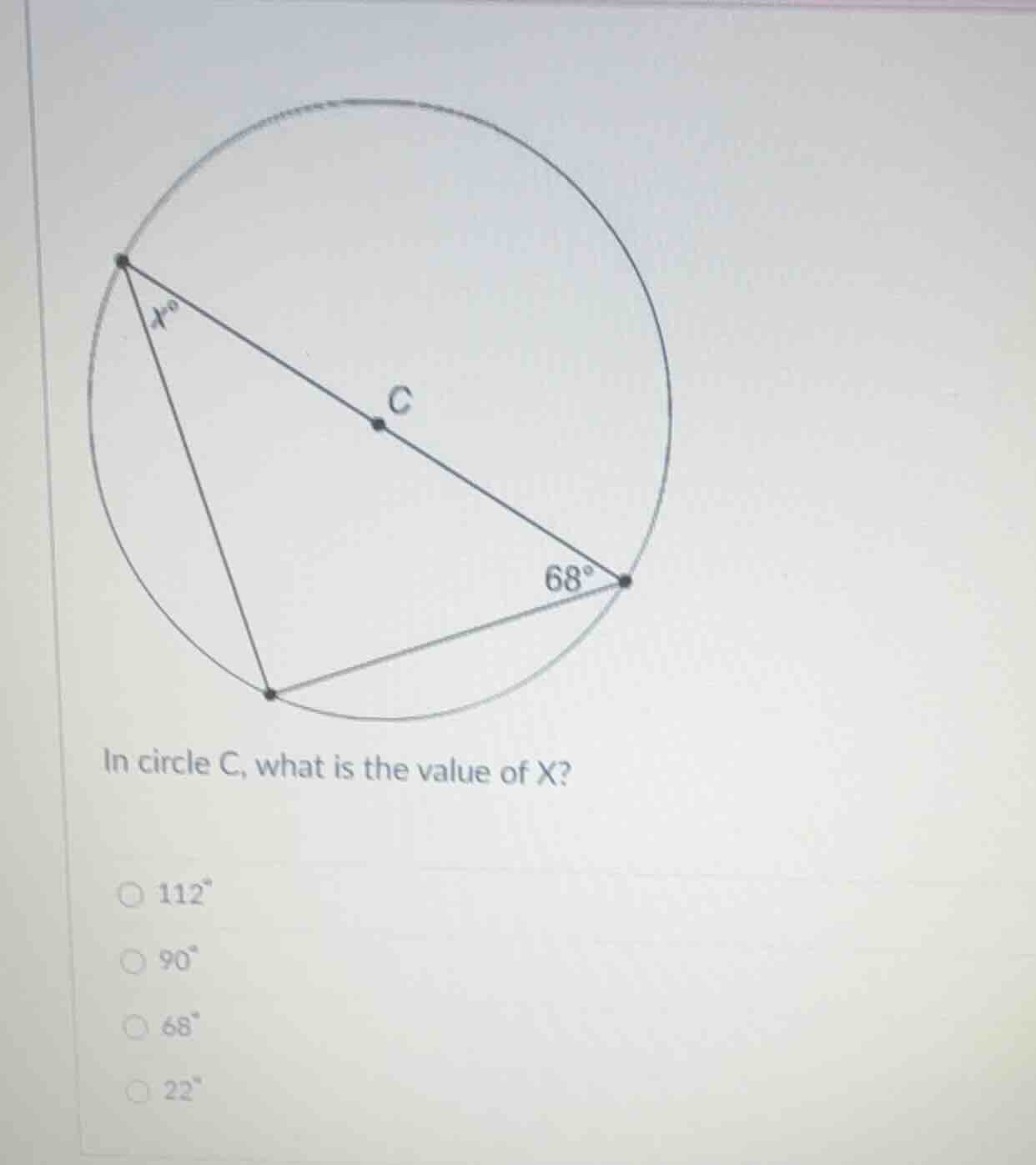
in circle c, what is the value of x?
112°
90°
68°
22°
Step1: Recognize the triangle type
The triangle is inscribed in a circle with one side as the diameter (since \( C \) is the center, the line through \( C \) is a diameter). A triangle inscribed with one side as the diameter is a right triangle, so one angle is \( 90^\circ \).
Step2: Use angle sum property
In a triangle, the sum of angles is \( 180^\circ \). Let the right angle be \( 90^\circ \), one angle is \( 68^\circ \), and the third angle is \( x^\circ \). So, \( x + 68 + 90 = 180 \).
Step3: Solve for \( x \)
Simplify the equation: \( x + 158 = 180 \). Subtract \( 158 \) from both sides: \( x = 180 - 158 = 22 \). Wait, no, wait—wait, maybe I mixed up. Wait, the diameter subtends a right angle, so the right angle is opposite the diameter. Wait, the angle given is \( 68^\circ \), and we need to find \( x \). Wait, no, actually, in a right - angled triangle (since diameter subtends \( 90^\circ \)), the two non - right angles sum to \( 90^\circ \)? Wait, no, sum of angles in a triangle is \( 180^\circ \). If one angle is \( 90^\circ \) (right angle, because diameter), another is \( 68^\circ \), then \( x=180 - 90 - 68=22^\circ \). Wait, but let's check again. The triangle with vertices on the circle, one side is diameter, so by Thales' theorem, the angle opposite the diameter is a right angle (\( 90^\circ \)). So the triangle is right - angled at the third vertex. So angles: \( 90^\circ \), \( 68^\circ \), and \( x^\circ \). So \( x = 180-(90 + 68)=22^\circ \).

Snap & solve any problem in the app
Get step-by-step solutions on Sovi AI
Photo-based solutions with guided steps
Explore more problems and detailed explanations
\( 22^\circ \) (corresponding to the option with \( 22^\circ \))