QUESTION IMAGE
Question
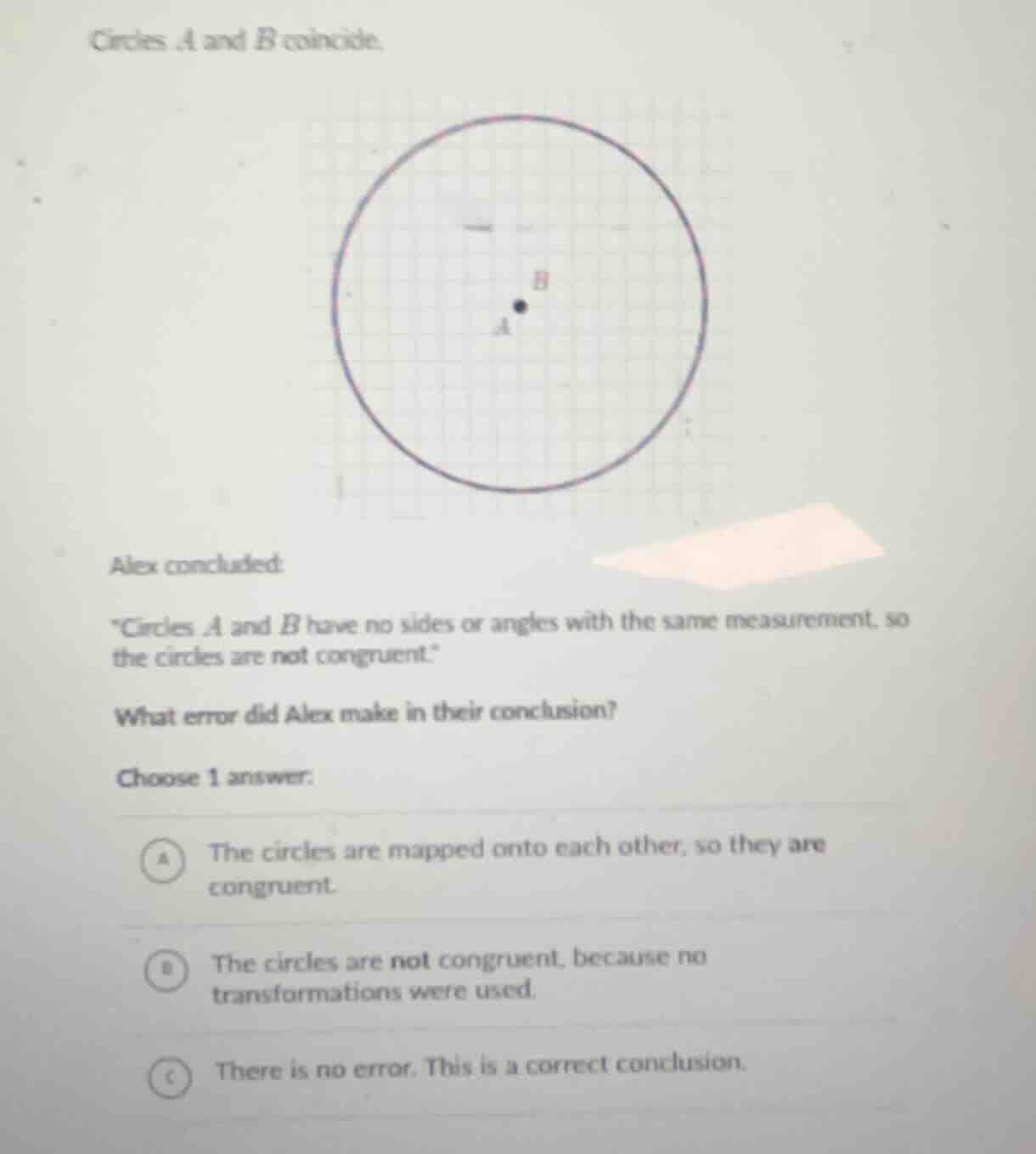
circles a and b coincide.
alex concluded:
\circles a and b have no sides or angles with the same measurement, so the circles are not congruent.\
what error did alex make in their conclusion?
choose 1 answer:
a the circles are mapped onto each other, so they are congruent.
b the circles are not congruent, because no transformations were used.
c there is no error. this is a correct conclusion.
To determine the error in Alex's conclusion, we analyze the concept of congruent circles. Congruent circles have the same radius (or diameter). If two circles coincide (as given for Circles A and B), they can be mapped onto each other (e.g., by translation, rotation, or reflection), meaning they are congruent. Alex incorrectly thought they aren't congruent by focusing on sides/angles (circles don't have sides/angles in the way polygons do, and their congruence is based on radius). Option A correctly states that since the circles are mapped onto each other, they are congruent, identifying Alex's error. Option B is wrong because congruence of circles doesn't require transformations to be applied, just the ability to map them. Option C is wrong as Alex's conclusion is incorrect.

Snap & solve any problem in the app
Get step-by-step solutions on Sovi AI
Photo-based solutions with guided steps
Explore more problems and detailed explanations
A. The circles are mapped onto each other, so they are congruent.