QUESTION IMAGE
Question
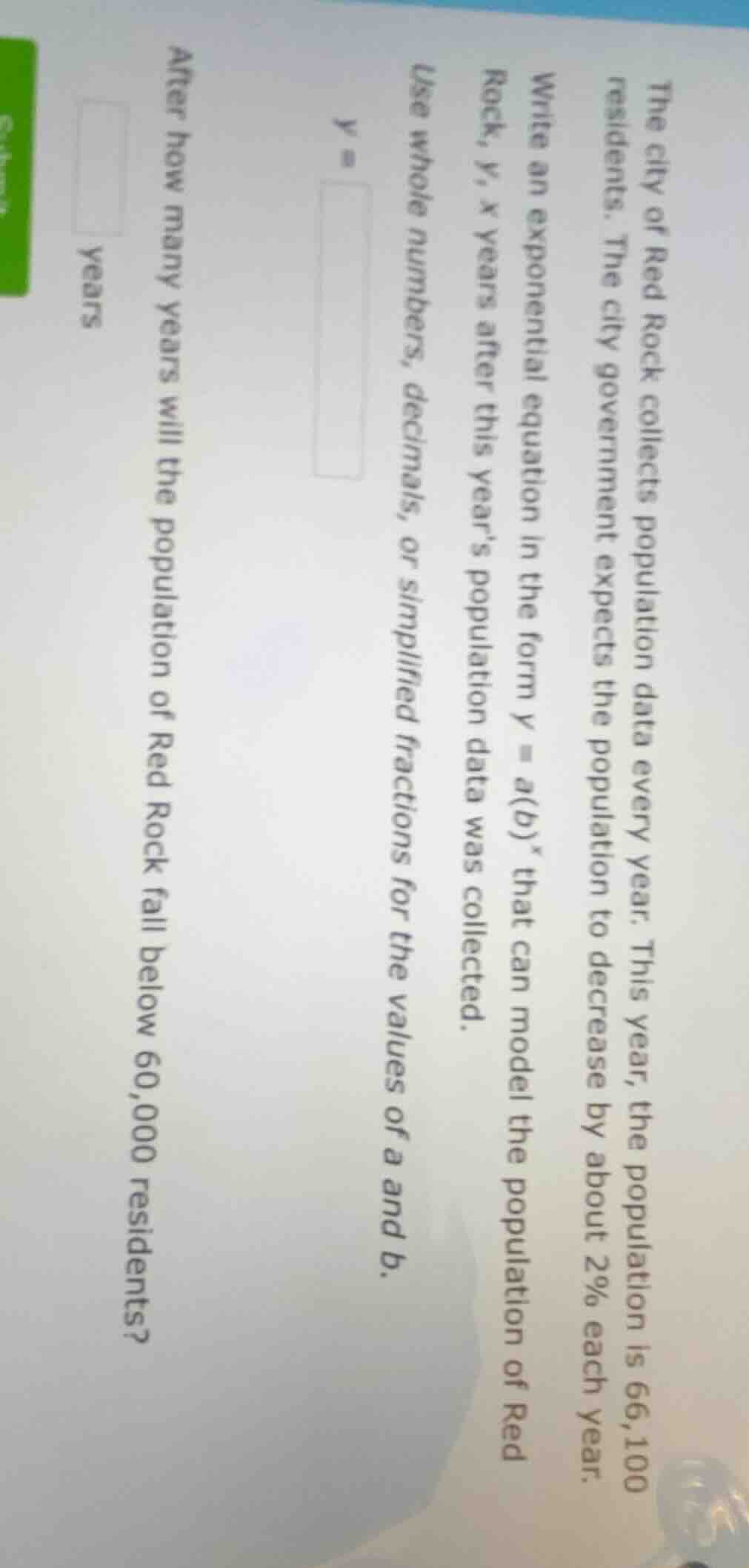
the city of red rock collects population data every year. this year, the population is 66,100 residents. the city government expects the population to decrease by about 2% each year. write an exponential equation in the form $y = a(b)^x$ that can model the population of red rock, $y$, $x$ years after this years population data was collected. use whole numbers, decimals, or simplified fractions for the values of $a$ and $b$. $y = \square$ after how many years will the population of red rock fall below 60,000 residents? \square years
Step1: Define exponential decay model
The standard exponential decay form is $y = a(b)^x$, where $a$ is the initial population, and $b$ is the decay factor.
Initial population $a = 66100$. Since the population decreases by 2% annually, the remaining percentage is $100\% - 2\% = 98\%$, so $b = 0.98$.
The equation is $y = 66100(0.98)^x$
Step2: Set up inequality for population threshold
We need $y < 60000$, so substitute the model:
$66100(0.98)^x < 60000$
Step3: Isolate the exponential term
Divide both sides by 66100:
$(0.98)^x < \frac{60000}{66100} \approx 0.9077$
Step4: Solve for x using logarithms
Take the natural logarithm of both sides (logarithms preserve inequalities for positive bases <1, reversing the sign):
$x > \frac{\ln(0.9077)}{\ln(0.98)}$
Calculate the values: $\ln(0.9077) \approx -0.0962$, $\ln(0.98) \approx -0.0202$
$x > \frac{-0.0962}{-0.0202} \approx 4.76$
Step5: Interpret the result
Since $x$ represents full years, we round up to the next whole number.

Snap & solve any problem in the app
Get step-by-step solutions on Sovi AI
Photo-based solutions with guided steps
Explore more problems and detailed explanations
$y = 66100(0.98)^x$
5 years