QUESTION IMAGE
Question
claim - evidence - reasoning
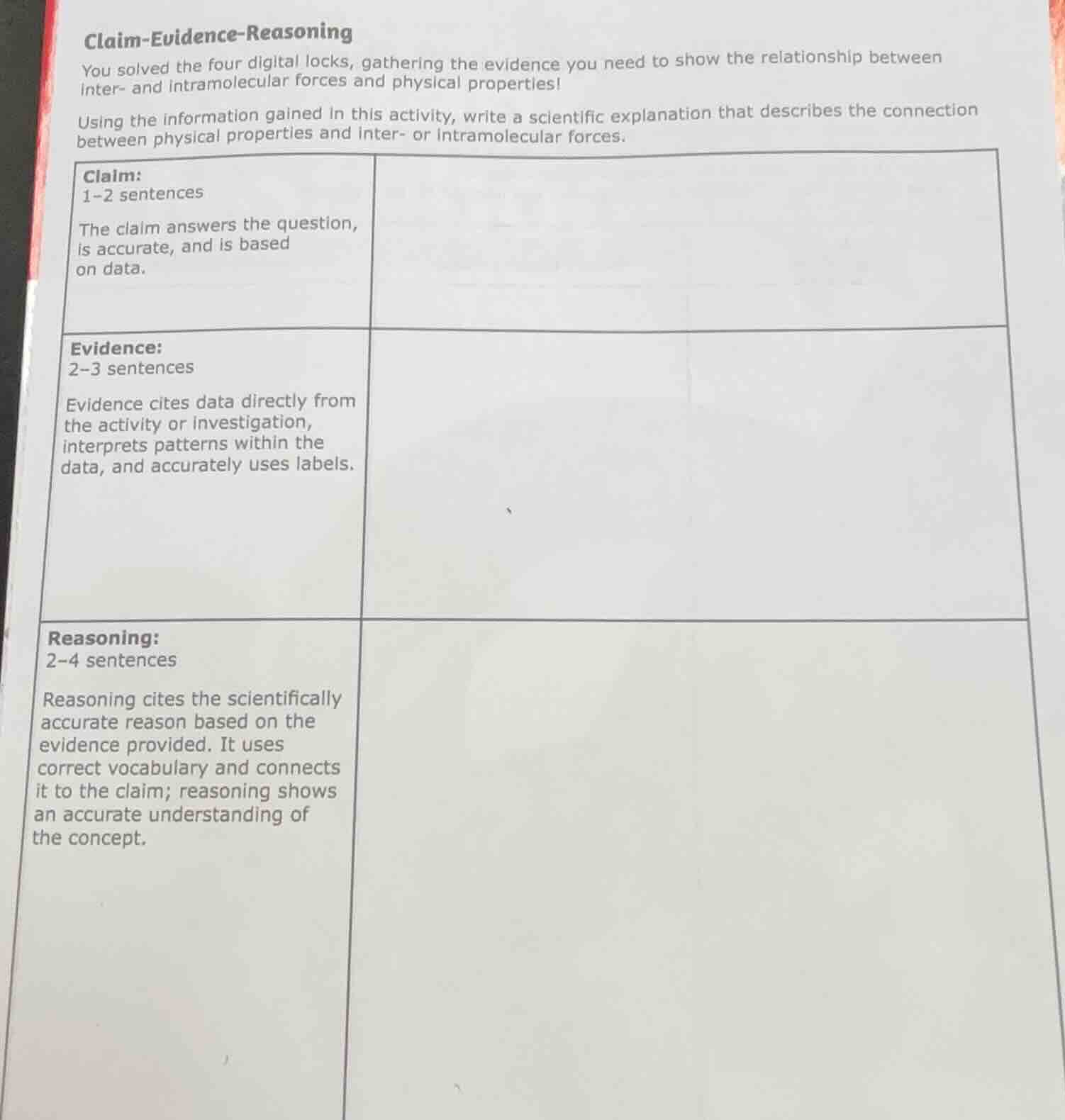
you solved the four digital locks, gathering the evidence you need to show the relationship between inter - and intramolecular forces and physical properties!
using the information gained in this activity, write a scientific explanation that describes the connection between physical properties and inter - or intramolecular forces.
claim:
1 - 2 sentences
the claim answers the question,
is accurate, and is based
on data.
evidence:
2 - 3 sentences
evidence cites data directly from
the activity or investigation,
interprets patterns within the
data, and accurately uses labels.
reasoning:
2 - 4 sentences
reasoning cites the scientifically
accurate reason based on the
evidence provided. it uses
correct vocabulary and connects
it to the claim; reasoning shows
an accurate understanding of
the concept.
Claim:
The strength of inter - and intramolecular forces directly influences the physical properties of substances, such as boiling point, melting point, and solubility. Substances with stronger intermolecular forces generally have higher boiling and melting points, and specific solubility behaviors.
Evidence:
For example, water ($\ce{H_2O}$) has hydrogen bonding (a strong intermolecular force), and it has a relatively high boiling point of $100^\circ\mathrm{C}$ at standard pressure. In contrast, methane ($\ce{CH_4}$) has only weak London dispersion forces and has a very low boiling point of $- 161.5^\circ\mathrm{C}$. Also, ionic compounds (with strong intramolecular ionic bonds and strong intermolecular forces) like sodium chloride ($\ce{NaCl}$) are highly soluble in polar solvents like water.
Reasoning:
Intermolecular forces, such as hydrogen bonding, dipole - dipole interactions, and London dispersion forces, act between molecules. Stronger intermolecular forces require more energy to overcome, which is why substances with strong intermolecular forces have higher boiling and melting points as more heat energy is needed to separate the molecules. Intramolecular forces, like covalent and ionic bonds, determine the chemical identity of a substance but also influence how the molecules interact with each other and with other substances (like in solubility). For instance, the polar nature of water molecules (due to intramolecular polar covalent bonds and intermolecular hydrogen bonding) allows it to dissolve ionic compounds by interacting with the ions, which is related to the intermolecular forces between water and the ions. The differences in boiling points between water and methane show that the stronger intermolecular forces in water (hydrogen bonding) lead to a much higher boiling point as more energy is required to break those forces and convert water from liquid to gas.

Snap & solve any problem in the app
Get step-by-step solutions on Sovi AI
Photo-based solutions with guided steps
Explore more problems and detailed explanations
Claim:
The strength of inter - and intramolecular forces directly influences the physical properties of substances, such as boiling point, melting point, and solubility. Substances with stronger intermolecular forces generally have higher boiling and melting points, and specific solubility behaviors.
Evidence:
For example, water ($\ce{H_2O}$) has hydrogen bonding (a strong intermolecular force), and it has a relatively high boiling point of $100^\circ\mathrm{C}$ at standard pressure. In contrast, methane ($\ce{CH_4}$) has only weak London dispersion forces and has a very low boiling point of $- 161.5^\circ\mathrm{C}$. Also, ionic compounds (with strong intramolecular ionic bonds and strong intermolecular forces) like sodium chloride ($\ce{NaCl}$) are highly soluble in polar solvents like water.
Reasoning:
Intermolecular forces, such as hydrogen bonding, dipole - dipole interactions, and London dispersion forces, act between molecules. Stronger intermolecular forces require more energy to overcome, which is why substances with strong intermolecular forces have higher boiling and melting points as more heat energy is needed to separate the molecules. Intramolecular forces, like covalent and ionic bonds, determine the chemical identity of a substance but also influence how the molecules interact with each other and with other substances (like in solubility). For instance, the polar nature of water molecules (due to intramolecular polar covalent bonds and intermolecular hydrogen bonding) allows it to dissolve ionic compounds by interacting with the ions, which is related to the intermolecular forces between water and the ions. The differences in boiling points between water and methane show that the stronger intermolecular forces in water (hydrogen bonding) lead to a much higher boiling point as more energy is required to break those forces and convert water from liquid to gas.