QUESTION IMAGE
Question
claims and arguments
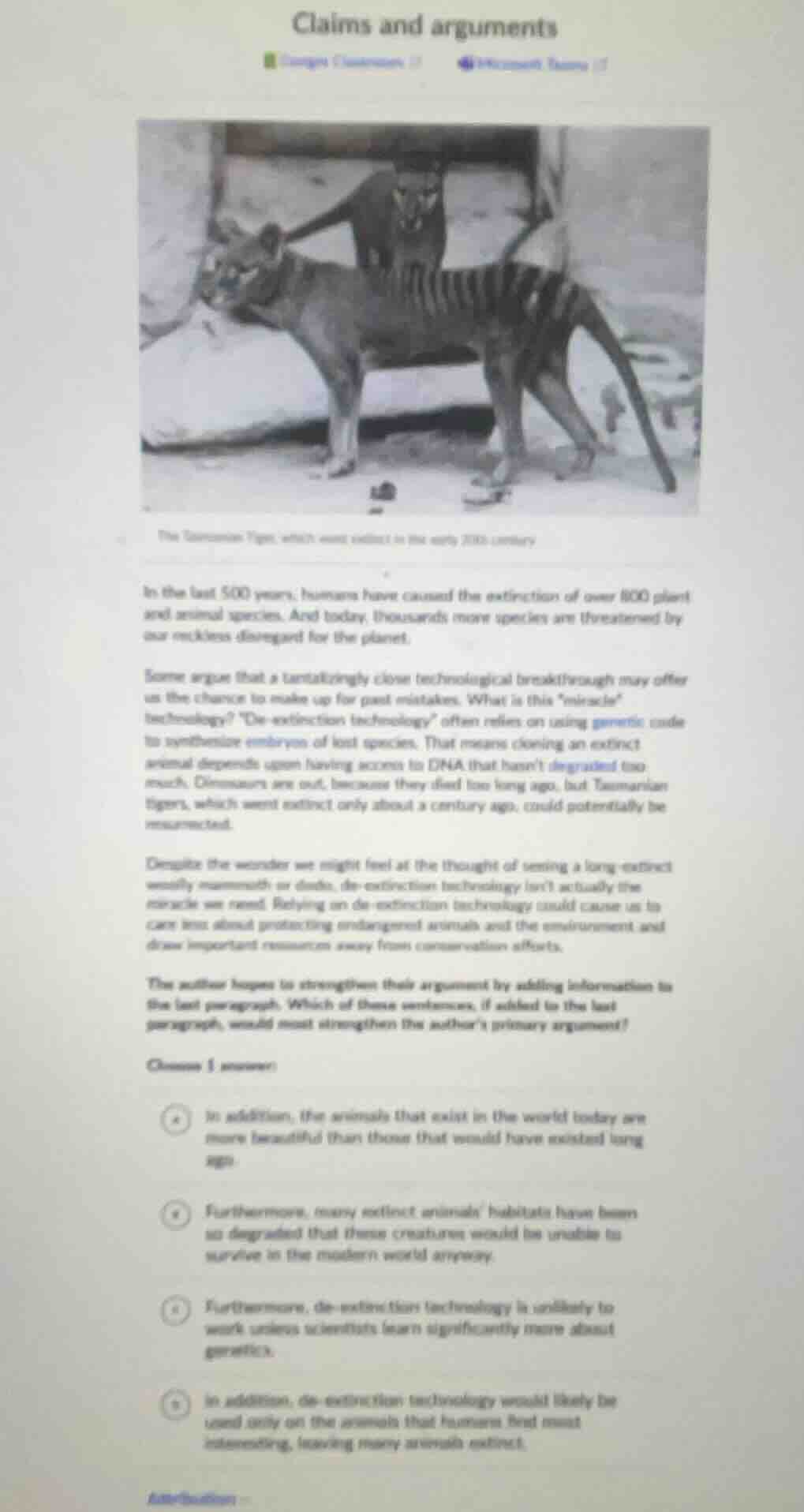
the tasmanian tiger, which went extinct in the early 20th century
in the last 500 years, humans have caused the extinction of over 800 plant and animal species. and today, thousands more species are threatened by our reckless disregard for the planet.
some argue that a tantalizingly close technological breakthrough may offer us the chance to make up for past mistakes. what is this \miracle\ technology? \de - extinction technology\ often relies on using genetic code to synthesize embryos of lost species. that means cloning an extinct animal depends upon having access to dna that hasnt degraded too much. dinosaurs are out, because they died too long ago, but tasmanian tigers, which went extinct only about a century ago, could potentially be resurrected.
despite the wonder we might feel at the thought of seeing a long - extinct woolly mammoth or dodo, de - extinction technology isnt actually the miracle we need. relying on de - extinction technology could cause us to care less about protecting endangered animals and the environment and draw important resources away from conservation efforts.
the author hopes to strengthen their argument by adding information to the last paragraph. which of these sentences, if added to the last paragraph, would most strengthen the author’s primary argument?
choose 1 answer:
a in addition, the animals that exist in the world today are more beautiful than those that would have existed long ago.
b furthermore, many extinct animals’ habitats have been so degraded that these creatures would be unable to survive in the modern world anyway.
c furthermore, de - extinction technology is unlikely to work unless scientists learn significantly more about genetics.
d in addition, de - extinction technology would likely be used only on the animals that humans find most interesting, leaving many animals extinct.
The author's primary argument is that de - extinction technology is not a miracle and has drawbacks like reducing care for conservation and diverting resources. We need to find an option that strengthens this.
- Option A: Beauty of animals is irrelevant to the argument about de - extinction's drawbacks.
- Option B: If extinct animals' habitats are degraded so they can't survive, it shows that even if we de - extinct them, they can't live, so de - extinction is not useful. This strengthens the idea that de - extinction is not a solution and we should focus on conservation.
- Option C: The technology's dependence on genetics knowledge is about the technology's feasibility, not about why it's not a miracle or its impact on conservation, so it doesn't strengthen the main argument.
- Option D: Which animals the technology is used on doesn't relate to the argument about conservation and resource diversion.

Snap & solve any problem in the app
Get step-by-step solutions on Sovi AI
Photo-based solutions with guided steps
Explore more problems and detailed explanations
B. Furthermore, many extinct animals’ habitats have been so degraded that these creatures would be unable to survive in the modern world anyway.