QUESTION IMAGE
Question
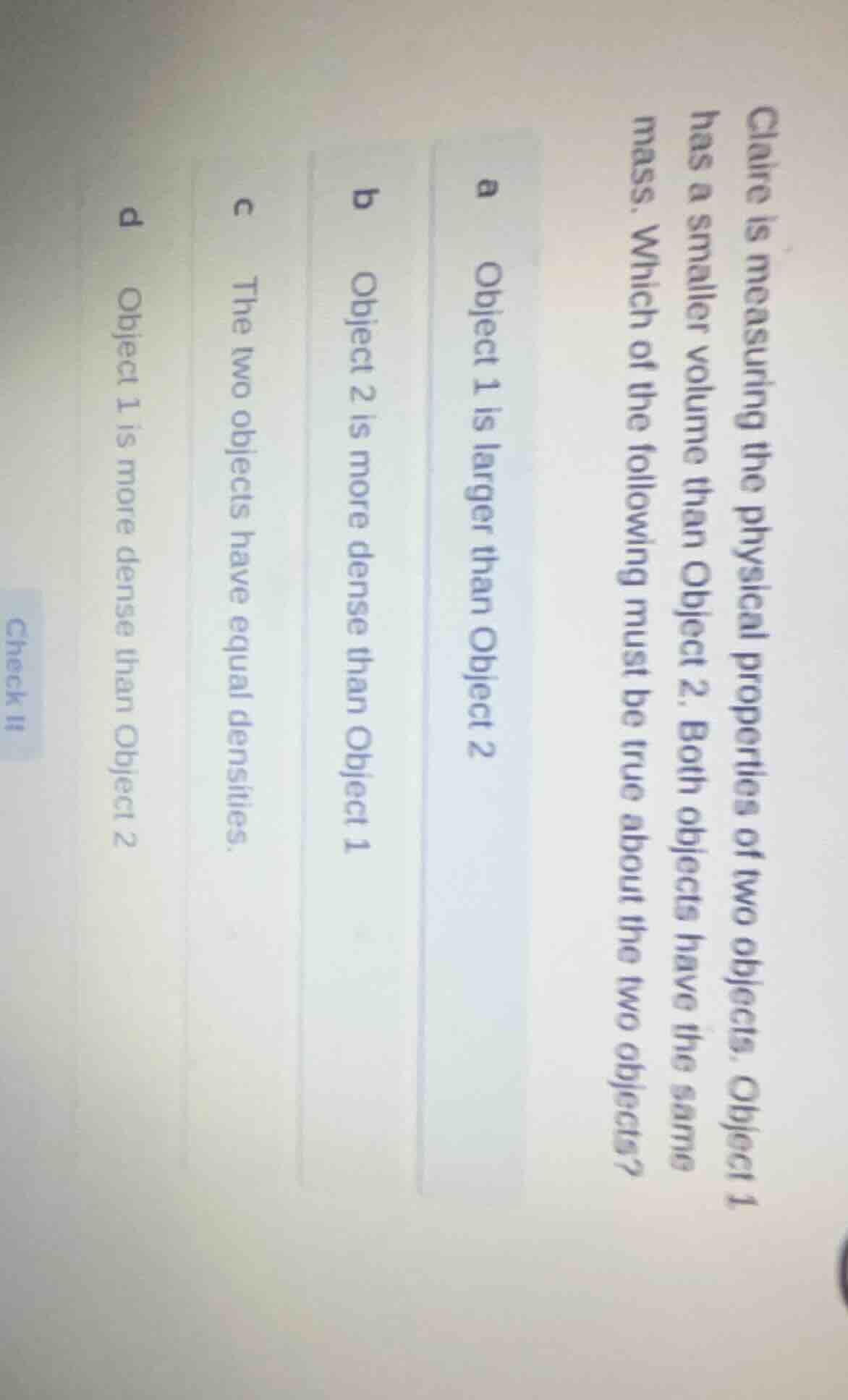
claire is measuring the physical properties of two objects. object 1 has a smaller volume than object 2. both objects have the same mass. which of the following must be true about the two objects?
a object 1 is larger than object 2
b object 2 is more dense than object 1
c the two objects have equal densities.
d object 1 is more dense than object 2
Density is defined as mass divided by volume ($
ho = \frac{m}{V}$). Both objects have the same mass ($m_1 = m_2$), and Object 1 has a smaller volume than Object 2 ($V_1 < V_2$). Using the density formula, for Object 1: $
ho_1 = \frac{m_1}{V_1}$, for Object 2: $
ho_2 = \frac{m_2}{V_2}$. Since $m_1 = m_2$ and $V_1 < V_2$, when dividing the same mass by a smaller volume, the resulting density is larger. So $
ho_1 >
ho_2$, meaning Object 1 is more dense than Object 2. Option a is incorrect because volume (not size/larger) is given as smaller for Object 1. Option b is incorrect as we just established Object 1 is more dense. Option c is incorrect because the volumes are different (so densities can't be equal with the same mass).

Snap & solve any problem in the app
Get step-by-step solutions on Sovi AI
Photo-based solutions with guided steps
Explore more problems and detailed explanations
d. Object 1 is more dense than Object 2