QUESTION IMAGE
Question
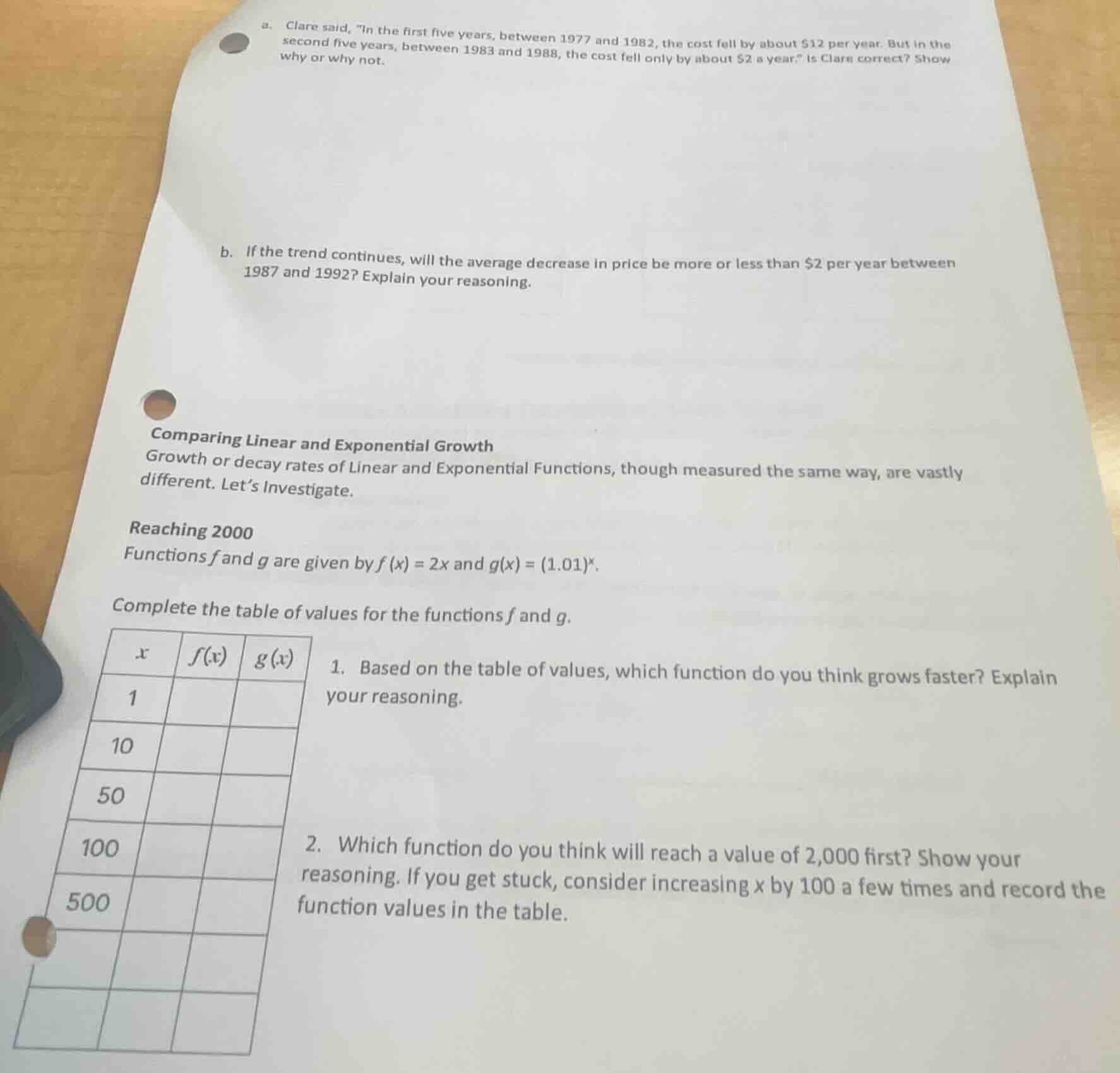
a. clare said, \in the first five years, between 1977 and 1982, the cost fell by about $12 per year. but in the second five years, between 1983 and 1988, the cost fell only by about $2 a year.\ is clare correct? show why or why not.
b. if the trend continues, will the average decrease in price be more or less than $2 per year between 1987 and 1992? explain your reasoning.
comparing linear and exponential growth
growth or decay rates of linear and exponential functions, though measured the same way, are vastly different. let’s investigate.
reaching 2000
functions ( f ) and ( g ) are given by ( f(x) = 2x ) and ( g(x) = (1.01)^x ).
complete the table of values for the functions ( f ) and ( g ).
| ( x ) | ( f(x) ) | ( g(x) ) |
|---|---|---|
| 10 | ||
| 50 | ||
| 100 | ||
| 500 | ||
- based on the table of values, which function do you think grows faster? explain your reasoning.
- which function do you think will reach a value of 2,000 first? show your reasoning. if you get stuck, consider increasing ( x ) by 100 a few times and record the function values in the table.
Step1: Calculate $f(x)=2x$ for each $x$
For $x=1$: $f(1)=2(1)=2$
For $x=10$: $f(10)=2(10)=20$
For $x=50$: $f(50)=2(50)=100$
For $x=100$: $f(100)=2(100)=200$
For $x=500$: $f(500)=2(500)=1000$
Step2: Calculate $g(x)=(1.01)^x$ for each $x$
For $x=1$: $g(1)=(1.01)^1=1.01$
For $x=10$: $g(10)=(1.01)^{10}\approx1.1046$
For $x=50$: $g(50)=(1.01)^{50}\approx1.6446$
For $x=100$: $g(100)=(1.01)^{100}\approx2.7048$
For $x=500$: $g(500)=(1.01)^{500}\approx144.7728$
Step3: Fill completed table
| $x$ | $f(x)$ | $g(x)$ |
|---|---|---|
| 10 | 20 | $\approx1.1046$ |
| 50 | 100 | $\approx1.6446$ |
| 100 | 200 | $\approx2.7048$ |
| 500 | 1000 | $\approx144.7728$ |
Step4: Answer growth rate question
Linear $f(x)$ has higher values now, but exponential $g(x)$ has a multiplicative growth rate that accelerates over time, while linear $f(x)$ has constant additive growth.
Step5: Find $x$ for $f(x)=2000$
Set $2x=2000$, solve for $x$:
$x=\frac{2000}{2}=1000$
Step6: Find $x$ for $g(x)=2000$
Set $(1.01)^x=2000$. Use logarithm:
$x=\frac{\ln(2000)}{\ln(1.01)}\approx\frac{7.6009}{0.00995}\approx763$

Snap & solve any problem in the app
Get step-by-step solutions on Sovi AI
Photo-based solutions with guided steps
Explore more problems and detailed explanations
Completed Table:
| $x$ | $f(x)$ | $g(x)$ |
|---|---|---|
| 10 | 20 | $\approx1.1046$ |
| 50 | 100 | $\approx1.6446$ |
| 100 | 200 | $\approx2.7048$ |
| 500 | 1000 | $\approx144.7728$ |
- Initially, $f(x)$ grows faster, but $g(x)$ (exponential) will eventually grow much faster because exponential functions have accelerating growth, while linear functions have constant, steady growth.
- $g(x)=(1.01)^x$ will reach 2000 first. For $f(x)=2000$, $x=1000$. For $g(x)=2000$, $x\approx763$, which is smaller than 1000.
---
Note: Parts a and b of the first question are unanswerable without additional data (cost values for 1977-1988). Please provide the missing cost data to solve those questions.