QUESTION IMAGE
Question
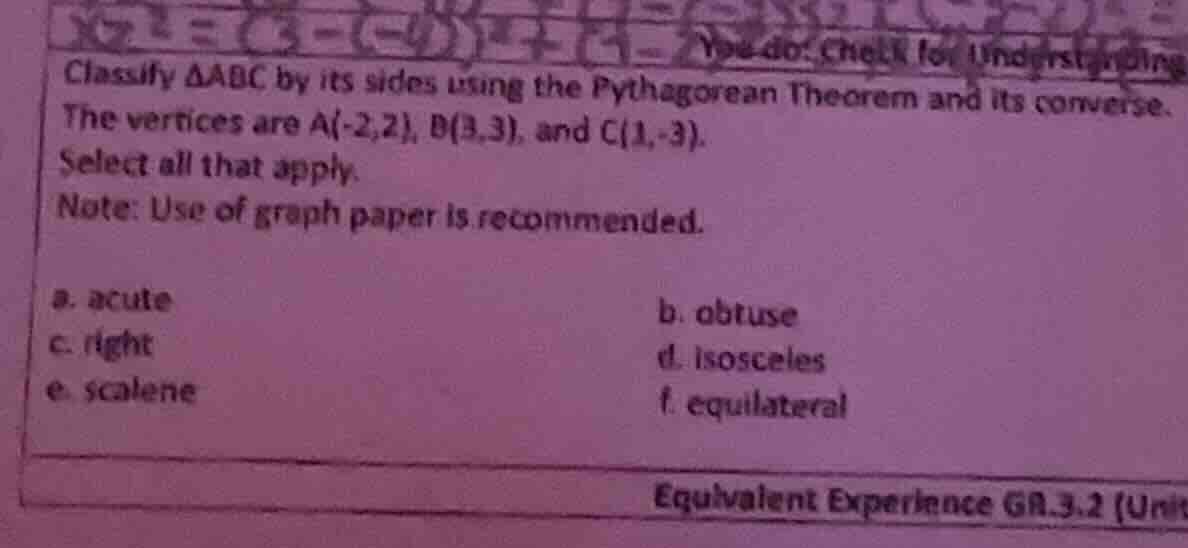
classify $delta abc$ by its sides using the pythagorean theorem and its converse.
the vertices are $a(-2,2)$, $b(3,3)$, and $c(1,-3)$.
select all that apply.
note: use of graph paper is recommended.
a. acute
b. obtuse
c. right
d. isosceles
e. scalene
f. equilateral
Step1: Calculate length of AB
Use distance formula:
$AB = \sqrt{(x_2-x_1)^2 + (y_2-y_1)^2} = \sqrt{(3-(-2))^2 + (3-2)^2} = \sqrt{5^2 + 1^2} = \sqrt{25+1} = \sqrt{26}$
Step2: Calculate length of BC
Use distance formula:
$BC = \sqrt{(1-3)^2 + (-3-3)^2} = \sqrt{(-2)^2 + (-6)^2} = \sqrt{4+36} = \sqrt{40}$
Step3: Calculate length of AC
Use distance formula:
$AC = \sqrt{(1-(-2))^2 + (-3-2)^2} = \sqrt{3^2 + (-5)^2} = \sqrt{9+25} = \sqrt{34}$
Step4: Check side equality
All side lengths $\sqrt{26}$, $\sqrt{34}$, $\sqrt{40}$ are unique.
Step5: Check triangle type via Pythagoras
Square the sides: $(\sqrt{26})^2=26$, $(\sqrt{34})^2=34$, $(\sqrt{40})^2=40$.
Test converse: $26+34=60>40$, so acute.

Snap & solve any problem in the app
Get step-by-step solutions on Sovi AI
Photo-based solutions with guided steps
Explore more problems and detailed explanations
a. acute, e. scalene