QUESTION IMAGE
Question
close reading
british colonial policies
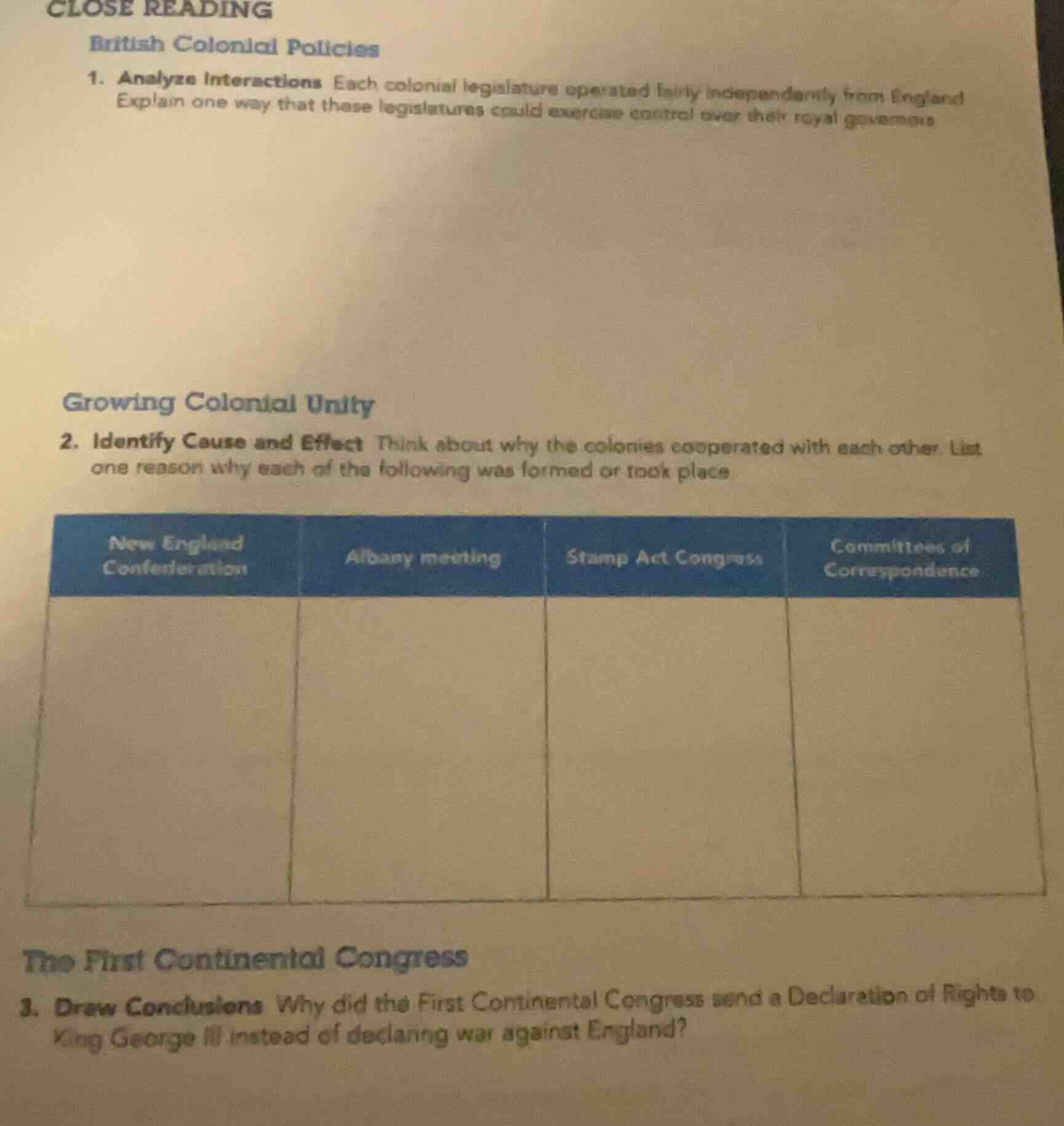
- analyze interactions each colonial legislature operated fairly independently from england
explain one way that these legislatures could exercise control over their royal governors
growing colonial unity
- identify cause and effect think about why the colonies cooperated with each other. list
one reason why each of the following was formed or took place
new england
confederation\talbany meeting\tstamp act congress\tcommittees of
\t\t\t\tcorrespondence
the first continental congress
- draw conclusions why did the first continental congress send a declaration of rights to
king george iii instead of declaring war against england?
Brief Explanations
- For colonial legislatures' control over royal governors: Colonial legislatures held the power to approve the governor's salary and funding for their official activities, giving them leverage to influence or restrict the governor's actions, as the governor relied on this financial support to carry out their role.
- For the colonial unity groups:
- New England Confederation: Formed to provide mutual defense against shared threats like Native American raids and Dutch colonial expansion in the region.
- Albany meeting: Proposed a unified colonial government to coordinate defense against French territorial expansion and Native American alliances during the French and Indian War.
- Stamp Act Congress: Organized to collectively protest the British Stamp Act, asserting that colonists should only be taxed by their own elected representatives, and to coordinate a unified response to the tax.
- Committees of Correspondence: Established to share information and coordinate resistance against British policies across the colonies, ensuring a unified colonial voice and response to perceived British injustices.
- For the First Continental Congress: The delegates still sought reconciliation with Britain rather than full independence. They believed sending the Declaration of Rights would persuade King George III to address their grievances (like repealing coercive acts and recognizing colonial self-governance) without resorting to war, as many colonists still identified as British citizens and hoped for a peaceful resolution.

Snap & solve any problem in the app
Get step-by-step solutions on Sovi AI
Photo-based solutions with guided steps
Explore more problems and detailed explanations
- Colonial legislatures could control royal governors by holding the power to approve the governor's salary and official funding, using this financial leverage to influence the governor's actions.
2.
- New England Confederation: To coordinate mutual defense against Native American raids and Dutch expansion.
- Albany meeting: To create a unified colonial framework for defense against French and Native American threats in the French and Indian War.
- Stamp Act Congress: To collectively protest the British Stamp Act and assert the principle of "no taxation without representation."
- Committees of Correspondence: To share information and coordinate colonial resistance to unfair British policies across all colonies.
- The First Continental Congress sent the Declaration of Rights instead of declaring war because most delegates still sought peaceful reconciliation with Britain, hoped to persuade King George III to address their grievances and recognize colonial rights, and many colonists still identified as British citizens rather than seeking full independence.