QUESTION IMAGE
Question
cockroaches are eaten by lizards. because the lizards have small heads, the lizards are unable to eat the very large adult cockroaches, and instead prey upon small and medium sized adults. over time, only the large headed lizards survive.
__________ female birds that lay close to the optimum number of eggs have the most surviving offspring. those that lay fewer or more eggs have lower relative fitness.
__________ a population of birds with various size beaks eats seeds. small seeds can be eaten by birds with small beaks. larger, thicker seeds can only be eaten by birds with larger, thicker beaks. during a drought, only large thick seeds exist so only the large, thick - beaked birds survive.
__________ black rabbits (bb) and white rabbits (bb) are both able to survive because they can camouflage into the white and black rocks in their environment. however, the intermediate gray rabbits (bb) do not survive. this results in only white and black rabbits.
__________ small lizards have difficulty defending territories so they end up dying out. large lizards are more likely to be preyed upon by owls. over time, only medium sized lizards end up surviving.
__________ women often have complications during labor while giving birth to very large babies, whereas very small babies tend to be underdeveloped. as a result, medium sized babies are the ones that end up surviving to adulthood.
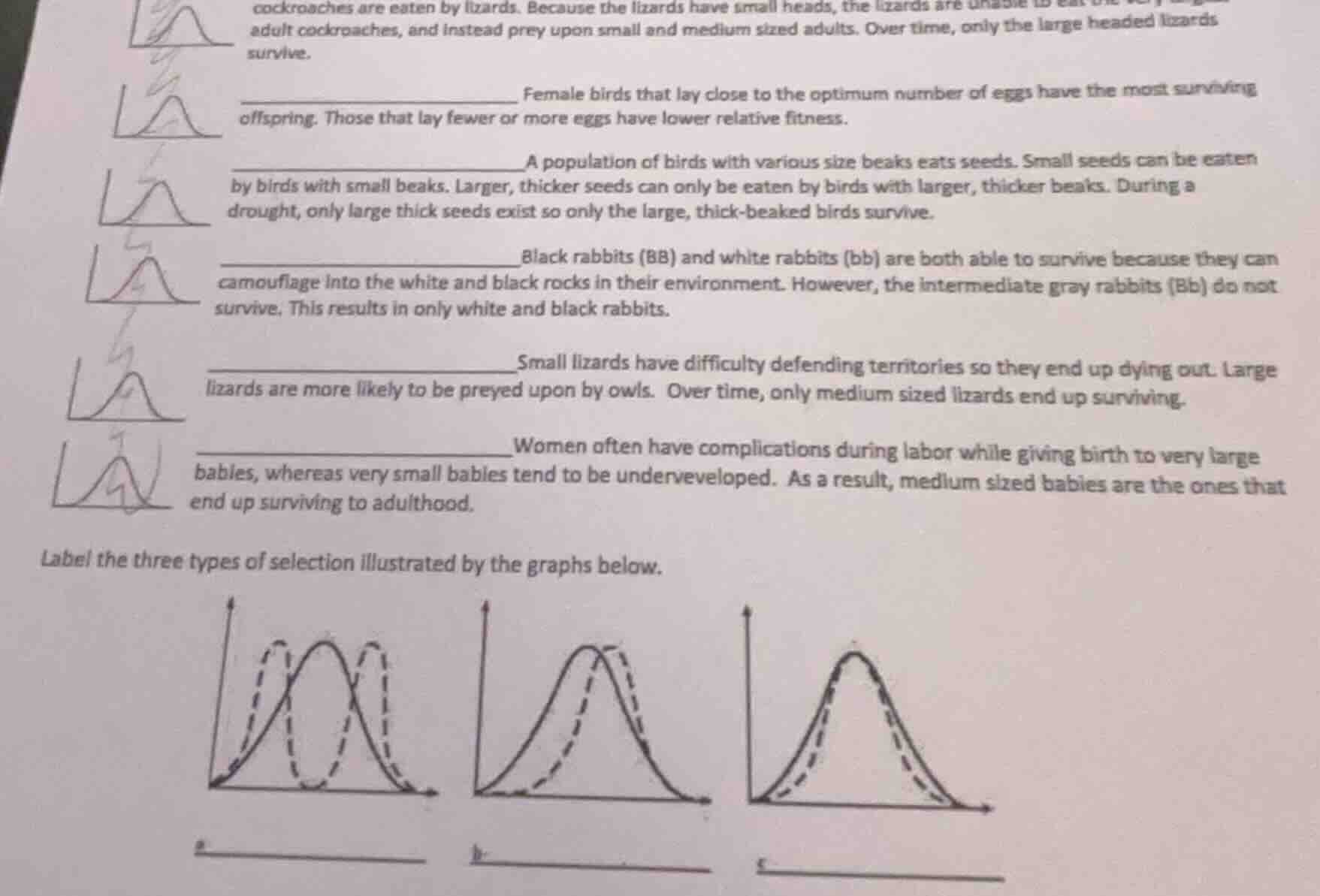
label the three types of selection illustrated by the graphs below.
(three graphs are shown here, each with a curve, and below each graph there is a blank line labeled a, b, c respectively for filling in the type of selection)
First, define the three selection types:
- Directional Selection: Shifts the population trait distribution toward one extreme phenotype (one end of the curve is favored, the peak moves left/right).
- Stabilizing Selection: Favors the intermediate phenotype, narrowing the curve and reducing variation (the peak stays centered, curve becomes narrower).
- Disruptive (Diversifying) Selection: Favors both extreme phenotypes, splitting the curve into two distinct peaks (intermediate traits are selected against).
Match scenarios to selection types:
- Large-headed lizards survive: Favors one extreme (large heads) → Directional Selection
- Optimum egg number (intermediate) favored: Intermediate trait favored → Stabilizing Selection
- Large thick-beaked birds survive: Favors one extreme (large beaks) → Directional Selection
- Black/white rabbits survive, gray do not: Favors both extremes → Disruptive Selection
- Medium-sized lizards survive: Intermediate trait favored → Stabilizing Selection
- Medium-sized babies survive: Intermediate trait favored → Stabilizing Selection
Label the graphs:
- Graph a: Two distinct peaks (favors both extremes) → Disruptive (Diversifying) Selection
- Graph b: Narrower centered peak (favors intermediate) → Stabilizing Selection
- Graph c: Peak shifted to one extreme → Directional Selection

Snap & solve any problem in the app
Get step-by-step solutions on Sovi AI
Photo-based solutions with guided steps
Explore more problems and detailed explanations
Scenario Matches (top to bottom):
- Directional Selection
- Stabilizing Selection
- Directional Selection
- Disruptive (Diversifying) Selection
- Stabilizing Selection
- Stabilizing Selection
Graph Labels:
a. Disruptive (Diversifying) Selection
b. Stabilizing Selection
c. Directional Selection