QUESTION IMAGE
Question
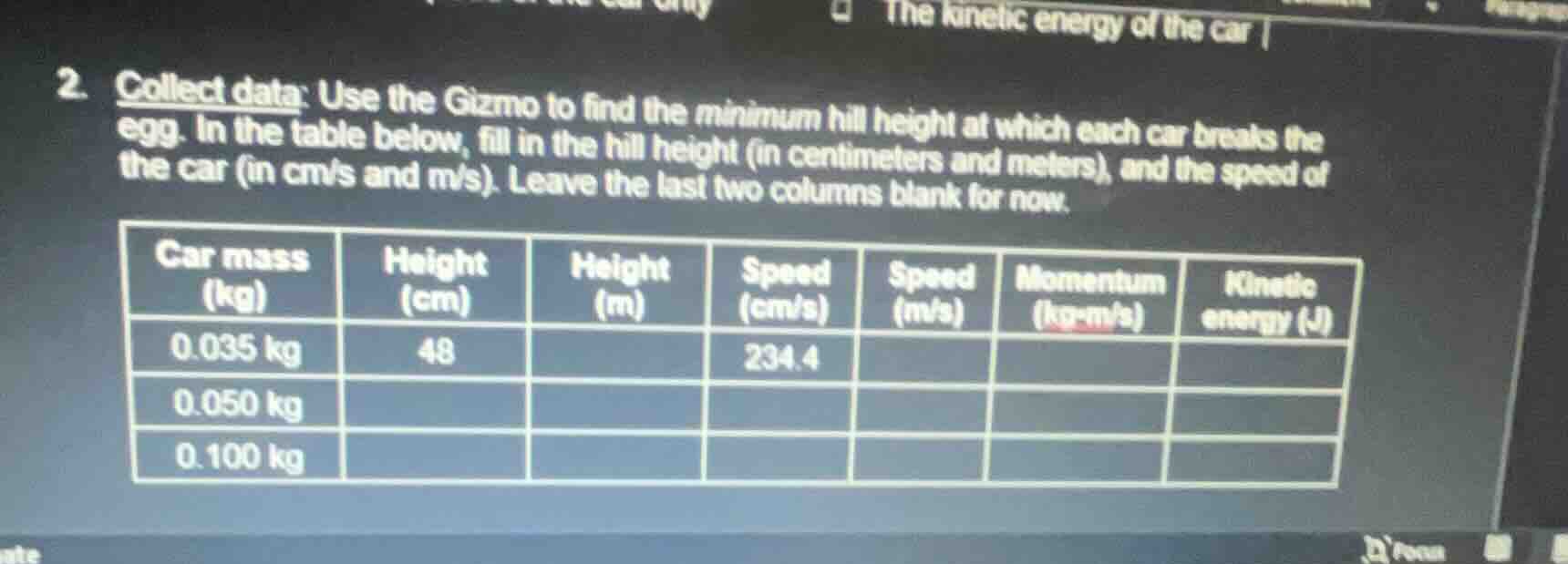
- collect data: use the gizmo to find the minimum hill height at which each car breaks the egg. in the table below, fill in the hill height (in centimeters and meters), and the speed of the car (in cm/s and m/s). leave the last two columns blank for now.
car mass (kg) | height (cm) | height (m) | speed (cm/s) | speed (m/s) | momentum (kg·m/s) | kinetic energy (j)
0.035 kg | 48 | | 234.4 | | |
0.050 kg | | | | | |
0.100 kg | | | | | |
To solve for the missing values (height in meters, speed in m/s, momentum, and kinetic energy) for the first row (car mass = 0.035 kg) and understand how to approach the other rows, we use unit conversions and physics formulas (conservation of energy, momentum, kinetic energy).
Step 1: Convert Height from cm to m
We know that \( 1 \, \text{m} = 100 \, \text{cm} \), so to convert centimeters to meters, we divide by 100.
For the first row, height \( = 48 \, \text{cm} \).
\[
\text{Height (m)} = \frac{48 \, \text{cm}}{100} = 0.48 \, \text{m}
\]
Step 2: Convert Speed from cm/s to m/s
We know that \( 1 \, \text{m} = 100 \, \text{cm} \) and \( 1 \, \text{s} = 1 \, \text{s} \), so to convert cm/s to m/s, we divide by 100.
For the first row, speed \( = 234.4 \, \text{cm/s} \).
\[
\text{Speed (m/s)} = \frac{234.4 \, \text{cm/s}}{100} = 2.344 \, \text{m/s}
\]
Step 3: Calculate Momentum
Momentum (\( p \)) is given by \( p = m \cdot v \), where \( m \) is mass (in kg) and \( v \) is velocity (in m/s).
For the first row, \( m = 0.035 \, \text{kg} \) and \( v = 2.344 \, \text{m/s} \).
\[
p = 0.035 \, \text{kg} \times 2.344 \, \text{m/s} \approx 0.08204 \, \text{kg·m/s}
\]
Step 4: Calculate Kinetic Energy
Kinetic Energy (\( KE \)) is given by \( KE = \frac{1}{2} m v^2 \), where \( m \) is mass (in kg) and \( v \) is velocity (in m/s).
For the first row, \( m = 0.035 \, \text{kg} \) and \( v = 2.344 \, \text{m/s} \).
\[
KE = \frac{1}{2} \times 0.035 \, \text{kg} \times (2.344 \, \text{m/s})^2
\]
First, calculate \( (2.344)^2 \approx 5.494 \).
\[
KE = 0.5 \times 0.035 \times 5.494 \approx 0.096155 \, \text{J}
\]
Step 5: Approach for Other Rows (0.050 kg and 0.100 kg cars)
To find the minimum hill height for these cars, we use the conservation of energy: the gravitational potential energy at the top of the hill (\( PE = mgh \)) converts to kinetic energy at the bottom (\( KE = \frac{1}{2}mv^2 \)). Assuming no energy loss, \( mgh = \frac{1}{2}mv^2 \), so \( gh = \frac{1}{2}v^2 \) (mass cancels out). This means the speed at the bottom depends only on the height of the hill (not the mass of the car).
For the 0.035 kg car, we found \( h = 0.48 \, \text{m} \) and \( v = 2.344 \, \text{m/s} \). For the 0.050 kg and 0.100 kg cars, the minimum hill height to break the egg will be the same (since speed depends only on height, and the egg breaks at a specific speed). Thus:
- Height (cm) for 0.050 kg and 0.100 kg cars = 48 cm (same as 0.035 kg car).
- Height (m) = 0.48 m (same as 0.035 kg car).
- Speed (cm/s) = 234.4 cm/s (same as 0.035 kg car, since speed depends only on height).
- Speed (m/s) = 2.344 m/s (same as 0.035 kg car).
Filling the Table
| Car mass (kg) | Height (cm) | Height (m) | Speed (cm/s) | Speed (m/s) | Momentum (kg·m/s) | Kinetic Energy (J) |
|---|---|---|---|---|---|---|
| 0.050 | 48 | 0.48 | 234.4 | 2.344 | \( 0.050 \times 2.344 \approx 0.117 \) | \( \frac{1}{2} \times 0.050 \times (2.344)^2 \approx 0.137 \) |
| 0.100 | 48 | 0.48 | 234.4 | 2.344 | \( 0.100 \times 2.344 \approx 0.234 \) | \( \frac{1}{2} \times 0.100 \times (2.344)^2 \approx 0.274 \) |
Final Answers for the First Row (0.035 kg car)
- Height (m): \( \boldsymbol{0.48} \)
- Speed (m/s): \( \boldsymbol{2.…

Snap & solve any problem in the app
Get step-by-step solutions on Sovi AI
Photo-based solutions with guided steps
Explore more problems and detailed explanations
To solve for the missing values (height in meters, speed in m/s, momentum, and kinetic energy) for the first row (car mass = 0.035 kg) and understand how to approach the other rows, we use unit conversions and physics formulas (conservation of energy, momentum, kinetic energy).
Step 1: Convert Height from cm to m
We know that \( 1 \, \text{m} = 100 \, \text{cm} \), so to convert centimeters to meters, we divide by 100.
For the first row, height \( = 48 \, \text{cm} \).
\[
\text{Height (m)} = \frac{48 \, \text{cm}}{100} = 0.48 \, \text{m}
\]
Step 2: Convert Speed from cm/s to m/s
We know that \( 1 \, \text{m} = 100 \, \text{cm} \) and \( 1 \, \text{s} = 1 \, \text{s} \), so to convert cm/s to m/s, we divide by 100.
For the first row, speed \( = 234.4 \, \text{cm/s} \).
\[
\text{Speed (m/s)} = \frac{234.4 \, \text{cm/s}}{100} = 2.344 \, \text{m/s}
\]
Step 3: Calculate Momentum
Momentum (\( p \)) is given by \( p = m \cdot v \), where \( m \) is mass (in kg) and \( v \) is velocity (in m/s).
For the first row, \( m = 0.035 \, \text{kg} \) and \( v = 2.344 \, \text{m/s} \).
\[
p = 0.035 \, \text{kg} \times 2.344 \, \text{m/s} \approx 0.08204 \, \text{kg·m/s}
\]
Step 4: Calculate Kinetic Energy
Kinetic Energy (\( KE \)) is given by \( KE = \frac{1}{2} m v^2 \), where \( m \) is mass (in kg) and \( v \) is velocity (in m/s).
For the first row, \( m = 0.035 \, \text{kg} \) and \( v = 2.344 \, \text{m/s} \).
\[
KE = \frac{1}{2} \times 0.035 \, \text{kg} \times (2.344 \, \text{m/s})^2
\]
First, calculate \( (2.344)^2 \approx 5.494 \).
\[
KE = 0.5 \times 0.035 \times 5.494 \approx 0.096155 \, \text{J}
\]
Step 5: Approach for Other Rows (0.050 kg and 0.100 kg cars)
To find the minimum hill height for these cars, we use the conservation of energy: the gravitational potential energy at the top of the hill (\( PE = mgh \)) converts to kinetic energy at the bottom (\( KE = \frac{1}{2}mv^2 \)). Assuming no energy loss, \( mgh = \frac{1}{2}mv^2 \), so \( gh = \frac{1}{2}v^2 \) (mass cancels out). This means the speed at the bottom depends only on the height of the hill (not the mass of the car).
For the 0.035 kg car, we found \( h = 0.48 \, \text{m} \) and \( v = 2.344 \, \text{m/s} \). For the 0.050 kg and 0.100 kg cars, the minimum hill height to break the egg will be the same (since speed depends only on height, and the egg breaks at a specific speed). Thus:
- Height (cm) for 0.050 kg and 0.100 kg cars = 48 cm (same as 0.035 kg car).
- Height (m) = 0.48 m (same as 0.035 kg car).
- Speed (cm/s) = 234.4 cm/s (same as 0.035 kg car, since speed depends only on height).
- Speed (m/s) = 2.344 m/s (same as 0.035 kg car).
Filling the Table
| Car mass (kg) | Height (cm) | Height (m) | Speed (cm/s) | Speed (m/s) | Momentum (kg·m/s) | Kinetic Energy (J) |
|---|---|---|---|---|---|---|
| 0.050 | 48 | 0.48 | 234.4 | 2.344 | \( 0.050 \times 2.344 \approx 0.117 \) | \( \frac{1}{2} \times 0.050 \times (2.344)^2 \approx 0.137 \) |
| 0.100 | 48 | 0.48 | 234.4 | 2.344 | \( 0.100 \times 2.344 \approx 0.234 \) | \( \frac{1}{2} \times 0.100 \times (2.344)^2 \approx 0.274 \) |
Final Answers for the First Row (0.035 kg car)
- Height (m): \( \boldsymbol{0.48} \)
- Speed (m/s): \( \boldsymbol{2.344} \)
- Momentum: \( \boldsymbol{\approx 0.082 \, \text{kg·m/s}} \)
- Kinetic Energy: \( \boldsymbol{\approx 0.096 \, \text{J}} \)
For the other rows, the height and speed remain the same (due to conservation of energy), while momentum and kinetic energy increase with mass (since \( p = mv \) and \( KE = \frac{1}{2}mv^2 \)).