QUESTION IMAGE
Question
collecting rocks
rachel m. barker
1997
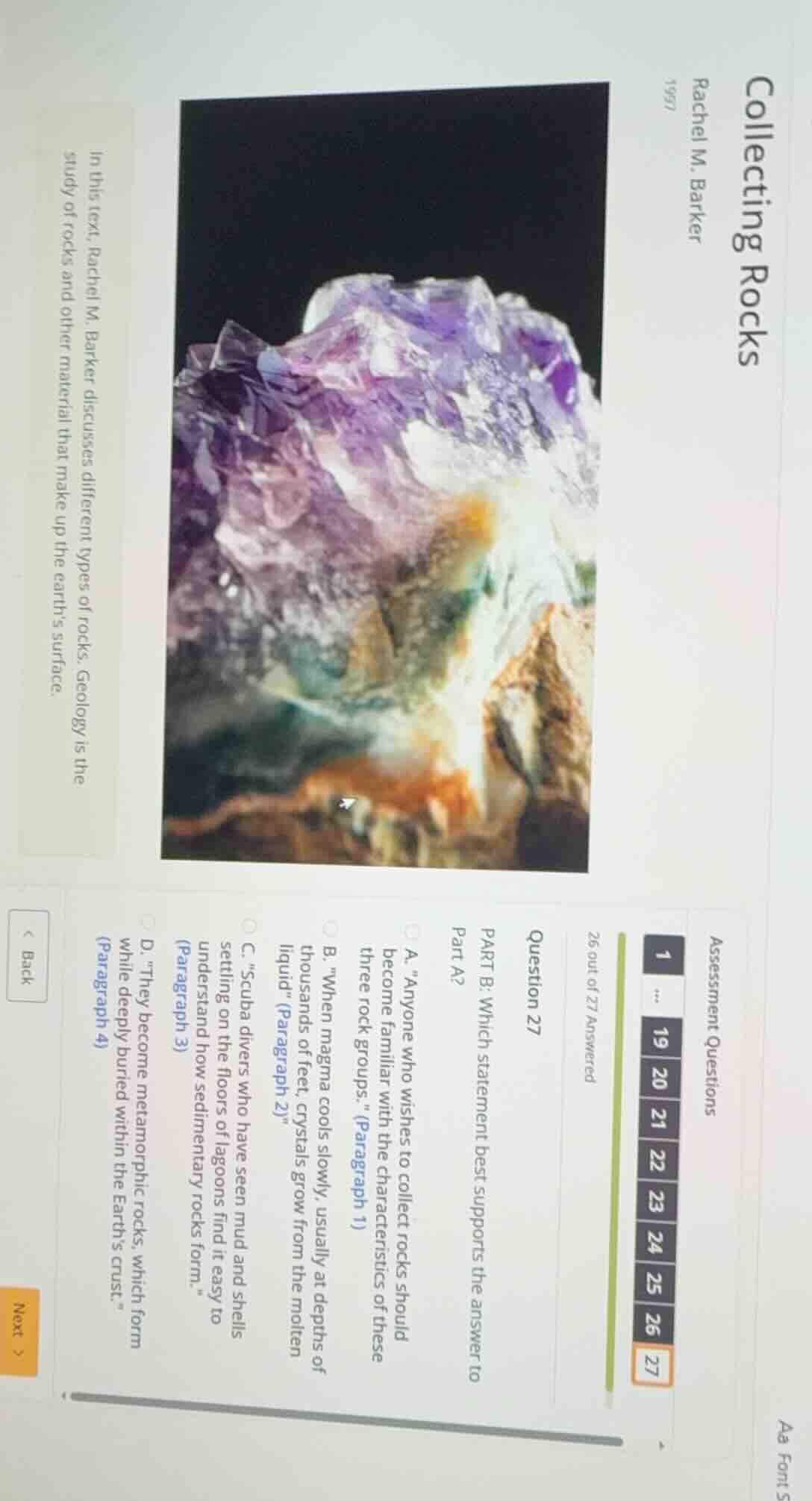
in this text, rachel m. barker discusses different types of rocks. geology is the study of rocks and other material that make up the earth’s surface.
question 27
part b: which statement best supports the answer to part a?
a. \anyone who wishes to collect rocks should become familiar with the characteristics of these three rock groups.\ (paragraph 1)
b. \when magma cools slowly, usually at depths of thousands of feet, crystals grow from the molten liquid.\ (paragraph 2)
c. \scuba divers who have seen mud and shells settling on the floors of lagoons find it easy to understand how sedimentary rocks form.\ (paragraph 3)
d. \they become metamorphic rocks, which form while deeply buried within the earth’s crust.\ (paragraph 4)
To solve this, we analyze each option:
- Option A: Talks about rock collectors familiarizing with rock groups. This is about rock collection, not rock formation.
- Option B: Describes how crystals grow from molten magma (igneous rock formation). But the question likely relates to sedimentary or metamorphic? Wait, no—wait, the original question (Part A, not shown) likely asks about a type of rock. But for Part B (supporting Part A), let's check the options. Wait, maybe the original Part A was about sedimentary rocks? Let's re - evaluate:
- Option C: Mentions scuba divers seeing mud/shells settling (sedimentation, key to sedimentary rock formation). This directly supports how sedimentary rocks form (sediments accumulate).
- Option D: Talks about metamorphic rocks (formed by burial/heat/pressure), not related to sedimentation.
To determine the correct answer, we analyze each option:
- Option A focuses on rock collection, not rock formation.
- Option B describes igneous rock formation (crystals from magma), not relevant to the likely focus of Part A (e.g., sedimentary rocks).
- Option C mentions mud and shells settling (sedimentation), a key process in sedimentary rock formation, so it supports the answer to Part A (likely about sedimentary rocks).
- Option D describes metamorphic rock formation, unrelated to sedimentation.

Snap & solve any problem in the app
Get step-by-step solutions on Sovi AI
Photo-based solutions with guided steps
Explore more problems and detailed explanations
C. "Scuba divers who have seen mud and shells settling on the floors of lagoons find it easy to understand how sedimentary rocks form." (Paragraph 3)