QUESTION IMAGE
Question
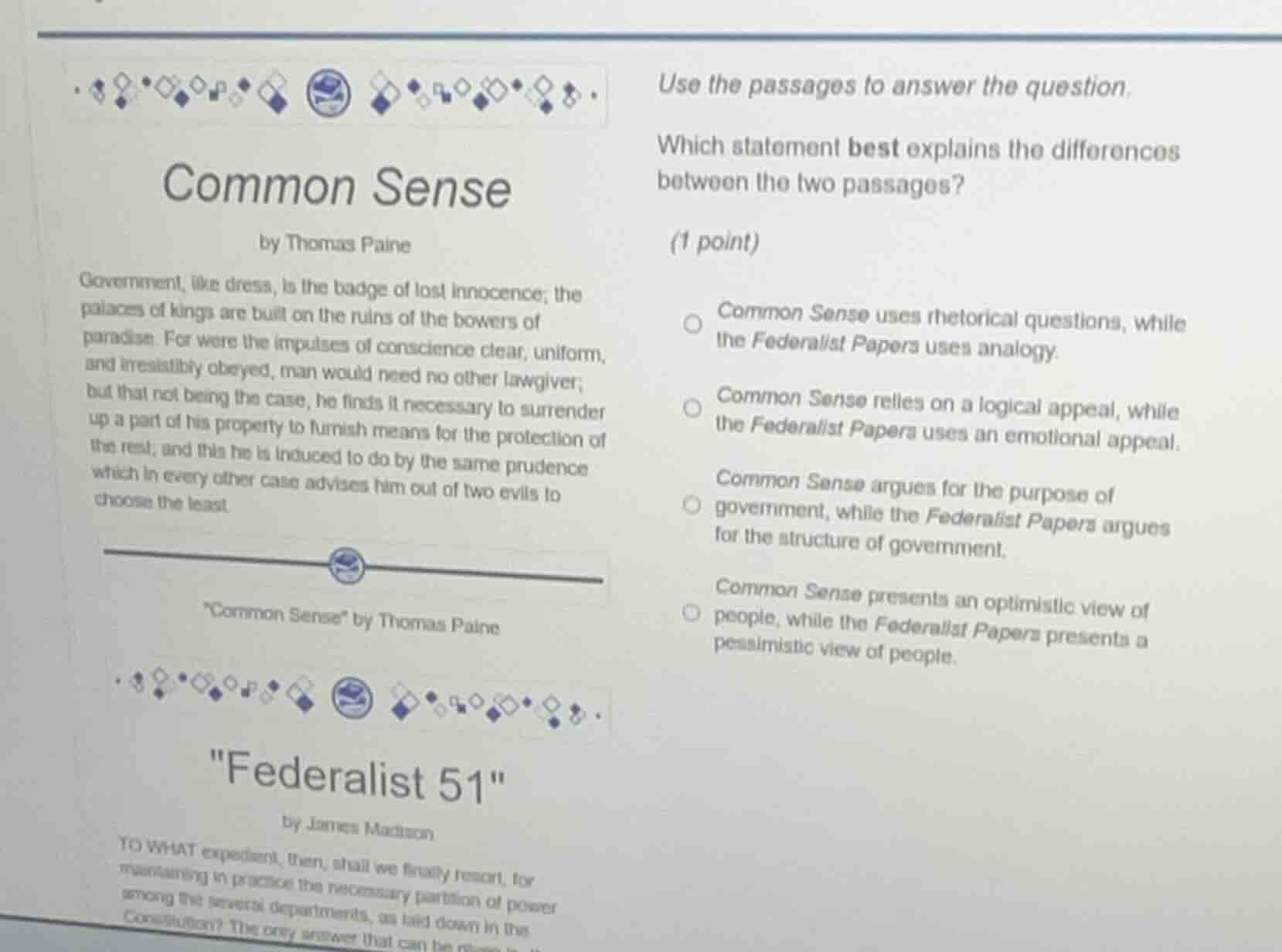
common sense by thomas paine government, like dress, is the badge of lost innocence; the palaces of kings are built on the ruins of the bowers of paradise. for were the impulses of conscience clear, uniform, and irresistibly obeyed, man would need no other lawgiver; but that not being the case, he finds it necessary to surrender up a part of his property to furnish means for the protection of the rest, and this he is induced to do by the same prudence which in every other case advises him out of two evils to choose the least. \common sense\ by thomas paine \federalist 51\ by james madison to what expedient, then, shall we finally resort, for maintaining in practice the necessary partition of power among the several departments, as laid down in the constitution? the only answer that can be given use the passages to answer the question. which statement best explains the differences between the two passages? (1 point) common sense uses rhetorical questions, while the federalist papers uses analogy. common sense relies on a logical appeal, while the federalist papers uses an emotional appeal. common sense argues for the purpose of government, while the federalist papers argues for the structure of government. common sense presents an optimistic view of people, while the federalist papers presents a pessimistic view of people.
- Analyze Option 1: The passage from "Common Sense" uses analogy (government as dress, badge of lost innocence), and "Federalist 51" (from the visible part) uses a rhetorical question ("TO WHAT expedient..."). So this option has the techniques reversed.
- Analyze Option 2: "Common Sense" here is making a logical appeal about why government is needed (choosing the least evil), but "Federalist 51" is about the structure of government (partition of power), not an emotional appeal. So this is incorrect.
- Analyze Option 3: "Common Sense" in the given passage discusses the purpose of government (why people need government, as a necessary evil to protect property, choosing the least evil), while "Federalist 51" (from the visible question in the passage: "maintaining... partition of power among the several departments") is about the structure of government (how power is divided). This matches the focus of each passage.
- Analyze Option 4: There's no clear indication in the given passages that "Common Sense" has an optimistic view or "Federalist 51" a pessimistic view of people. The "Common Sense" passage is about government's purpose, not people's nature, and "Federalist 51" is about power structure, not people's nature either. So this is incorrect.

Snap & solve any problem in the app
Get step-by-step solutions on Sovi AI
Photo-based solutions with guided steps
Explore more problems and detailed explanations
C. Common Sense argues for the purpose of government, while the Federalist Papers argues for the structure of government.