QUESTION IMAGE
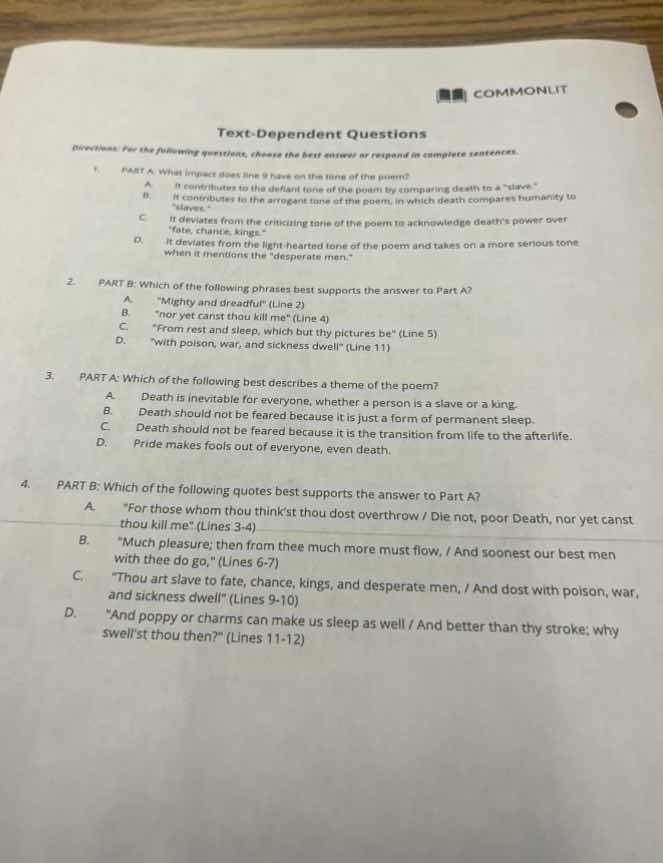
Question
commonlit
text-dependent questions
directions: for the following questions, choose the best answer or respond in complete sentences.
- part a: what impact does line 9 have on the tone of the poem?
a. it contributes to the defiant tone of the poem by comparing death to a \slave.\
b. it contributes to the arrogant tone of the poem, in which death compares humanity to \slaves.\
c. it deviates from the criticizing tone of the poem to acknowledge deaths power over \fickle, cruel kings.\
d. it deviates from the light-hearted tone of the poem and takes on a more serious tone when it mentions the \desperate men.\
- part b: which of the following phrases best supports the answer to part a?
a. \mighty and dreadful\(line 2)
b.
or yet canst thou kill me\(line 4)
c. \from rest and sleep, which but thy pictures be\(line 5)
d. \with poison, war, and sickness dwell\(line 11)
- part a: which of the following best describes a theme of the poem?
a. death is inevitable for everyone, whether a person is a slave or a king.
b. death should not be feared because it is just a form of permanent sleep.
c. death should not be feared because it is the transition from life to the afterlife.
d. pride makes fools out of everyone, even death.
- part b: which of the following quotes best supports the answer to part a?
a. \for those whom thou thinkst thou dost overthrow / die not, poor death, nor yet canst thou kill me.\(lines 3-4)
b. \much pleasure; then from thee much more must flow, / and soonest our best men with thee do go.\(lines 6-7)
c. \thou art slave to fate, chance, kings, and desperate men, / and dost with poison, war, and sickness dwell\(lines 9-10)
d. \and poppy or charms can make us sleep as well / and better than thy stroke; why swellst thou then?\(lines 11-12)
These questions refer to the poem Death, Be Not Proud by John Donne.
- Question 1 (Part A): Line 9 ("Thou art slave to fate...") frames Death as powerless, reinforcing the defiant, mocking tone of the poem that rejects Death's authority.
- Question 1 (Part B): The phrase "nor yet canst thou kill me" directly supports the defiant tone by asserting Death cannot truly end a person's existence, aligning with the answer to Part A.
- Question 3 (Part A): A core theme of the poem is that Death is not something to fear, as it is just a temporary, rest-like state, and ultimately Death itself will be destroyed.
- Question 3 (Part B): The lines "And poppy or charms can make us sleep as well / And better than thy stroke; why swell'st thou then?" argue that ordinary things can provide rest as well as Death, undermining Death's power and supporting the theme that it should not be feared.

Snap & solve any problem in the app
Get step-by-step solutions on Sovi AI
Photo-based solutions with guided steps
Explore more problems and detailed explanations
- PART A: A. It contributes to the defiant tone of the poem by comparing death to a "slave."
PART B: B. "nor yet canst thou kill me" (Line 4)
- PART A: B. Death should not be feared because it is just a form of permanent sleep.
PART B: D. "And poppy or charms can make us sleep as well / And better than thy stroke; why swell'st thou then?" (Lines 11-12)