QUESTION IMAGE
Question
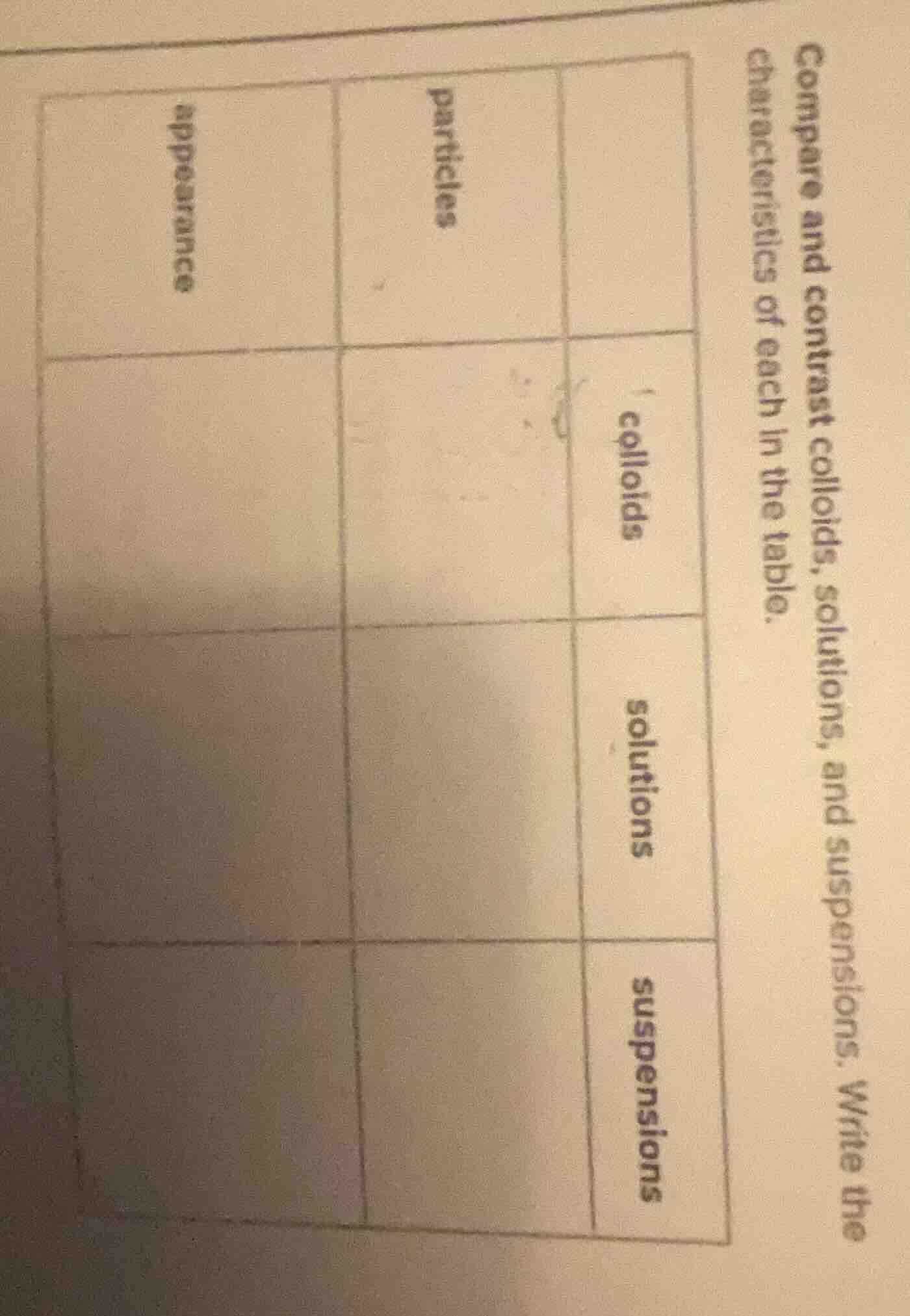
compare and contrast colloids, solutions, and suspensions. write the characteristics of each in the table.
| solutions | colloids | suspensions | |
| particles | |||
| appearance |
To solve this, we analyze the characteristics of colloids, solutions, and suspensions:
For the "Particles" column:
- Colloids: Particle size is between \(1 - 1000\) nm (or \(10^{-9}-10^{-6}\) m). These particles are larger than solution particles but smaller than suspension particles. They are often large molecules or aggregates, and show the Tyndall effect (scattering of light).
- Solutions: Particle size is less than \(1\) nm (\(<10^{-9}\) m). The particles are individual ions or molecules, so they are too small to scatter light (no Tyndall effect) and pass through filters and semipermeable membranes.
- Suspensions: Particle size is greater than \(1000\) nm (\(>10^{-6}\) m). The particles are large, visible (or can be seen under a microscope), and do not pass through filters (they can be separated by filtration).
For the "Appearance" column:
- Colloids: Usually appear cloudy or translucent. They may show the Tyndall effect (light beam visible when passed through). Examples: milk, fog.
- Solutions: Appear clear and transparent because the particles are too small to scatter light. Examples: salt water, sugar solution.
- Suspensions: Appear cloudy or opaque, and the particles may settle over time (heterogeneous, non - uniform). Examples: sand in water, muddy water.
We can now fill the table:
| Colloids | Solutions | Suspensions | |
|---|---|---|---|
| Appearance | Cloudy/translucent, Tyndall effect visible | Clear, transparent, no Tyndall effect | Cloudy/opaque, particles settle over time |
If we were to present this in a more concise tabular form for the answer (as per the question's request to write the characteristics in the table):
| Colloids | Solutions | Suspensions | |
|---|---|---|---|
| Appearance | Cloudy/translucent | Clear/transparent | Cloudy/opaque, settles |
(Note: The symbols "+" for shows Tyndall effect, "-" for does not show Tyndall effect are used for brevity)

Snap & solve any problem in the app
Get step-by-step solutions on Sovi AI
Photo-based solutions with guided steps
Explore more problems and detailed explanations
To solve this, we analyze the characteristics of colloids, solutions, and suspensions:
For the "Particles" column:
- Colloids: Particle size is between \(1 - 1000\) nm (or \(10^{-9}-10^{-6}\) m). These particles are larger than solution particles but smaller than suspension particles. They are often large molecules or aggregates, and show the Tyndall effect (scattering of light).
- Solutions: Particle size is less than \(1\) nm (\(<10^{-9}\) m). The particles are individual ions or molecules, so they are too small to scatter light (no Tyndall effect) and pass through filters and semipermeable membranes.
- Suspensions: Particle size is greater than \(1000\) nm (\(>10^{-6}\) m). The particles are large, visible (or can be seen under a microscope), and do not pass through filters (they can be separated by filtration).
For the "Appearance" column:
- Colloids: Usually appear cloudy or translucent. They may show the Tyndall effect (light beam visible when passed through). Examples: milk, fog.
- Solutions: Appear clear and transparent because the particles are too small to scatter light. Examples: salt water, sugar solution.
- Suspensions: Appear cloudy or opaque, and the particles may settle over time (heterogeneous, non - uniform). Examples: sand in water, muddy water.
We can now fill the table:
| Colloids | Solutions | Suspensions | |
|---|---|---|---|
| Appearance | Cloudy/translucent, Tyndall effect visible | Clear, transparent, no Tyndall effect | Cloudy/opaque, particles settle over time |
If we were to present this in a more concise tabular form for the answer (as per the question's request to write the characteristics in the table):
| Colloids | Solutions | Suspensions | |
|---|---|---|---|
| Appearance | Cloudy/translucent | Clear/transparent | Cloudy/opaque, settles |
(Note: The symbols "+" for shows Tyndall effect, "-" for does not show Tyndall effect are used for brevity)