QUESTION IMAGE
Question
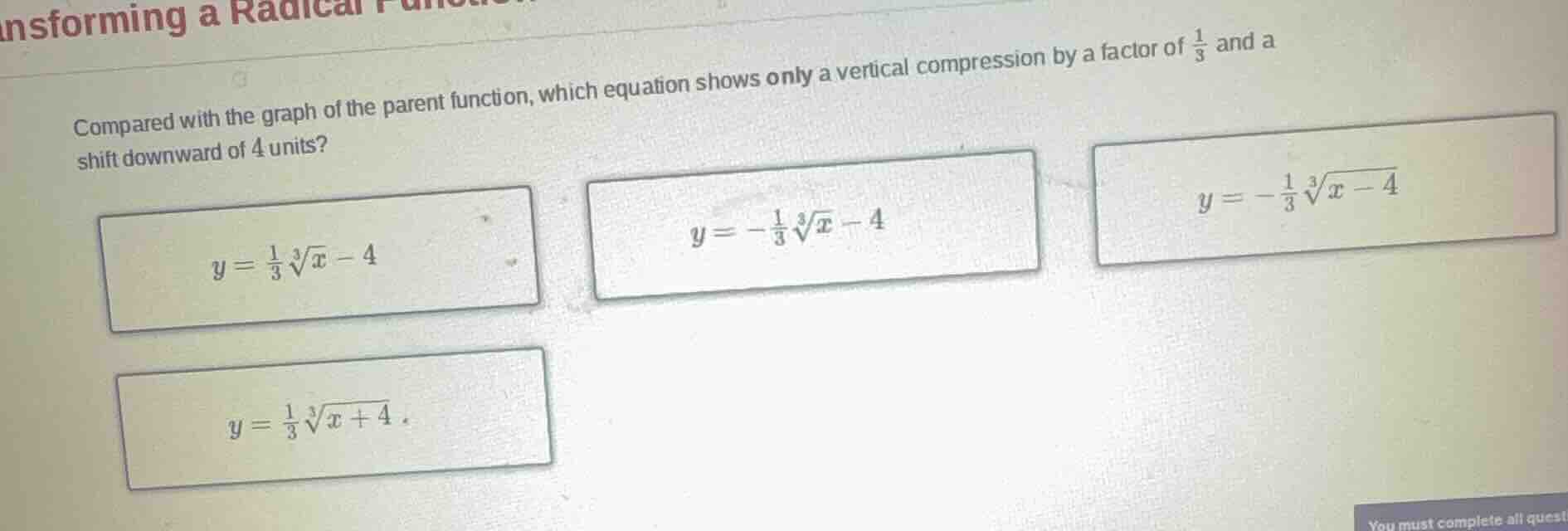
compared with the graph of the parent function, which equation shows only a vertical compression by a factor of \\(\frac{1}{3}\\) and a shift downward of 4 units? \\(y = \frac{1}{3}\sqrt3{x} - 4\\) \\(y = -\frac{1}{3}\sqrt3{x} - 4\\) \\(y = -\frac{1}{3}\sqrt3{x - 4}\\) \\(y = \frac{1}{3}\sqrt3{x + 4}\\)
Step1: Recall Transformations
For a radical function \( y = a\sqrt[3]{x - h}+k \), \(|a|\) is vertical stretch/compression (compression if \(|a|<1\)), \(h\) is horizontal shift, \(k\) is vertical shift (down if \(k<0\)). We need vertical compression by \(\frac{1}{3}\) (so \(a = \frac{1}{3}\)) and shift down 4 (so \(k=-4\)), no reflection (\(a\) positive) and no horizontal shift (\(h = 0\)).
Step2: Analyze Each Option
- Option 1: \( y=\frac{1}{3}\sqrt[3]{x}-4 \). Here, \(a=\frac{1}{3}\) (vertical compression), \(k = - 4\) (shift down 4), \(h = 0\) (no horizontal shift), no reflection.
- Option 2: \( y=-\frac{1}{3}\sqrt[3]{x}-4 \). Has a reflection (\(a\) negative), not just compression and shift down.
- Option 3: \( y=\frac{1}{3}\sqrt[3]{x + 4}\). Vertical shift is 0, horizontal shift right? No, \(x+4\) is left shift, and no vertical shift down 4.
- Option 4: \( y=-\frac{1}{3}\sqrt[3]{x-4}\). Reflection, horizontal shift, not matching.

Snap & solve any problem in the app
Get step-by-step solutions on Sovi AI
Photo-based solutions with guided steps
Explore more problems and detailed explanations
\( y=\frac{1}{3}\sqrt[3]{x}-4 \)