QUESTION IMAGE
Question
comparing fact with folktale
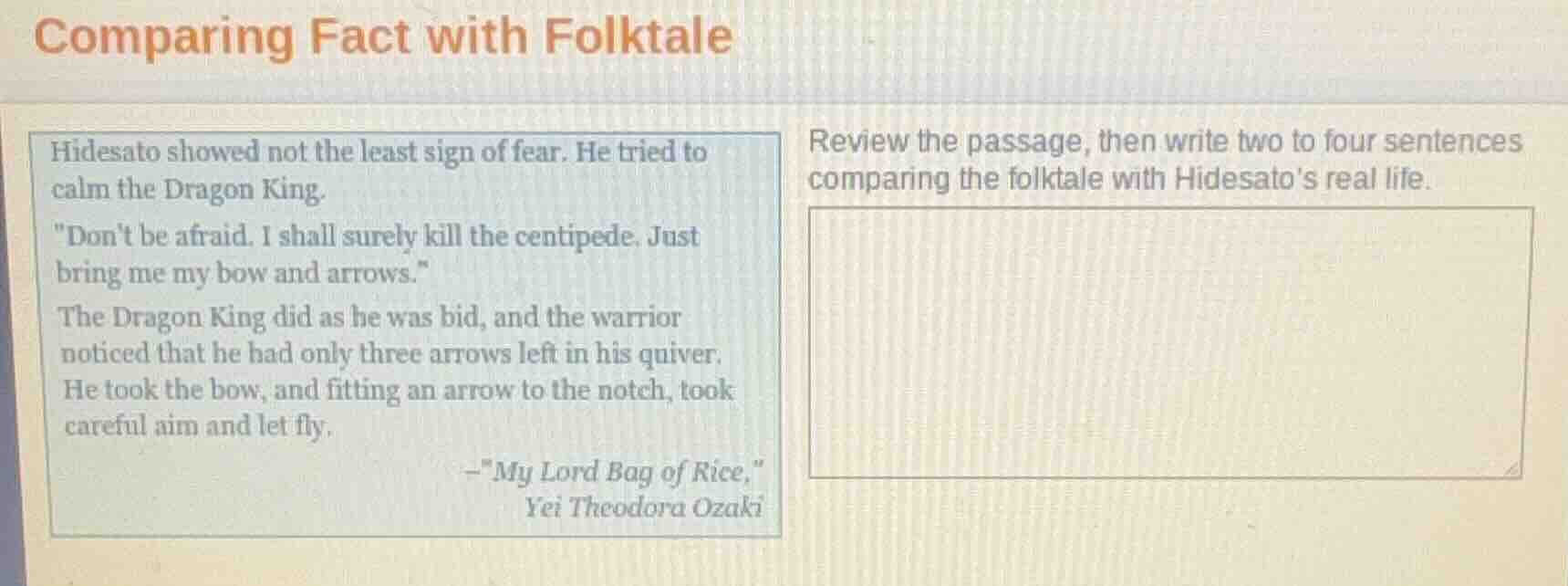
hidesato showed not the least sign of fear. he tried to calm the dragon king.
\dont be afraid. i shall surely kill the centipede. just bring me my bow and arrows.\
the dragon king did as he was bid, and the warrior noticed that he had only three arrows left in his quiver. he took the bow, and fitting an arrow to the notch, took careful aim and let fly.
-\my lord bag of rice,\
yei theodora ozaki
review the passage, then write two to four sentences comparing the folktale with hidesatos real life.
The folktale depicts Hidesato as a fearless, heroic warrior who confronts a supernatural threat (a giant centipede at the behest of a Dragon King), framing him as a mythic figure with extraordinary courage. In real life, Hidesato (historical figure Fujiwara no Hidesato) was a powerful 10th-century Japanese warlord known for military victories against regional rivals, but his feats were grounded in political and military conflict, not supernatural encounters. The folktale exaggerates his bravery into a magical, larger-than-life narrative, while his real legacy is tied to medieval Japanese power struggles and territorial expansion, though both versions highlight his reputation as a bold, capable leader.

Snap & solve any problem in the app
Get step-by-step solutions on Sovi AI
Photo-based solutions with guided steps
Explore more problems and detailed explanations
The folktale casts Hidesato as a fearless hero who faces a supernatural centipede at a dragon king's request, framing his courage in a magical, mythic context. In real life, the historical Hidesato was a 10th-century Japanese warlord known for military successes in regional power struggles, with his feats rooted in political and military conflict rather than fantasy. While both the folktale and real history emphasize his bold, capable leadership, the folktale exaggerates his story into a whimsical supernatural adventure, unlike his grounded, real-world legacy of military and political influence.